Cloud-native security requires treating infrastructure as code and enforcing least privilege. Small teams must automate identity checks and encrypt data at rest. You reduce risk by verifying provider configurations and monitoring access patterns continuously.
The Scale of Risk in Small Teams
Cloud-native security matters at small scale because the attack surface does not shrink with headcount. You host the same APIs, databases, and containers as larger competitors. Attackers automate scanning for open ports and exposed credentials. They do not distinguish between a startup and an enterprise. The cost of a breach often exceeds annual revenue for small entities. You must assume your environment is visible to adversaries.
The shared responsibility model defines who secures what. The provider secures the physical hardware and network infrastructure. You secure the data, identities, and application code. Misunderstanding this boundary leads to gaps. You might assume the cloud provider protects your database contents. They only protect the server hosting the database. You must configure access controls and encryption yourself.
Automating Infrastructure Security
Infrastructure as code treats server configurations as version-controlled text files. You define servers, networks, and firewalls in code rather than clicking buttons in a dashboard. This approach provides a single source of truth. It allows you to review security settings before deployment. If a configuration change introduces a vulnerability, the code review catches it.
Manual configuration drift occurs when someone changes a setting outside the code. This creates inconsistencies that are hard to audit. Automated pipelines prevent this drift. They apply the same secure configuration every time. You can test security policies against the code. This is a core principle of shift-left security. Moving checks earlier in the development cycle reduces the cost of fixing errors.
Managing Identities and Permissions
Overprivileged cloud identities are a common failure point. Accounts often retain permissions they no longer need. A developer might keep access to production databases after leaving a project. These excess permissions expand the blast radius of a compromised account. You must enforce the principle of least privilege.
Regular audits identify unused permissions. Automated tools can flag identities that have not accessed a resource in a set period. You should revoke these permissions. Access key rotation ensures that compromised credentials expire quickly. Static keys that never change remain vulnerable indefinitely. If you use long-term credentials, you must rotate them frequently. Short-lived tokens are safer. They limit the window an attacker has to act.
Protecting Data in Transit and At Rest
Data encryption prevents attackers from reading stolen information. You must encrypt data at rest on storage devices. You must also encrypt data in transit across networks. The cloud provider often offers encryption by default. However, you control the keys in many scenarios.
Bring your own key encryption gives you control over the cryptographic keys. You manage the lifecycle of these keys. The provider cannot access your data without your permission. This adds a layer of protection against insider threats at the provider. It also satisfies certain regulatory requirements. You must store these keys securely. Losing them means losing access to your data permanently. Key management systems automate this process.
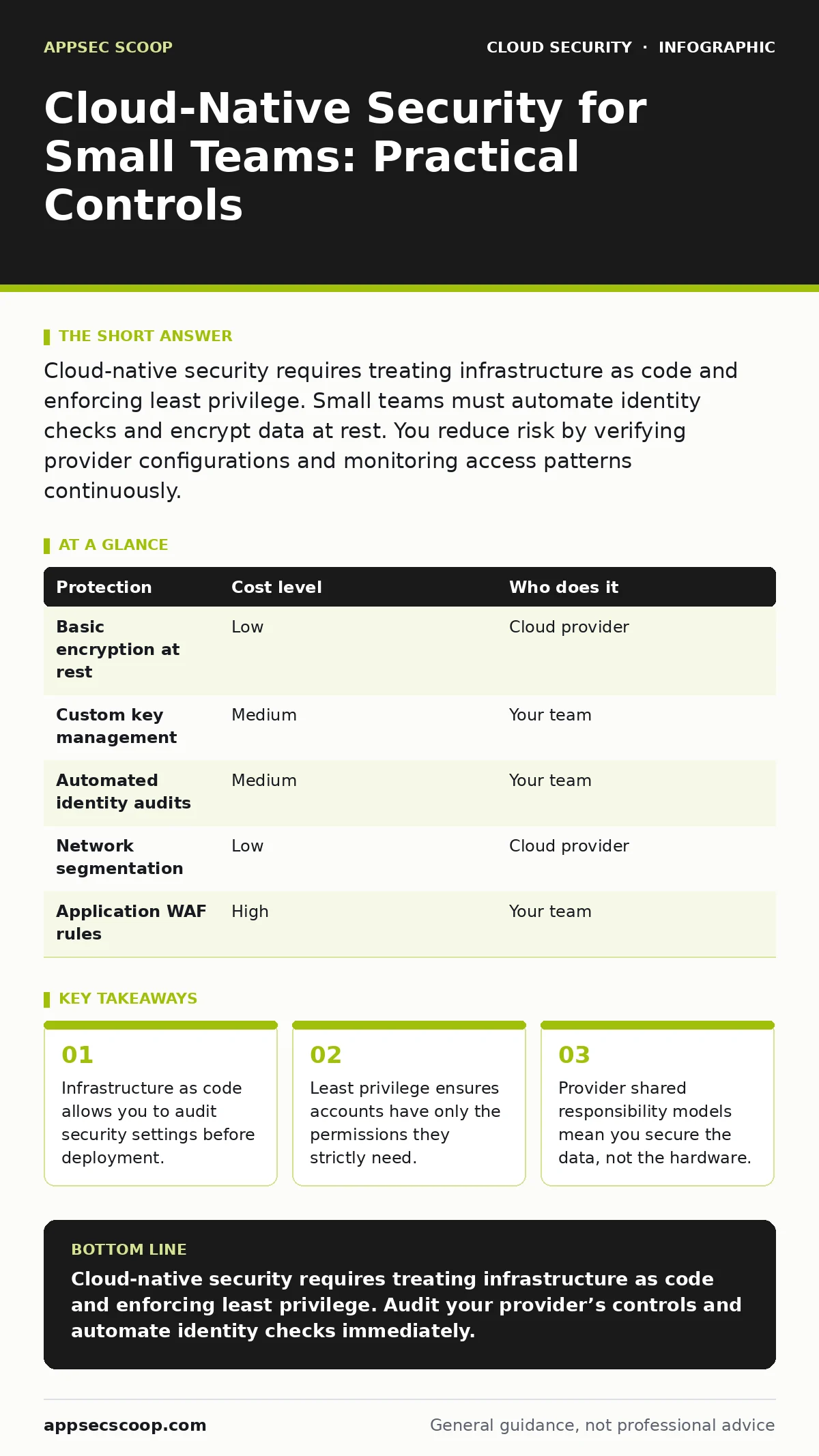
Table: Protection, Cost, and Responsibility
| Protection | Cost level | Who does it |
|---|---|---|
| Basic encryption at rest | Low | Cloud provider |
| Custom key management | Medium | Your team |
| Automated identity audits | Medium | Your team |
| Network segmentation | Low | Cloud provider |
| Application WAF rules | High | Your team |
This table illustrates the division of labour. Basic protections are cheap and automated. Advanced controls require your effort and budget. You must decide where to invest. High-value data needs stronger controls. Custom key management costs more than default encryption. It also requires more administrative overhead. You cannot implement all controls at once. Prioritise based on risk.
See also: What Is Federated Identity: How Single Sign-On Works and Why It Matters · Data sovereignty definition: controlling where your data lives and obeys
Questions for Your IT Provider
You should verify your provider’s security practices. Do not assume they handle everything. Ask specific questions about their responsibilities. These questions clarify the boundary of their support. They also reveal potential gaps in your security posture.
- What specific configurations do you manage versus what we manage?
- How do you monitor for leaked cloud access keys in our environment?
- Do you provide automated reporting on cloud vulnerability management?
- How do you enforce MFA for cloud accounts for all staff?
- What is your process for incident response if our data is exposed?
- Can you demonstrate how you test infrastructure as code for security flaws?
These questions force concrete answers. Vague responses indicate a lack of process. You need documented procedures. Ask for evidence of regular audits. Verify that they use automated tools. Manual checks are prone to error at scale.
Hidden Costs and Trade-Offs
Security controls add complexity. Complex systems are harder to operate. You must balance security with usability. Overly strict controls hinder productivity. Developers may bypass security if it slows them down. This creates shadow IT. They use unapproved tools to get work done.
The hidden cost of security is operational overhead. You spend time configuring and monitoring controls. This time comes from other projects. You must automate where possible. Manual tasks scale poorly. They become bottlenecks as you grow. Invest in tools that reduce manual effort. The initial setup cost is higher. The long-term maintenance cost is lower.
Building a Resilient Posture
Resilience means recovering from incidents. You must plan for failure. Assume breaches will occur. Your goal is to detect them quickly and limit damage. Monitoring and logging are essential. You need to see what happens in your environment.
Cloud vulnerability management identifies known weaknesses in your software. You must patch these weaknesses promptly. Unpatched systems are easy targets. Automated scanning helps track these vulnerabilities. You should integrate scanning into your deployment pipeline. This ensures new code is checked before release.
Your security posture is not static. Threats evolve. You must update your controls regularly. Review your access policies quarterly. Check your encryption settings annually. Audit your provider’s performance yearly. Continuous improvement is the only sustainable strategy. You must stay informed about new threats.
Key takeaways
- Infrastructure as code allows you to audit security settings before deployment.
- Least privilege ensures accounts have only the permissions they strictly need.
- Provider shared responsibility models mean you secure the data, not the hardware.
Cloud-native security requires treating infrastructure as code and enforcing least privilege. Audit your provider’s controls and automate identity checks immediately.
Frequently asked questions
Do small businesses really need cloud-native security?
Yes, small businesses face the same technical risks as large enterprises. Attackers target any accessible data, regardless of company size.
What is infrastructure as code?
It is a practice where you define your cloud resources in text files. You deploy these files to create servers and networks automatically.
How do I handle leaked cloud access keys?
Use automated tools to scan for exposed keys in public repositories. Rotate keys immediately if you find any compromised credentials.
Is MFA enough for cloud account security?
MFA adds a layer of protection but does not prevent all attacks. You must also enforce least privilege and monitor for unusual activity.
How this guide was produced: written by the AppSec Scoop editorial team with AI assistance, checked against the public references listed below, and reviewed when the facts change. See our editorial policy or report an error.