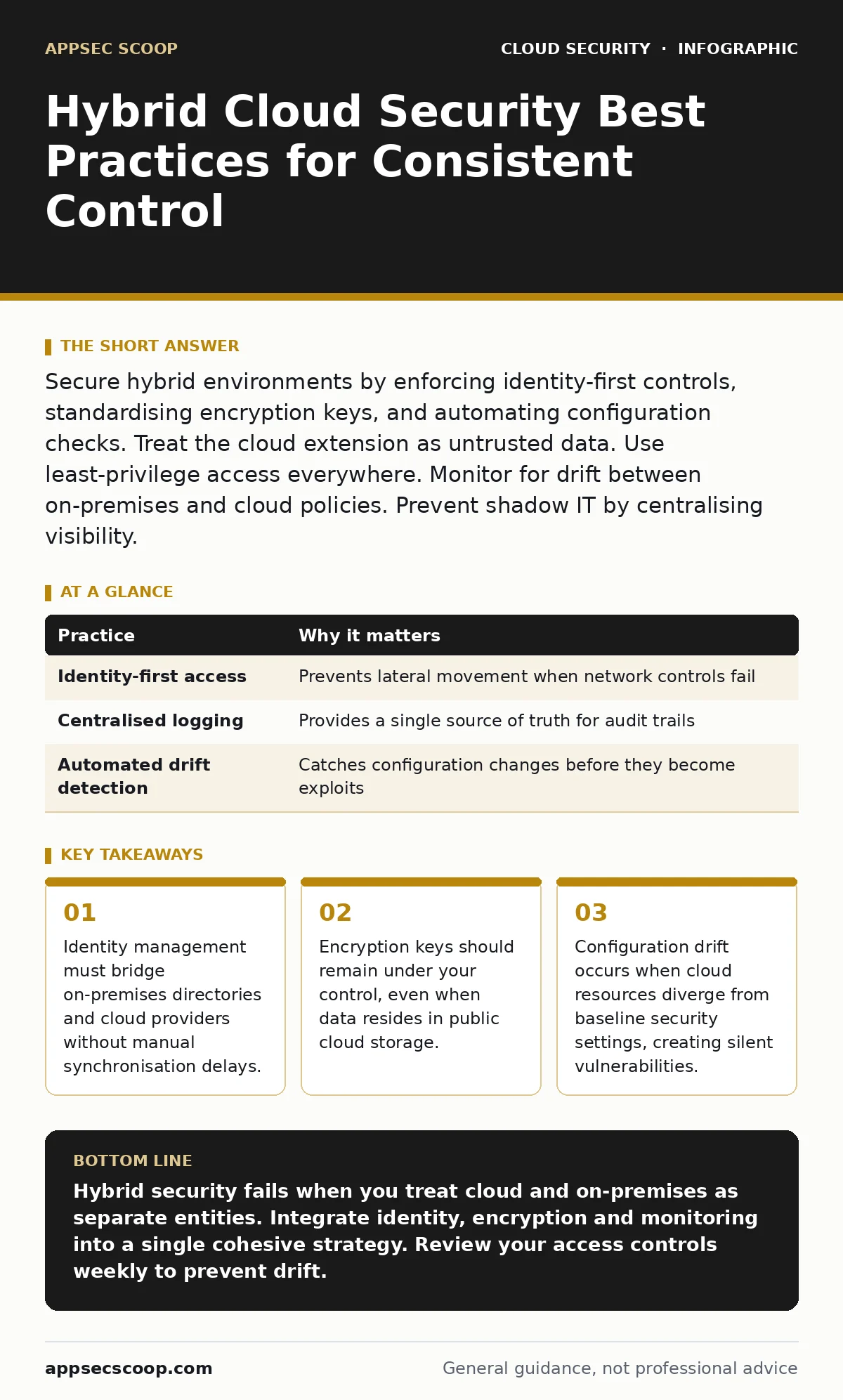
Secure hybrid environments by enforcing identity-first controls, standardising encryption keys, and automating configuration checks. Treat the cloud extension as untrusted data. Use least-privilege access everywhere. Monitor for drift between on-premises and cloud policies. Prevent shadow IT by centralising visibility.
Why hybrid cloud security best practices differ from single-cloud models
Hybrid cloud security best practices address the friction between static on-premises controls and dynamic cloud environments. Traditional security relies on a defined network perimeter. Cloud infrastructure dissolves that boundary. You manage workloads across data centres and public providers simultaneously. This creates complexity in visibility and enforcement. A policy that works on a firewall may not apply to a cloud function. You need controls that translate across both environments.
Imagine a database that splits its storage between a local server and a cloud bucket. If the local side uses strict access lists but the cloud side defaults to broad permissions, an attacker only needs to breach the weaker link. The hybrid model multiplies attack surfaces. It also multiplies configuration errors. You cannot secure each side in isolation. The integration points are where failures occur.
1. Enforce identity-first access control
Network boundaries are porous in cloud environments. Identity becomes the new perimeter. You must verify who is requesting access, not just where they are connecting from. Role-based access control (RBAC) assigns permissions based on job function rather than individual identity. This reduces the risk of orphaned accounts. Attribute-based access control (ABAC) adds context, such as time of day or device health, to permission decisions.
Tip: Map every cloud service account to a human or service identity in your central directory. Do not create local cloud accounts that exist outside your identity provider. This ensures that when an employee leaves, their access revokes everywhere instantly. See our guide on MFA for cloud accounts for details on verifying identity strength.
| Practice | Why it matters |
|---|---|
| Identity-first access | Prevents lateral movement when network controls fail |
| Centralised logging | Provides a single source of truth for audit trails |
| Automated drift detection | Catches configuration changes before they become exploits |
2. Standardise encryption key management
Data in transit and at rest requires encryption. In a hybrid setup, data moves between environments frequently. Using different encryption standards or key management systems for each side creates operational chaos. You risk losing access to data if keys are mismanaged. Key management systems (KMS) store and rotate cryptographic keys.
Tip: Use a single KMS provider that supports both on-premises HSMs and cloud storage. Ensure that keys never leave the hardware security module (HSM) during operations. This maintains control over decryption, even if cloud storage is compromised. Avoid storing keys in code repositories or configuration files.
3. Automate configuration drift detection
Cloud resources change state constantly. Developers deploy new instances, update settings, or open ports. Manual checks cannot keep pace. Configuration drift occurs when actual settings diverge from your security baseline. This drift creates vulnerabilities that are not immediately visible. Continuous compliance scanning compares current states against desired states.
Tip: Implement infrastructure as code (IaC) scanning before deployment. This catches insecure defaults early. Run post-deployment scans every hour. Alert only on critical deviations to avoid noise. Do not rely on monthly audits. The window for exploitation in cloud environments is measured in minutes, not months.
4. Segment cloud workloads logically
VPCs (Virtual Private Clouds) isolate resources within a provider. However, hybrid connections often bridge these isolations. You must treat the cloud extension as untrusted. Micro-segmentation limits the blast radius of a breach. It restricts communication between workloads to only what is necessary.
Tip: Define strict security groups for each workload tier. Deny all inbound traffic by default. Allow only specific ports and protocols required for operation. Regularly review these rules. Remove unused permissions. See cloud security groups for deeper technical implementation details.
See also: Data sovereignty definition: controlling where your data lives and obeys · Shift-Left Security Misunderstandings and How to Fix Them
5. Centralise logging and monitoring
Logs from on-premises systems and cloud providers use different formats. This fragmentation hinders incident response. You need a unified view of security events. Centralised logging aggregates data into a single repository. This enables correlation of events across environments.
Tip: Forward all cloud audit logs to your on-premises SIEM (Security Information and Event Management) system. Normalise the data format during ingestion. Set up alerts for anomalous behaviour, such as login from new geographic locations. Ensure log retention meets regulatory requirements.
6. Govern cloud entitlements rigorously
Overprivileged accounts are a major risk. Users and services often retain permissions they no longer need. This accumulates over time. Entitlement management tracks who has access to what. It identifies excess permissions.
Tip: Conduct quarterly access reviews. Force users to re-certify their access rights. Remove permissions that are not actively used. See overprivileged cloud identities for strategies to reduce permission creep. Do not grant administrative access by default.
7. Secure the hybrid connection
The link between on-premises and cloud is a critical path. VPNs (Virtual Private Networks) and dedicated connections provide this link. If this connection is compromised, attackers gain entry to both environments. You must encrypt and authenticate this traffic.
Tip: Use mutual TLS (mTLS) for all hybrid connections. This ensures both ends verify each other's identity. Monitor connection health and latency. Detect unusual traffic patterns that may indicate a man-in-the-middle attack.
8. Test incident response across boundaries
Incidents rarely respect environment boundaries. A breach in the cloud may impact on-premises systems. Your response plan must cover both. Tabletop exercises simulate breaches in hybrid scenarios.
Tip: Run a drill where a cloud instance is compromised. Test how quickly you can isolate it without disrupting on-premises services. Verify that your forensic tools can capture evidence from both sides. Update your runbooks based on findings.
9. Prevent shadow cloud usage
Employees may use cloud services without IT approval. This shadow IT creates unmanaged data stores. These stores lack security controls. They become easy targets for attackers.
Tip: Deploy cloud access security brokers (CASB) to detect unapproved services. Block data exfiltration to unknown cloud storage. Educate users on approved tools. See SaaS account takeover for risks associated with unmanaged cloud apps.
Key takeaways
- Identity management must bridge on-premises directories and cloud providers without manual synchronisation delays.
- Encryption keys should remain under your control, even when data resides in public cloud storage.
- Configuration drift occurs when cloud resources diverge from baseline security settings, creating silent vulnerabilities.
Hybrid security fails when you treat cloud and on-premises as separate entities. Integrate identity, encryption and monitoring into a single cohesive strategy. Review your access controls weekly to prevent drift.
Frequently asked questions
How do I handle compliance in a hybrid cloud?
Map your regulatory requirements to specific technical controls. Ensure that data residency rules are enforced by network policies and storage configurations.
Is zero trust applicable to hybrid clouds?
Yes. Zero trust assumes no implicit trust based on location. It verifies every request, making it ideal for hybrid environments where boundaries are blurred.
What is the biggest risk in hybrid cloud?
Misconfiguration. Default settings in cloud services are often insecure. Without rigorous governance, these defaults create open doors for attackers.
How do I secure data in motion?
Encrypt all data in transit using TLS. Ensure that certificates are valid and up-to-date. Monitor for weak cipher suites.
How this guide was produced: written by the AppSec Scoop editorial team with AI assistance, checked against the public references listed below, and reviewed when the facts change. See our editorial policy or report an error.