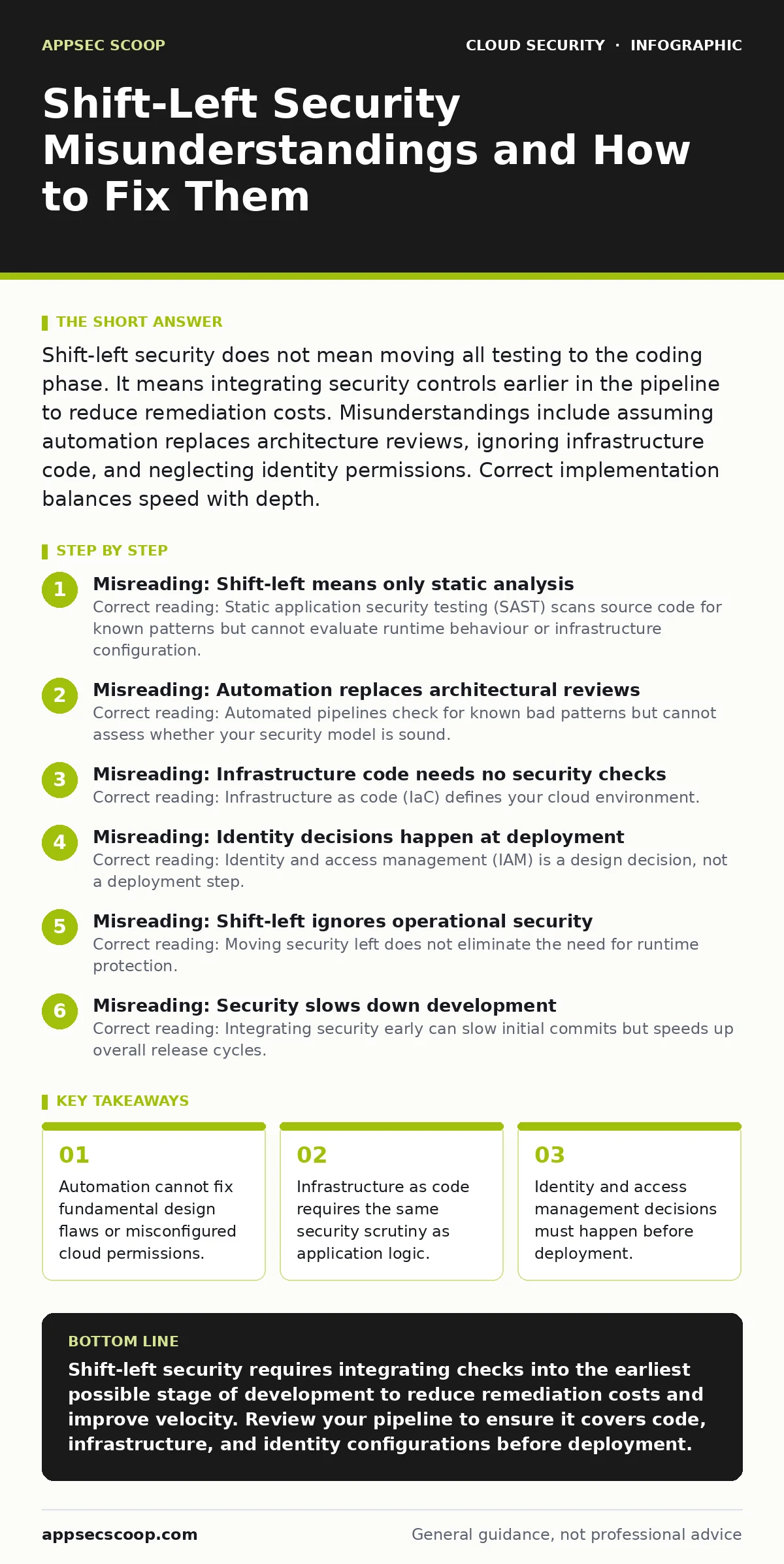
Shift-left security does not mean moving all testing to the coding phase. It means integrating security controls earlier in the pipeline to reduce remediation costs. Misunderstandings include assuming automation replaces architecture reviews, ignoring infrastructure code, and neglecting identity permissions. Correct implementation balances speed with depth.
Misreading: Shift-left means only static analysis
Correct reading: Static application security testing (SAST) scans source code for known patterns but cannot evaluate runtime behaviour or infrastructure configuration. Relying solely on SAST leaves critical gaps in how an application interacts with external services. You must integrate software composition analysis (SCA) to check third-party libraries for vulnerabilities. You also need dynamic analysis for runtime checks. Static tools flag syntax errors; they do not verify that your architecture enforces least privilege.
Imagine a developer uses a library with a known flaw. SAST detects the import. It does not tell you if the library is actually executed in production. It does not tell you if the data passed to it is sanitised. You need multiple detection methods to cover the full attack surface. Static analysis is a starting point, not a finish line.
Misreading: Automation replaces architectural reviews
Correct reading: Automated pipelines check for known bad patterns but cannot assess whether your security model is sound. A pipeline can pass if you use standard libraries correctly. It will not fail if you expose sensitive data because your API design lacks proper segmentation. You must retain manual architectural reviews for complex systems. Automation handles volume; humans handle context and intent.
Suppose you build a microservices architecture. The pipeline checks each service individually. It passes. But the communication between services is unencrypted. The pipeline does not know this unless you explicitly configure it to check service mesh policies. You need to define what "secure" means for your specific architecture. Automation enforces rules; it does not create them.
See the guide on cloud vulnerability management for how to prioritise findings from automated scans.
Misreading: Infrastructure code needs no security checks
Correct reading: Infrastructure as code (IaC) defines your cloud environment. If you treat IaC as merely operational configuration, you miss security misconfigurations before they reach production. IaC templates can grant overly broad permissions or open ports unnecessarily. You must scan IaC files for policy violations just as you scan application code. This prevents misconfigured resources from being provisioned.
Consider a template that creates a storage bucket. If the template allows public access, the bucket is vulnerable from the moment it is created. Scanning the code catches this error. Scanning the live resource catches it later. Catching it in code is cheaper and faster. You must integrate IaC scanning into your pull request process. This ensures that infrastructure changes are reviewed for security impact before deployment.
Check the guide on cloud security groups for details on network segmentation rules.
Misreading: Identity decisions happen at deployment
Correct reading: Identity and access management (IAM) is a design decision, not a deployment step. If you wait until deployment to assign permissions, you often grant broad access to ensure services work. This creates overprivileged cloud identities that are hard to restrict later. You must define the minimum required permissions during the design phase. Document these requirements and enforce them through policy-as-code.
Suppose a service needs to read from a database. The developer grants full admin access to the database to avoid troubleshooting permission errors. This works initially. It creates a massive risk if the service is compromised. You should define the exact read-only permission needed. You should test this permission in a development environment. This prevents privilege creep and reduces the blast radius of a breach.
Read the guide on overprivileged cloud identities for strategies to reduce access scope.
Misreading: Shift-left ignores operational security
Correct reading: Moving security left does not eliminate the need for runtime protection. It reduces the number of vulnerabilities that reach production. It does not stop attacks that exploit zero-day vulnerabilities or social engineering. You still need runtime defence mechanisms such as web application firewalls and intrusion detection systems. Shift-left and shift-right are complementary, not mutually exclusive. You build a secure foundation and then monitor for anomalies.
Imagine a new vulnerability is discovered in a framework you use. Your shift-left tools did not know about it when you coded. Your application is deployed. You need runtime monitoring to detect exploitation attempts. You need patching processes to fix the issue quickly. Shift-left prevents known issues. Runtime security handles the unknown. Both are necessary for a complete defence strategy.
Review the guide on cloud penetration testing for validating your runtime defences.
See also: CSPM vs CNAPP: Which Cloud Security Tool Fits Your Stack
Misreading: Security slows down development
Correct reading: Integrating security early can slow initial commits but speeds up overall release cycles. Fixing a security flaw in production requires emergency patches, rollbacks, and incident response. Fixing it in the code editor takes seconds. The cost of remediation increases exponentially as you move right in the pipeline. Early detection reduces rework. It allows developers to fix issues while the context is fresh. This improves velocity in the long term.
Suppose a developer introduces a dependency with a critical vulnerability. If caught in code review, they replace it in minutes. If caught in production, the team stops all other work to patch it. This disruption affects multiple teams. Early integration aligns security with developer workflows. It reduces friction by providing immediate feedback. Security becomes a constraint that enables safe speed, not a blocker.
See the guide on access key rotation for maintaining credential hygiene without slowing deployments.
Read the guide on leaked cloud access keys for handling credential exposure.
Check the guide on federated identity for managing user access across services.
Review the guide on bring your own key encryption for data protection strategies.
Key takeaways
- Automation cannot fix fundamental design flaws or misconfigured cloud permissions.
- Infrastructure as code requires the same security scrutiny as application logic.
- Identity and access management decisions must happen before deployment.
Shift-left security requires integrating checks into the earliest possible stage of development to reduce remediation costs and improve velocity. Review your pipeline to ensure it covers code, infrastructure, and identity configurations before deployment.
Frequently asked questions
Does shift-left security eliminate the need for penetration testing?
No, shift-left reduces the number of obvious vulnerabilities but cannot replace active exploitation testing. Penetration testing validates the effectiveness of your controls against real-world attack scenarios.
How do I balance security checks with developer speed?
Integrate lightweight, fast checks into the local development environment and pull request process. Reserve heavier, slower scans for later stages of the pipeline to avoid blocking every commit.
Can automated tools detect logic flaws in my application?
Automated tools struggle with business logic flaws because they lack context about intended behaviour. You must use manual testing and code reviews to identify logic errors that automated scanners miss.
Is shift-left only for cloud-native applications?
No, the principles apply to any software development lifecycle. However, cloud environments benefit more due to the dynamic nature of infrastructure and the ease of misconfiguration in cloud services.
How this guide was produced: written by the AppSec Scoop editorial team with AI assistance, checked against the public references listed below, and reviewed when the facts change. See our editorial policy or report an error.