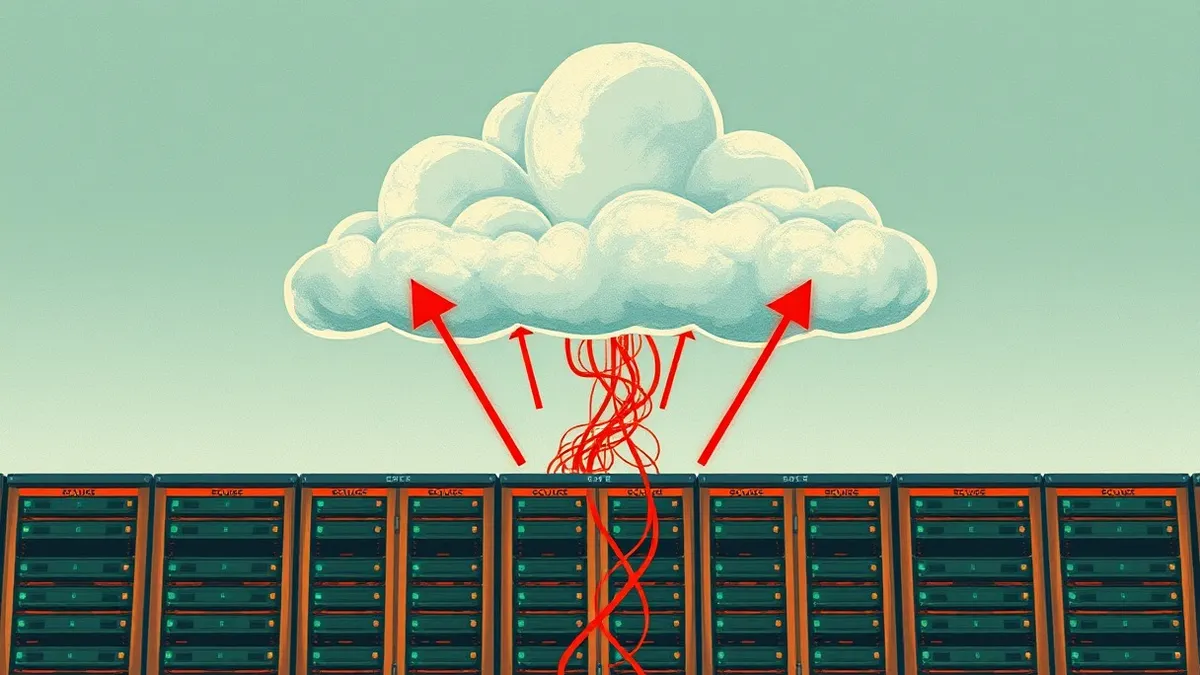
Cloud penetration testing simulates real attacks on your cloud infrastructure to find security weaknesses. Unlike standard scans, it tests how services interact and how permissions are configured. You identify risks by attempting to move laterally between services, revealing gaps in your defence that automated tools often overlook.
The Bank Vault Analogy
Imagine your cloud environment is a large bank. Traditional security scanners are like guards checking if the front door is locked. They verify the lock mechanism works but do not check if the safe behind the door is open. Cloud penetration testing is the security consultant hired to try every key in the ring, talk to the staff, and see if they can reach the vault without forcing the door. This analogy carries through the entire process. You are not just checking the perimeter; you are testing the internal rules that govern who can access what.
Defining the Scope and Rules
Before any testing begins, you must define exactly what can be touched. In the cloud, actions can cascade. A test on one service might trigger a billing alert or disrupt a dependent application. You agree on a list of accounts, regions, and services that are fair game. This prevents accidental disruption. You also agree on the methods allowed. Some cloud providers restrict certain attack techniques, even during authorised tests. Ignoring these restrictions can lead to account suspension.
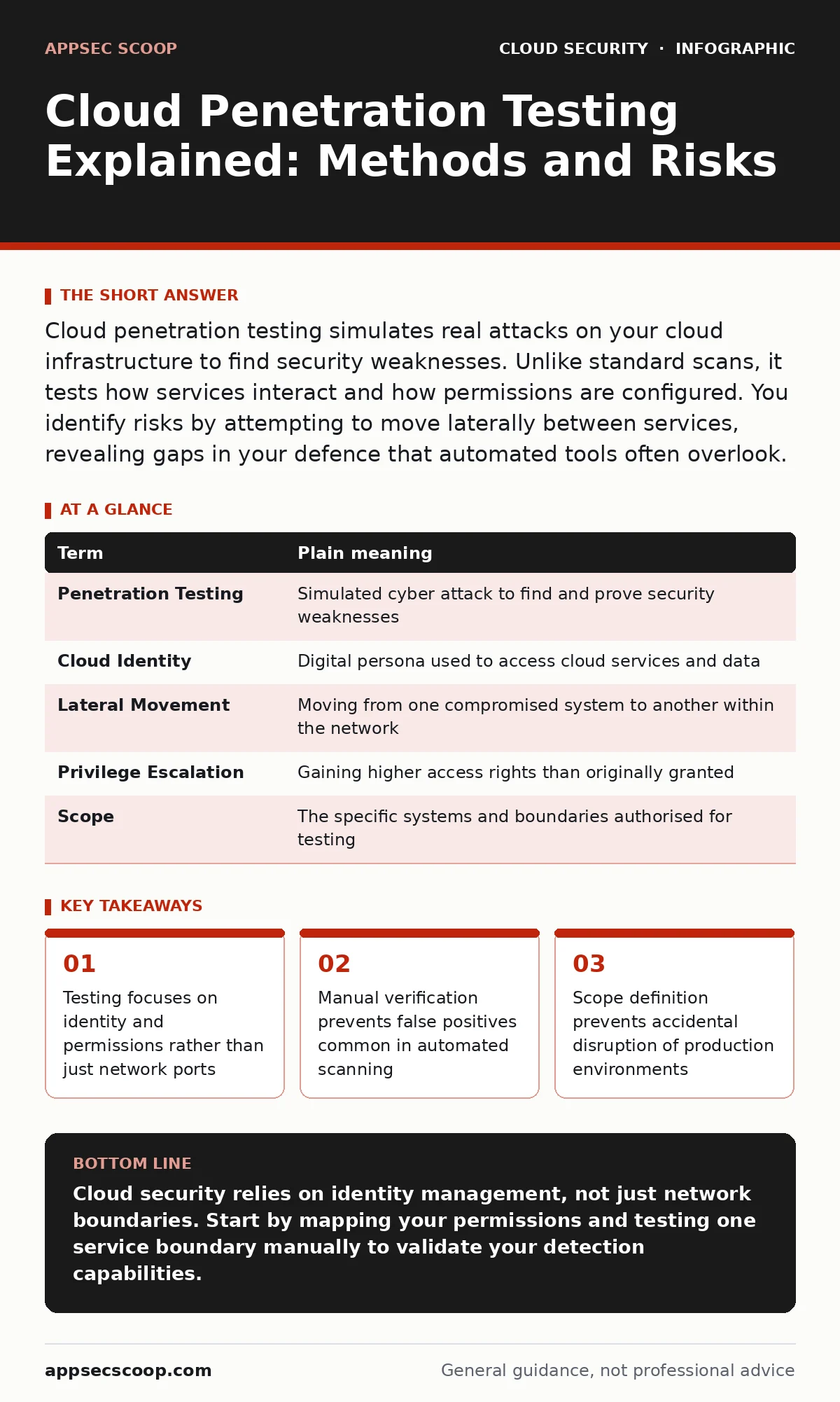
| Term | Plain meaning |
|---|---|
| Penetration Testing | Simulated cyber attack to find and prove security weaknesses |
| Cloud Identity | Digital persona used to access cloud services and data |
| Lateral Movement | Moving from one compromised system to another within the network |
| Privilege Escalation | Gaining higher access rights than originally granted |
| Scope | The specific systems and boundaries authorised for testing |
Identity Over Infrastructure
In on-premises networks, firewalls are the primary defence. In the cloud, identity is the new perimeter. You do not just connect to an IP address; you authenticate as an entity with specific permissions. This shift changes how you test. You look for overprivileged cloud identities that have more access than necessary. A developer account that can delete production databases is a risk, even if the network is isolated. Testing these permissions reveals how much damage a single compromised credential can cause.
Simulating Real-World Movement
Automated scanners list vulnerabilities, but they do not chain them together. A human tester looks for how two minor issues combine to create a major breach. Suppose a storage bucket is publicly readable and a web server trusts that bucket for configuration. An attacker reads the config, finds database credentials, and accesses the data. This is lateral movement. You simulate this path to see if your detection systems alert on the sequence of events. This tests your monitoring, not just your configuration.
The Cost of False Positives
Automated tools often report issues that are not real risks. A port might be open but filtered by a higher-level security group. A service might be exposed but require credentials that no one has. Manual testing validates these findings. You confirm that the vulnerability is exploitable. This reduces the noise for your security team. It ensures they focus on real threats. This validation step is time-consuming but necessary. It prevents alert fatigue, where teams ignore warnings because most are false alarms.
See also: CSPM vs CNAPP: Which Cloud Security Tool Fits Your Stack
Integration with Development
Testing should not happen only at the end of a project. Integrating security checks early in the development process is known as shift-left security. This catches issues when they are cheap to fix. However, penetration testing is complex. It requires deep knowledge of the cloud provider’s specific services. You cannot fully automate this. You need skilled humans to think like attackers. They find the edge cases that scripts miss. This human element is why penetration testing remains distinct from automated compliance scans.
First Practical Steps
You do not need a full-scale engagement to start. You can begin with small, controlled tests. Follow these steps to build your internal capability:
- Map your entitlements: List all identities with access to critical resources. Check for unused accounts.
- Test one boundary: Pick a single service, like a web application, and test if users can access data they should not.
- Review logs: Check if your logging system captured the test actions. If not, you cannot detect real attacks.
Ensuring Ongoing Security
A single test gives you a snapshot in time. Cloud environments change daily. New services are added, permissions are updated, and old ones are forgotten. You need a way to continuously monitor for drift. This involves regular reviews of misconfigured IAM roles and cloud entitlements. You should also ensure MFA for cloud accounts is enforced everywhere. This adds a layer of defence that compensates for weak permissions. Testing validates that these controls work as intended.
Key takeaways
- Testing focuses on identity and permissions rather than just network ports
- Manual verification prevents false positives common in automated scanning
- Scope definition prevents accidental disruption of production environments
Cloud security relies on identity management, not just network boundaries. Start by mapping your permissions and testing one service boundary manually to validate your detection capabilities.
Frequently asked questions
Can I use automated tools instead of human testers?
Automated tools find known misconfigurations, but human testers find complex logic flaws and chained vulnerabilities that tools miss.
How often should we perform cloud penetration testing?
You should test after significant infrastructure changes and at least annually, or more frequently for high-risk systems.
Is cloud penetration testing allowed by providers?
Most major providers allow it but require prior notification and restrict certain attack methods to prevent service disruption.
What is the difference between scanning and penetration testing?
Scanning identifies potential issues using patterns, while penetration testing attempts to exploit them to prove risk and impact.
How this guide was produced: written by the AppSec Scoop editorial team with AI assistance, checked against the public references listed below, and reviewed when the facts change. See our editorial policy or report an error.