
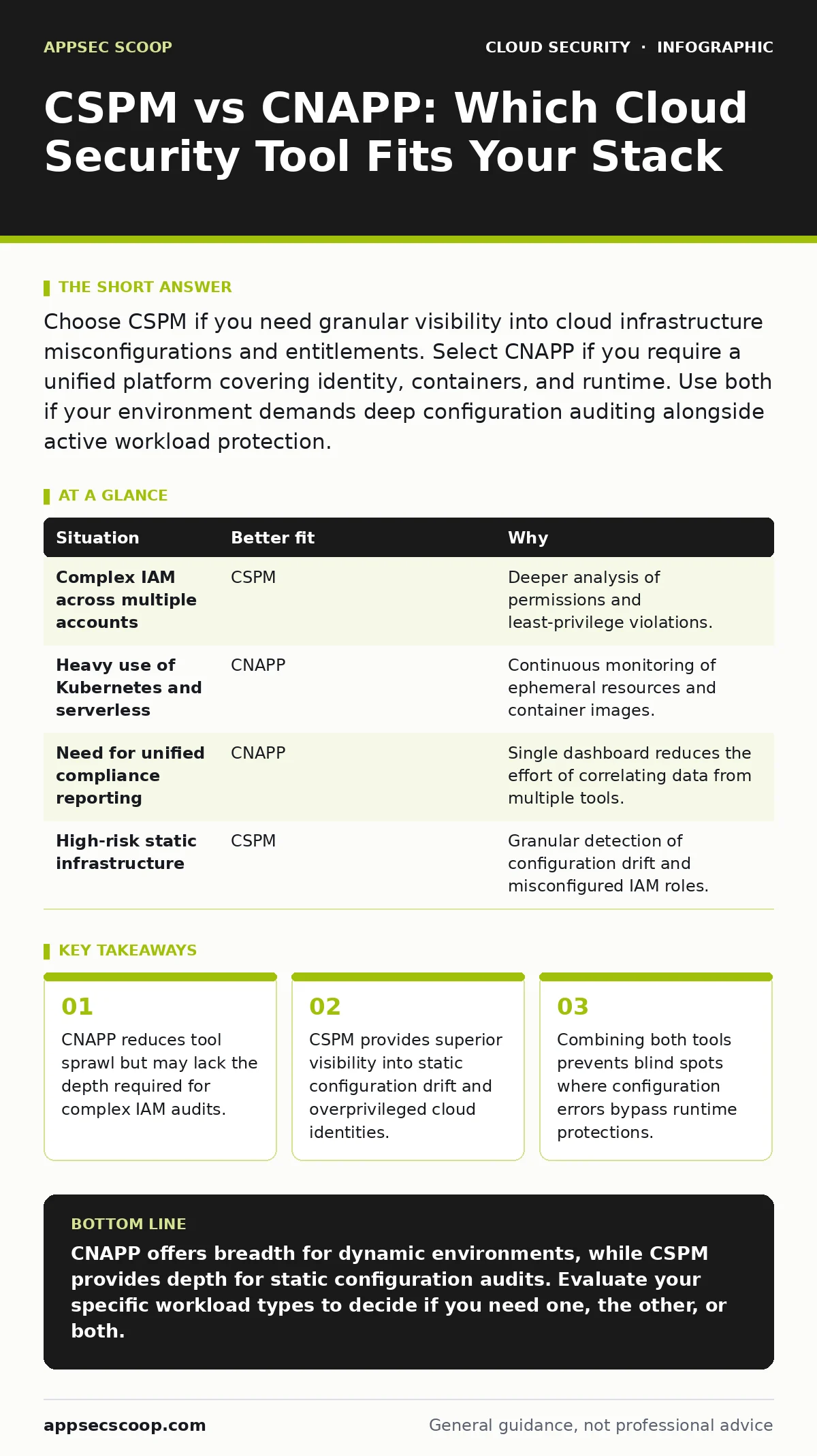
Choose CSPM if you need granular visibility into cloud infrastructure misconfigurations and entitlements. Select CNAPP if you require a unified platform covering identity, containers, and runtime. Use both if your environment demands deep configuration auditing alongside active workload protection.
Does your team manage static configuration or active workloads?
Cloud Security Posture Management (CSPM) focuses on the static state of your cloud infrastructure. It scans resources to find misconfigured IAM roles, open storage buckets, and non-compliant network settings. This approach treats the cloud environment as a fixed entity that must be audited against a set of rules.
Cloud Native Application Protection Platform (CNAPP) takes a broader view. It includes CSPM capabilities but adds protection for containers, serverless functions, and application code. CNAPP monitors the lifecycle of an application from development through deployment. It looks for vulnerabilities in the code and threats during execution.
If your primary concern is ensuring that your cloud accounts adhere to compliance standards, CSPM is the narrower, deeper tool. It excels at identifying structural weaknesses before any code runs. If you are running dynamic microservices, the static view of CSPM misses the behaviour of the application itself.
How complex is your identity and access management?
Identity is the new perimeter. A single misconfigured IAM role can grant an attacker full control over your environment. CSPM tools are often better at mapping the complex web of permissions across multiple cloud accounts. They highlight overprivileged cloud identities that have more access than necessary.
CNAPP platforms aggregate identity data but often treat it as one signal among many. They may flag a high-risk identity but lack the detailed breakdown of why that identity is risky. For teams managing hundreds of service accounts, the granular reporting of a dedicated CSPM is often more actionable.
Imagine a scenario where a developer’s service account has write access to production databases. A CSPM will flag this as a policy violation immediately. A CNAPP might only flag this if the account is actively trying to exfiltrate data. The prevention model of CSPM catches the error before it becomes an incident.
Is your application deployed in containers or serverless functions?
If your architecture relies heavily on Kubernetes or serverless computing, CNAPP is the more natural fit. These environments are ephemeral. Resources appear and disappear in seconds. Traditional CSPM tools struggle to keep up with this velocity. They may scan a resource after it has already been deleted.
CNAPP integrates with the build pipeline. It scans container images for vulnerabilities before they are deployed. It also monitors container runtime security to detect malicious behaviour during execution. This continuous monitoring is critical for environments where the infrastructure changes every minute.
CSPM can still audit the underlying cloud resources that host these containers, such as cloud security groups and VPC configurations. However, it does not inspect the container image itself. If your primary risk is a vulnerable library inside a container, CSPM will not see it.
Do you need to reduce tool sprawl or maximise detection depth?
CNAPP promises consolidation. It aims to replace multiple point solutions with a single dashboard. This reduces the operational overhead of managing separate tools. However, this consolidation often comes at the cost of depth. The configuration rules in a CNAPP may be less comprehensive than those in a specialised CSPM.
CSPM offers deeper configuration auditing. It can detect subtle misconfigurations in cloud entitlements that a broader platform might miss. If your team values precise, actionable findings over a unified view, CSPM remains the superior choice for configuration management.
Suppose you are using bring your own key encryption for your data. A dedicated CSPM might audit the key management service policies in greater detail than a CNAPP. It ensures that the keys themselves are not exposed through misconfigured permissions. This level of detail is often lost in a broader platform.
| Situation | Better fit | Why |
|---|---|---|
| Complex IAM across multiple accounts | CSPM | Deeper analysis of permissions and least-privilege violations. |
| Heavy use of Kubernetes and serverless | CNAPP | Continuous monitoring of ephemeral resources and container images. |
| Need for unified compliance reporting | CNAPP | Single dashboard reduces the effort of correlating data from multiple tools. |
| High-risk static infrastructure | CSPM | Granular detection of configuration drift and misconfigured IAM roles. |
When to use both tools together
Using both CSPM and CNAPP is not redundant. It creates a layered defence. CSPM handles the deep audit of the cloud infrastructure’s static configuration. It ensures that the foundation is secure. CNAPP handles the dynamic aspects of the applications running on that foundation.
This combination prevents blind spots. A CSPM might find that a cloud firewall is correctly configured. However, a CNAPP can detect if an application is bypassing that firewall through a direct connection. The two tools complement each other by covering different phases of the security lifecycle.
For large organisations, the cost of two tools is justified by the reduction in risk. You gain the depth of configuration auditing and the breadth of application protection. This approach ensures that neither static errors nor dynamic threats go unnoticed.
See also: Stop Overprivileged Cloud Identities Before They Leak Data
The hidden cost of consolidation
Consolidating to a single CNAPP can create a false sense of security. Teams may assume that because they have one tool, they are fully covered. This leads to reduced scrutiny of the tool’s capabilities. You must verify that the CNAPP’s CSPM component is as rigorous as a standalone solution.
If the CNAPP lacks depth in identity management, you may miss overprivileged cloud identities. These identities are a primary vector for lateral movement. A dedicated CSPM is often better at mapping these relationships. Do not let the convenience of consolidation override the need for depth.
Final considerations for your stack
Your choice depends on your architecture and risk appetite. If you are building new applications in containers, start with CNAPP. It provides the necessary visibility into the application lifecycle. If you are managing legacy infrastructure or complex IAM, add a CSPM for deeper auditing.
Remember that no tool provides complete protection. You must still enforce least privilege and monitor for leaked cloud access keys. The tool is only as good as the policies you define within it. Choose the tool that matches your specific operational needs, not the one that promises the most features.
Key takeaways
- CNAPP reduces tool sprawl but may lack the depth required for complex IAM audits.
- CSPM provides superior visibility into static configuration drift and overprivileged cloud identities.
- Combining both tools prevents blind spots where configuration errors bypass runtime protections.
CNAPP offers breadth for dynamic environments, while CSPM provides depth for static configuration audits. Evaluate your specific workload types to decide if you need one, the other, or both.
Frequently asked questions
Can CNAPP replace a dedicated CSPM tool?
It can, but only if its configuration auditing capabilities are as deep as a standalone CSPM. Verify the rule sets and identity mapping features before removing a dedicated tool.
Is CSPM enough for containerised applications?
No. CSPM audits the underlying infrastructure but does not scan container images or monitor runtime behaviour. You need additional tools for those aspects.
How do I handle misconfigured IAM roles with CNAPP?
CNAPP can detect misconfigurations, but you may need to integrate it with a dedicated identity governance tool for detailed remediation steps.
Does using both tools increase alert noise?
It can, if not tuned correctly. Use the CSPM for configuration alerts and the CNAPP for runtime threats to keep the signals distinct and actionable.
How this guide was produced: written by the AppSec Scoop editorial team with AI assistance, checked against the public references listed below, and reviewed when the facts change. See our editorial policy or report an error.