
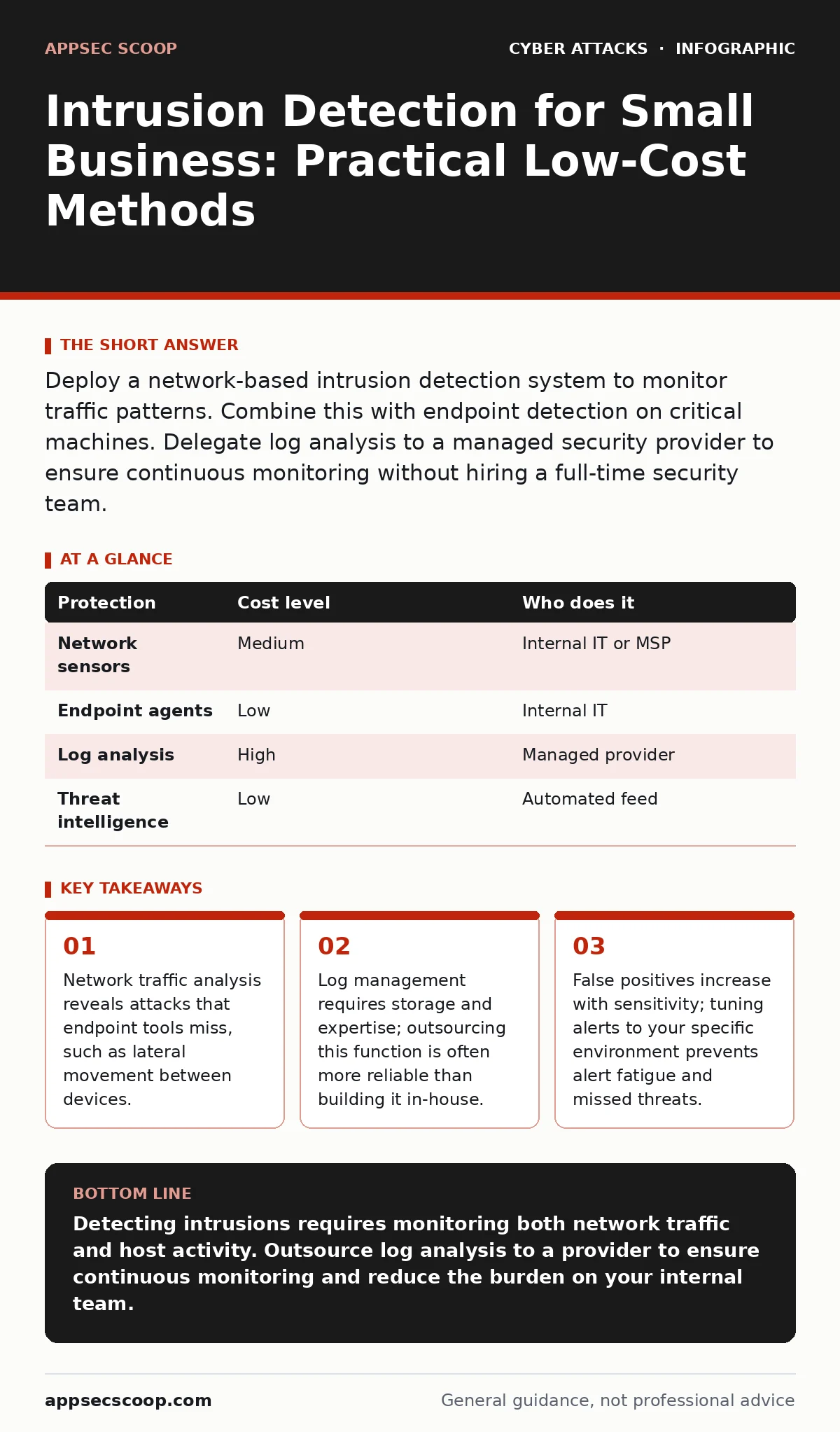
Deploy a network-based intrusion detection system to monitor traffic patterns. Combine this with endpoint detection on critical machines. Delegate log analysis to a managed security provider to ensure continuous monitoring without hiring a full-time security team.
The Blind Spot in Small Networks
Small organisations often assume that firewalls provide sufficient visibility. Firewalls filter traffic based on rules, but they do not inspect the content of every packet for malicious signatures. An intrusion detection system examines traffic for known attack patterns and anomalous behaviour. This distinction matters because many attacks bypass standard filtering by using allowed ports or encrypted channels.
Without active monitoring, you may not know you are compromised until data has left the network. This delay allows attackers to establish persistence and move laterally. Lateral movement is the process where an attacker moves from one compromised device to another within the same network. Small networks are particularly vulnerable to this because internal trust boundaries are often weak or non-existent.
Choosing the Right Detection Model
You must choose between network-based and host-based detection. Network-based intrusion detection systems sit at the network edge or critical junctions. They see all traffic passing through that point, regardless of the device involved. This gives you a broad view of external attacks and internal scanning.
Host-based intrusion detection systems run on individual devices. They monitor system calls, file changes and process behaviour. This is useful for detecting attacks that do not generate significant network traffic, such as local privilege escalation. For small businesses, a hybrid approach is usually best. You cannot install agents on every printer or IoT device, so network monitoring covers those blind spots.
Cost Effective Deployment Strategies
Budget constraints often lead teams to skip detection entirely. This is a false economy. You can achieve meaningful coverage without expensive appliances. Open-source solutions provide powerful detection engines without licensing fees. These tools require configuration and maintenance, which shifts the cost from software to labour.
Cloud-based security services offer a predictable monthly cost. They provide the infrastructure for log storage and analysis. This removes the need to buy and maintain servers for log management. You pay for what you use, which scales with your data volume. This model is often more affordable for small teams than managing on-premises hardware.
| Protection | Cost level | Who does it |
|---|---|---|
| Network sensors | Medium | Internal IT or MSP |
| Endpoint agents | Low | Internal IT |
| Log analysis | High | Managed provider |
| Threat intelligence | Low | Automated feed |
The Hidden Cost of Alert Fatigue
Detection systems generate noise. Every system generates alerts, many of which are false positives. A false positive is an alert that indicates a threat but is actually benign activity. If your system alerts you every time a user accesses a new website, you will stop looking at the alerts. This is alert fatigue.
Tuning your detection rules is critical. You must define what normal traffic looks like for your organisation. This baseline allows the system to flag deviations. If you do not tune the system, it will overwhelm your staff. You will miss the real attacks buried in the noise. Regular review of alerts is necessary to refine these baselines.
What to Delegate to Providers
You cannot do everything internally. Log management and analysis require specialised skills. A managed security service provider can handle the 24/7 monitoring that small teams cannot sustain. They have analysts who know how to distinguish between noise and genuine threats.
When evaluating providers, ask specific questions about their capabilities. Do not just ask if they offer monitoring. Ask how they handle initial triage. Ask about their response time to critical alerts. Ask what tools they use for correlation. Correlation is the process of linking multiple alerts to identify a single attack chain.
- How do you distinguish between a false positive and a genuine threat?
- What is your process for escalating critical incidents to our team?
- Do you provide regular reports on detected threats and trends?
- How do you handle log retention and compliance requirements?
See also: Encryption in Transit: How It Protects Data Between Systems
Integrating with Existing Defences
Intrusion detection does not work in isolation. It must feed into your incident response plan. When a threat is detected, you need a clear procedure for containment. This might involve isolating a device or blocking an IP address. Automation can help here. Some systems can trigger automated responses to block known bad actors.
Ensure your endpoint protection integrates with your detection system. Endpoint protection stops malware from executing, while detection identifies the attempt. Together, they provide layers of defence. If your endpoint tool fails, the network sensor might still catch the command-and-control traffic. This redundancy is vital for resilience.
Maintaining Detection Effectiveness
Detection rules become outdated. New attack techniques emerge regularly. You must update your signatures and rules. Open-source tools require manual updates, while commercial services often handle this automatically. Neglecting updates renders your detection system useless against modern threats.
Regular testing is also necessary. Simulate attacks to verify that your system detects them. This is known as purple teaming. It helps you identify gaps in your coverage. If you cannot detect a simulated attack, you cannot detect a real one. This process ensures your investment in detection remains effective over time.
Key takeaways
- Network traffic analysis reveals attacks that endpoint tools miss, such as lateral movement between devices.
- Log management requires storage and expertise; outsourcing this function is often more reliable than building it in-house.
- False positives increase with sensitivity; tuning alerts to your specific environment prevents alert fatigue and missed threats.
Detecting intrusions requires monitoring both network traffic and host activity. Outsource log analysis to a provider to ensure continuous monitoring and reduce the burden on your internal team.
Frequently asked questions
Can I use a firewall as an intrusion detection system?
No. Firewalls filter traffic based on rules. Intrusion detection systems inspect packet content for malicious signatures and anomalous behaviour. They serve different purposes.
How many sensors do I need for a small office?
One sensor at the internet edge is a minimum. Add sensors at critical internal junctions, such as between office segments and server rooms, to catch lateral movement.
Is cloud-based detection secure?
Yes, if the provider uses encryption for data in transit and at rest. Ensure the provider has strong security certifications and a clear data privacy policy.
What is the difference between IDS and IPS?
An intrusion detection system alerts you to threats. An intrusion prevention system actively blocks them. IPS can cause disruption if misconfigured, so IDS is often safer for small teams to start with.
How this guide was produced: written by the AppSec Scoop editorial team with AI assistance, checked against the public references listed below, and reviewed when the facts change. See our editorial policy or report an error.