
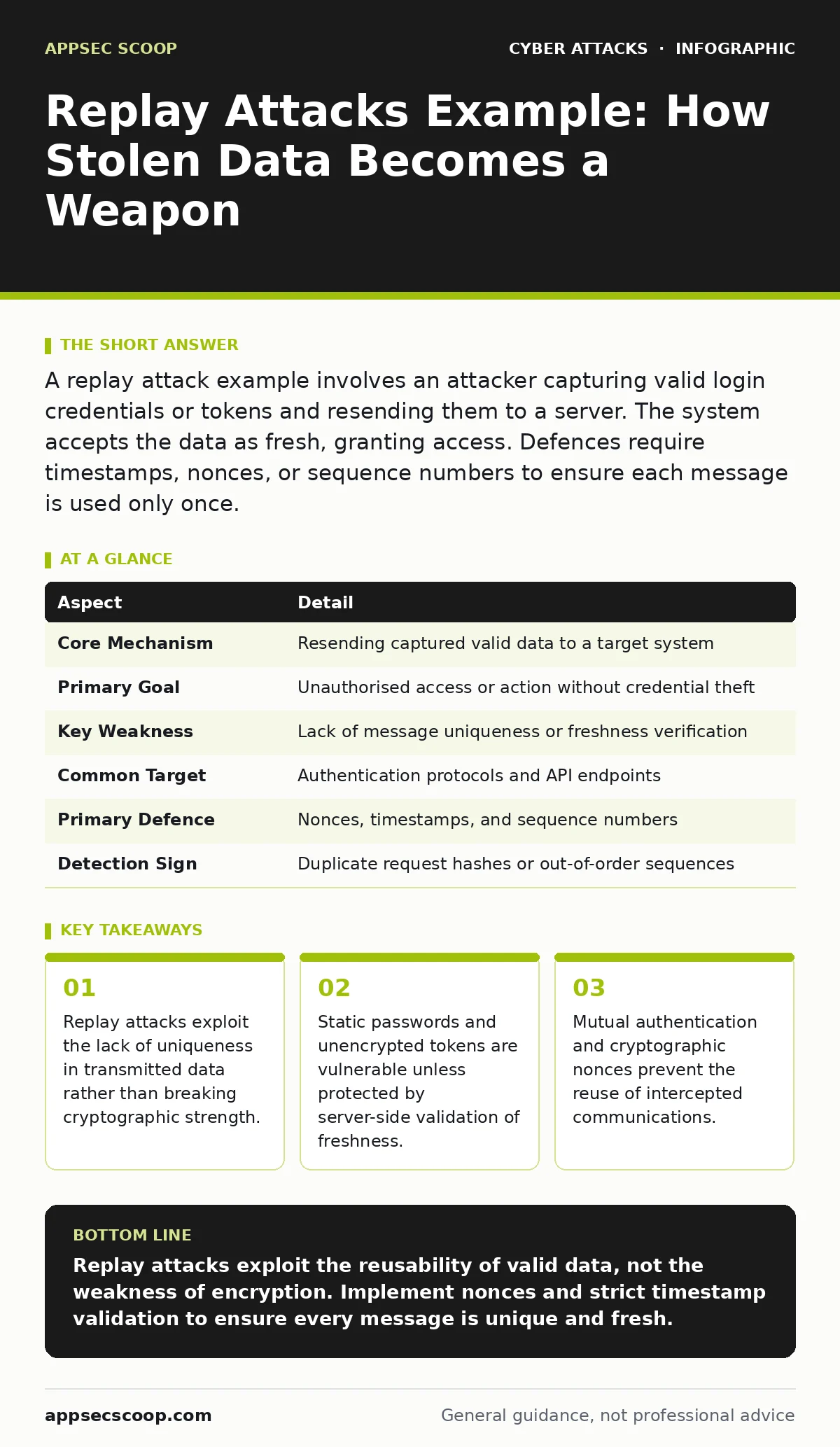
A replay attack example involves an attacker capturing valid login credentials or tokens and resending them to a server. The system accepts the data as fresh, granting access. Defences require timestamps, nonces, or sequence numbers to ensure each message is used only once.
The Echo Chamber Analogy
Imagine speaking into a walkie-talkie in a canyon. Your voice echoes back, identical to the original. If the person on the other end cannot distinguish your live voice from the echo, they might act on the repeated message. A replay attack operates on this principle within digital networks. An adversary does not need to understand the content of a communication. They only need to capture a valid transmission and resend it. The receiving system treats the duplicate as a new, legitimate request.
This mechanism bypasses traditional authentication checks. The data is correct. The cryptographic signature is valid. The only flaw is the timing and context. The system fails to recognise that the message has been seen before. This failure allows an attacker to impersonate a user or trigger actions without possessing the underlying secrets.
At a Glance
| Aspect | Detail |
|---|---|
| Core Mechanism | Resending captured valid data to a target system |
| Primary Goal | Unauthorised access or action without credential theft |
| Key Weakness | Lack of message uniqueness or freshness verification |
| Common Target | Authentication protocols and API endpoints |
| Primary Defence | Nonces, timestamps, and sequence numbers |
| Detection Sign | Duplicate request hashes or out-of-order sequences |
What Is a Replay Attacks Example
A replay attacks example often involves an interceptor capturing a login session. Suppose you log into a banking application. Your device sends a packet containing your encrypted credentials and a session token. An attacker on the same network captures this packet. They do not decrypt it. They simply wait for you to log out. Then, they resend the exact same packet to the bank’s server. The server sees valid credentials and a valid token. It grants access. The attacker is now inside, using your exact digital fingerprint.
This scenario highlights the danger of stateless systems. If the server does not record which tokens have been used, it cannot reject the duplicate. The attack succeeds because the protocol lacks a mechanism to identify previously transmitted data. The attacker gains entry without ever knowing your password.
How the Mechanism Works
The attack relies on the interception and retransmission of data. The adversary positions themselves between the client and the server. This position is often achieved through network sniffing on unsecured Wi-Fi or compromised routers. Once the valid data stream is captured, the attacker stores it. They do not alter the payload. Alteration would break digital signatures or checksums.
The retransmission occurs later. The timing is critical. The attacker waits for the original session to expire or for the user to be inactive. This creates a window where the replayed data appears fresh. The server processes the request. It validates the cryptographic integrity. It checks the user permissions. It fails to check the history. The result is unauthorised access. This method works against any protocol that does not enforce one-time use of credentials.
Who Is Affected
Systems that rely on static authentication methods are most vulnerable. Legacy protocols that use simple challenge-response mechanisms without nonces are prime targets. Internet of Things devices often use hardcoded tokens. These tokens never change. An attacker can capture them once and use them indefinitely. Financial APIs are also at risk. A repeated transaction request can drain an account if idempotency checks are missing.
Organisations with poor network segmentation face higher risks. Internal traffic is often trusted implicitly. An attacker who breaches the perimeter can replay internal commands. This amplifies the impact of initial intrusion. The damage spreads as the attacker reuses valid administrative commands. This connects directly to the risks discussed in our guide on intrusion detection systems, where lateral movement often goes unnoticed.
See also: Intrusion Detection for Small Business: Practical Low-Cost Methods · Password Hygiene: The Hidden Costs and Real Limits of Credential Care
What People Usually Get Wrong
Many assume that encryption prevents replay attacks. This is incorrect. Encryption ensures confidentiality. It does not ensure freshness. A perfectly encrypted message can be copied and pasted. The server decrypts it successfully. It sees valid data. It fails to see that the data is old. Encryption hides the content from the eavesdropper. It does not stop the eavesdropper from becoming a messenger.
Another common error is relying solely on strong passwords. Password strength is irrelevant if the authentication token is reused. The attacker never guesses the password. They use the valid token. This misconception leads teams to invest in password complexity while ignoring protocol design. The flaw is not in the secret. The flaw is in the state management. This overlaps with concepts in session hijacking, where the token itself is the target.
Correct Defences
The primary defence is ensuring message uniqueness. A nonce, or number used once, is a random value generated for each transaction. The server generates the nonce. The client includes it in the response. The server records the nonce. Any subsequent request with the same nonce is rejected. This ensures that even if the data is captured, it cannot be reused.
Timestamps provide another layer of protection. The client includes the current time in the request. The server checks if the time falls within an acceptable window. If the time is too old, the request is discarded. This limits the window for replay. However, clock synchronisation is required. Drift between client and server clocks can cause valid requests to be rejected. Sequence numbers offer a simpler alternative for stateful connections. Each message gets an incrementing number. The server expects the next number in the sequence.
Operational Checklist
Implementing these defences requires changes to protocol design. Legacy systems may need upgrading. Here is a checklist for securing your communications:
- Verify that all authentication protocols use nonces or sequence numbers.
- Ensure servers maintain a short-term cache of used nonces.
- Check that timestamps are validated against a trusted time source.
- Test for idempotency in API endpoints to prevent duplicate actions.
- Review network logs for duplicate request hashes or patterns.
This approach reduces the attack surface significantly. It forces attackers to break encryption or guess secrets. It removes the low-effort option of copying data. This aligns with broader cyber hygiene practices, where reducing unnecessary trust is a core principle.
The Hidden Cost of Complexity
Adding nonces and timestamps increases protocol overhead. Each request requires more data. Servers must store state for each active session. This consumes memory and processing power. For high-volume systems, this can be a bottleneck. Designers must balance security with performance. Storing nonces for too long wastes resources. Storing them for too short a period may cause legitimate retries to fail.
This trade-off often leads to weak implementations. Developers may use small nonce spaces. Attackers can then brute-force the nonce values. They send many requests until they guess a valid one. This turns a replay attack into a brute-force attack. The defence fails because the randomness was insufficient. The complexity of the defence introduces new failure modes.
Key takeaways
- Replay attacks exploit the lack of uniqueness in transmitted data rather than breaking cryptographic strength.
- Static passwords and unencrypted tokens are vulnerable unless protected by server-side validation of freshness.
- Mutual authentication and cryptographic nonces prevent the reuse of intercepted communications.
Replay attacks exploit the reusability of valid data, not the weakness of encryption. Implement nonces and strict timestamp validation to ensure every message is unique and fresh.
Frequently asked questions
Can HTTPS prevent replay attacks?
HTTPS encrypts data but does not inherently prevent replay. The application layer must implement nonces or tokens to ensure messages are not reused.
How do I detect a replay attack?
Look for duplicate request hashes, identical nonces, or out-of-sequence numbers in your server logs. Automated monitoring can flag these patterns.
Are one-time passwords vulnerable to replay?
One-time passwords are designed to resist replay. They are valid for only one use. However, if the system fails to invalidate the code after use, it becomes vulnerable.
What is the difference between replay and session hijacking?
Session hijacking involves stealing an active session token. Replay involves capturing and resending any valid data packet, including login credentials or commands.
How this guide was produced: written by the AppSec Scoop editorial team with AI assistance, checked against the public references listed below, and reviewed when the facts change. See our editorial policy or report an error.