
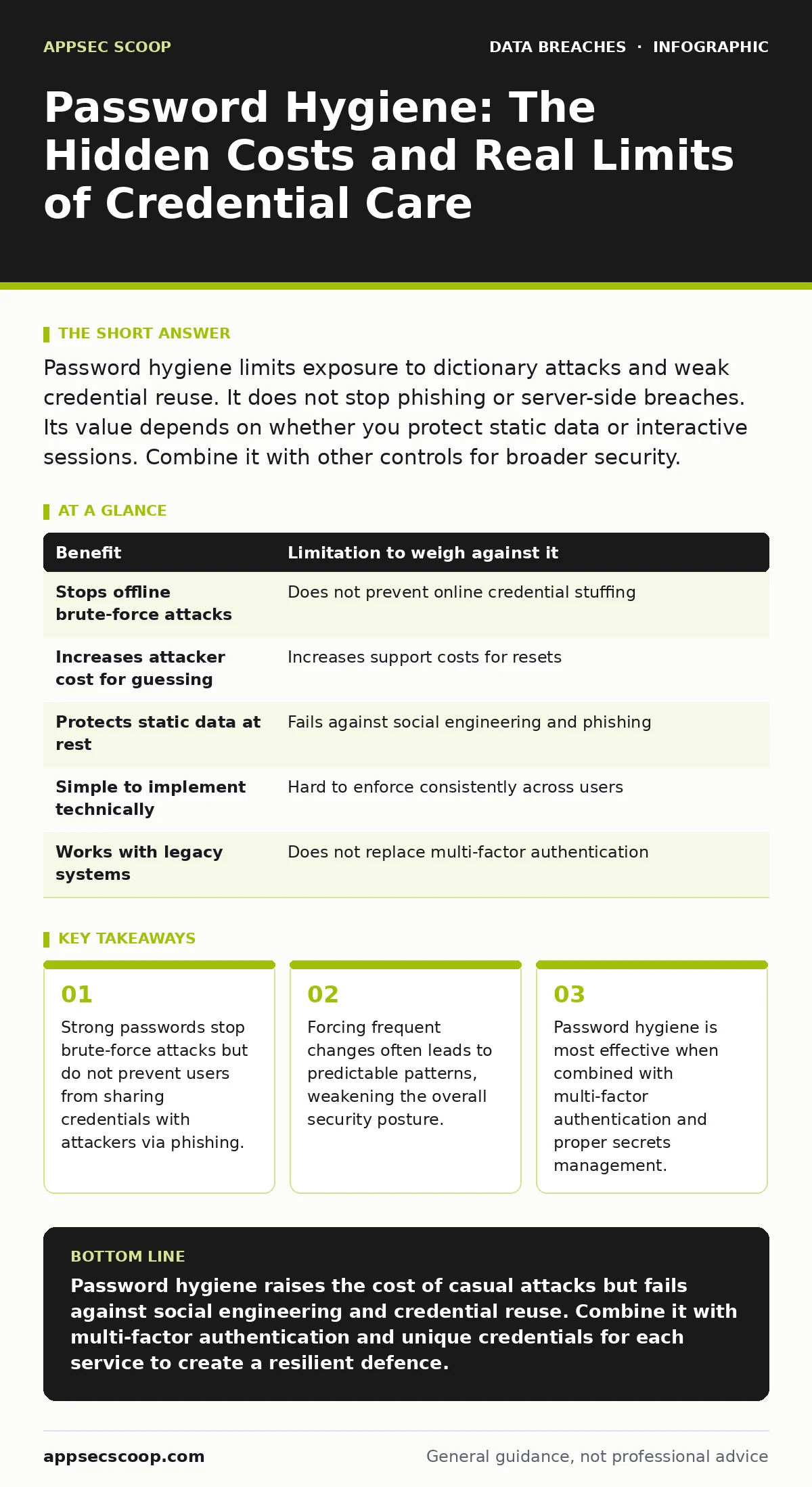
Password hygiene limits exposure to dictionary attacks and weak credential reuse. It does not stop phishing or server-side breaches. Its value depends on whether you protect static data or interactive sessions. Combine it with other controls for broader security.
The Mechanics of Credential Strength
Password hygiene refers to the practices used to create, store, and rotate credentials. The primary goal is to increase the entropy, or randomness, of the password. High entropy makes it difficult for an attacker to guess the correct sequence of characters. This defence works against offline attacks, where an attacker has obtained a hash of the password and attempts to reverse it.
When you use a long, random string, the number of possible combinations increases exponentially. This forces an attacker to spend more time and computational resources to find the correct match. If the cost of guessing exceeds the value of the account, the attacker may abandon the attempt. This economic friction is the core benefit of strong passwords.
However, password strength is only one factor in account security. It does not address the human element of social engineering. If an attacker tricks you into revealing your password, the strength of that password becomes irrelevant. The credential is compromised regardless of its complexity. This limitation means password hygiene alone cannot secure an account.
The Illusion of Forced Rotation
Many organisations mandate regular password changes, believing this limits the window of opportunity for attackers. The logic is that if a password is stolen, it will become invalid before the attacker can use it. This approach assumes that attackers act quickly and that users change to genuinely new passwords.
In practice, forced rotation often produces the opposite effect. Users facing frequent changes tend to adopt predictable patterns. They might increment a number at the end of the password or change a single letter. These patterns are easily recognised by modern cracking tools. The result is a cycle of weak passwords that provides a false sense of security.
This practice also increases support costs. Users forget their new passwords more often, leading to a higher volume of reset requests. The operational burden falls on the help desk, diverting resources from other security tasks. The trade-off here is clear: administrative convenience often undermines technical security.
Credential Stuffing and Reuse
The most significant threat to password hygiene is credential reuse. Users often employ the same password across multiple services. When one service suffers a data breach, the exposed credentials become valuable to attackers. They use these lists to attempt logins on other platforms, a technique known as credential stuffing.
Password hygiene cannot prevent credential stuffing if the user reuses passwords. A strong password on one site is compromised if it is the same as the password on a breached site. The attacker does not need to crack the password; they simply try the known combination. This bypasses the protection offered by complexity and length.
To mitigate this, you must treat each password as unique. This requires a reliable method for storing many distinct credentials. Manual management leads to reuse or weak variations. Automated tools can help, but they introduce their own risks if not managed correctly. The focus shifts from remembering passwords to securing the storage mechanism.
When Password Hygiene Adds Value
Password hygiene is worth the effort when protecting accounts that serve as gateways to sensitive data. These are high-value targets where the cost of compromise is significant. For these accounts, the additional friction of strong, unique passwords adds a meaningful layer of defence. It raises the barrier for automated attacks and casual theft.
It is also valuable in environments where other controls are absent. If you cannot implement multi-factor authentication or network segmentation, strong passwords are your primary line of defence. They provide a basic level of security that is better than nothing. In these cases, the benefits outweigh the operational costs.
Consider the context of secrets management. If you are managing access to critical infrastructure, password hygiene is part of a broader strategy. It works in tandem with encryption in transit and data masking to protect the full lifecycle of sensitive information. The password is just one component of a layered defence.
When Password Hygiene Falls Short
Password hygiene is not worth the investment when used as a standalone control for low-risk accounts. For public-facing forms or non-sensitive applications, the effort required to enforce strict password policies may exceed the potential damage of a breach. The resources spent on enforcement could be better directed elsewhere.
It is also ineffective against targeted phishing attacks. If an attacker impersonates a trusted service and tricks a user into handing over their credentials, the password strength is irrelevant. The attacker obtains the valid credential directly from the user. No amount of complexity can stop this social engineering vector.
In these scenarios, relying solely on password hygiene creates a false sense of security. It distracts from more effective controls like user education and multi-factor authentication. The focus should shift from the strength of the secret to the verification of the user's identity.
See also: Difference Between Data Breach and Data Exfiltration: The Operational Truth · Third Party Risk Assessment Checklist for Vendor Security
Balancing Benefits and Limitations
To make informed decisions, you must weigh the concrete benefits against the honest limitations. The table below summarises the trade-offs involved in password hygiene practices.
| Benefit | Limitation to weigh against it |
|---|---|
| Stops offline brute-force attacks | Does not prevent online credential stuffing |
| Increases attacker cost for guessing | Increases support costs for resets |
| Protects static data at rest | Fails against social engineering and phishing |
| Simple to implement technically | Hard to enforce consistently across users |
| Works with legacy systems | Does not replace multi-factor authentication |
This balance highlights that password hygiene is a partial solution. It addresses specific technical vulnerabilities but ignores human factors. A comprehensive security strategy must account for both. You cannot rely on passwords to solve problems they were never designed to handle.
Integrating with Broader Defences
Password hygiene should be viewed as one component of a larger security framework. It works best when combined with other controls that address its weaknesses. Multi-factor authentication adds a second layer of verification, mitigating the risk of stolen passwords. Even if the password is compromised, the attacker cannot access the account without the second factor.
You should also consider data breach costs. The financial impact of a breach often stems from the loss of data, not just the initial access. Proper data masking and encryption in transit reduce the value of stolen credentials. If an attacker cannot read the data they access, the breach is less damaging.
Furthermore, understanding breach dwell time is critical. Attackers often remain undetected for long periods. Strong passwords may slow them down, but they do not stop them. Continuous monitoring and rapid response are necessary to limit the damage. Password hygiene buys time; it does not prevent intrusion.
Key takeaways
- Strong passwords stop brute-force attacks but do not prevent users from sharing credentials with attackers via phishing.
- Forcing frequent changes often leads to predictable patterns, weakening the overall security posture.
- Password hygiene is most effective when combined with multi-factor authentication and proper secrets management.
Password hygiene raises the cost of casual attacks but fails against social engineering and credential reuse. Combine it with multi-factor authentication and unique credentials for each service to create a resilient defence.
Frequently asked questions
How long should a password be to be considered secure?
Length is more important than complexity. A password of fifteen random characters is significantly harder to crack than a shorter one with special symbols.
Do I need to change my passwords if I suspect a breach?
Yes, but only if you reused that password elsewhere. Changing a unique, strong password on an unaffected service is usually unnecessary and may weaken security.
Is a password manager safer than remembering passwords?
A password manager allows you to use unique, complex passwords for every service. This reduces the risk of credential stuffing, provided the master password is strong and protected.
Can password hygiene stop a sophisticated attacker?
No. Sophisticated attackers use social engineering and other techniques that bypass password strength. Hygiene only protects against automated guessing and offline cracking.
How this guide was produced: written by the AppSec Scoop editorial team with AI assistance, checked against the public references listed below, and reviewed when the facts change. See our editorial policy or report an error.