
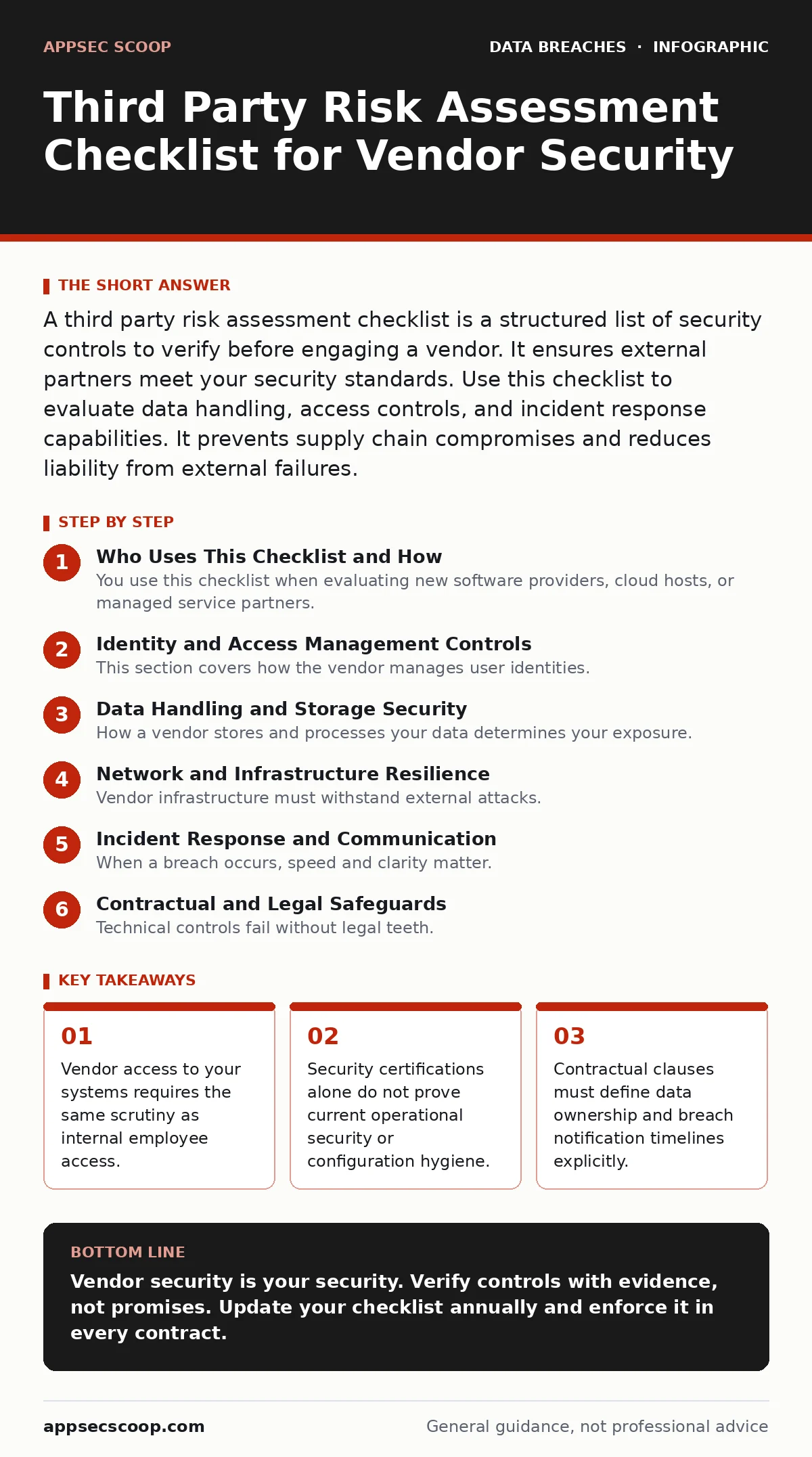
A third party risk assessment checklist is a structured list of security controls to verify before engaging a vendor. It ensures external partners meet your security standards. Use this checklist to evaluate data handling, access controls, and incident response capabilities. It prevents supply chain compromises and reduces liability from external failures.
Who Uses This Checklist and How
You use this checklist when evaluating new software providers, cloud hosts, or managed service partners. The goal is not to audit every line of their code, but to verify that their security posture matches your risk tolerance. A third party risk assessment checklist serves as a baseline for negotiation. It shifts the conversation from marketing claims to verifiable technical controls. You apply it before signing contracts and during annual reviews. It helps you identify gaps before they become incidents.
Identity and Access Management Controls
This section covers how the vendor manages user identities. Weak identity controls are the most common entry point for attackers. You must verify that the vendor enforces strict access boundaries.
- Multi-factor authentication requirement: Prevents credential theft from compromising administrative accounts.
- Principle of least privilege enforcement: Limits the damage an attacker can do if they gain access.
- Automated account provisioning and deprovisioning: Ensures former employees or contractors lose access immediately.
- Role-based access control documentation: Proves that access rights are tied to job functions, not personal preference.
- Regular access reviews: Catches privilege creep where users accumulate unnecessary permissions over time.
Data Handling and Storage Security
How a vendor stores and processes your data determines your exposure. If they lose control of your data, you lose control of your compliance status. You must understand where the data lives and how it is protected.
- Encryption at rest implementation: Protects data if physical storage media are stolen or lost.
- Encryption in transit protocols: Prevents interception of data moving between your systems and theirs.
- Data classification scheme: Ensures sensitive information receives stronger protection than public data.
- Clear data ownership clauses: Prevents vendors from claiming rights to your proprietary information.
- Secure deletion procedures: Guarantees data is unrecoverable when contracts end or records expire.
See our guide on data masking for techniques to reduce the value of data exposed during testing.
Network and Infrastructure Resilience
Vendor infrastructure must withstand external attacks. You need to know how they isolate your environment from others. Shared infrastructure increases the risk of cross-tenant leakage.
- Network segmentation strategy: Limits lateral movement if one part of their network is compromised.
- Intrusion detection and prevention systems: Identifies and blocks malicious traffic in real time.
- Vulnerability management process: Ensures known software flaws are patched before attackers exploit them.
- Disaster recovery testing frequency: Verifies that backup systems actually work during a crisis.
- Geographic data residency controls: Ensures data stays within jurisdictions you trust.
Refer to data sovereignty guidelines when selecting cloud regions for your vendors.
Incident Response and Communication
When a breach occurs, speed and clarity matter. You need to know how the vendor will alert you and what they will do. Silent breaches cause the most damage because you cannot contain the spread.
- Breach notification timeline: Defines how quickly you will be informed of a security incident.
- Incident response plan availability: Proves they have a structured approach to handling emergencies.
- Forensic investigation capabilities: Ensures they can determine the root cause of an attack.
- Customer support escalation path: Provides a direct line to security teams during a crisis.
- Post-incident reporting requirement: Forces transparency about what happened and how it was fixed.
Read about breach dwell time to understand why rapid detection is critical.
See also: How Typosquatting Works: The Step-by-Step Attack Lifecycle · Difference Between Data Breach and Data Exfiltration: The Operational Truth
Contractual and Legal Safeguards
Technical controls fail without legal teeth. Your contract must enforce security standards and define liabilities. Without these clauses, you have no recourse if the vendor fails to protect your data.
- Right to audit clause: Allows you to verify their security claims independently.
- Sub-processor approval requirement: Prevents them from outsourcing critical functions to unknown parties.
- Liability for data breaches: Defines financial responsibility if their negligence causes harm.
- Security addendum integration: Ensures security terms are legally binding, not just marketing promises.
- Termination for cause provision: Allows you to end the contract if security standards drop.
See data breach response plans for how to integrate vendor failures into your own procedures.
Continuous Monitoring and Review
Security is not a one-time event. Vendor risk changes as their business grows and threats evolve. You must monitor their performance continuously. Static assessments become outdated quickly.
- Quarterly security status reports: Provides regular updates on their security posture.
- Annual penetration testing results: Validates that their defenses work against real attacks.
- Change management process documentation: Ensures updates do not introduce new vulnerabilities.
- Employee security training records: Verifies that staff understand phishing and social engineering risks.
- Third-party certification validity: Confirms that their compliance badges are current and audited.
Check database security standards to ensure your vendor’s storage meets your expectations.
Common Pitfalls to Avoid
Many teams treat the checklist as a box-ticking exercise. This is dangerous. You must verify evidence, not just accept answers. A vendor can claim they have controls without proving they work.
Refer to unauthorized access patterns to recognise signs of weak internal controls.
Final Steps for Implementation
Integrate this checklist into your procurement workflow. Do not let vendors bypass it for speed. Security delays are cheaper than breach remediation. Update the checklist annually to reflect new threats. Share it with legal and engineering teams. Consistency is key. A third party risk assessment checklist is only effective if used every time.
See printed document leaks for physical security risks that digital checks often miss.
Key takeaways
- Vendor access to your systems requires the same scrutiny as internal employee access.
- Security certifications alone do not prove current operational security or configuration hygiene.
- Contractual clauses must define data ownership and breach notification timelines explicitly.
Vendor security is your security. Verify controls with evidence, not promises. Update your checklist annually and enforce it in every contract.
Frequently asked questions
How often should I review a vendor's security?
Review annually at minimum. Trigger immediate reviews after major incidents or significant changes to their service.
Can I trust a vendor's self-assessment questionnaire?
Self-assessments are a starting point. Always corroborate answers with independent audits or technical evidence.
What if a vendor refuses to answer some questions?
Treat refusal as a failure. High-risk questions require transparency. Consider alternative vendors if they withhold critical information.
Do I need to assess low-risk vendors?
Yes. Low-risk vendors can still access sensitive data or be used as a pivot point for attackers. Apply a scaled version of the checklist.
How this guide was produced: written by the AppSec Scoop editorial team with AI assistance, checked against the public references listed below, and reviewed when the facts change. See our editorial policy or report an error.