
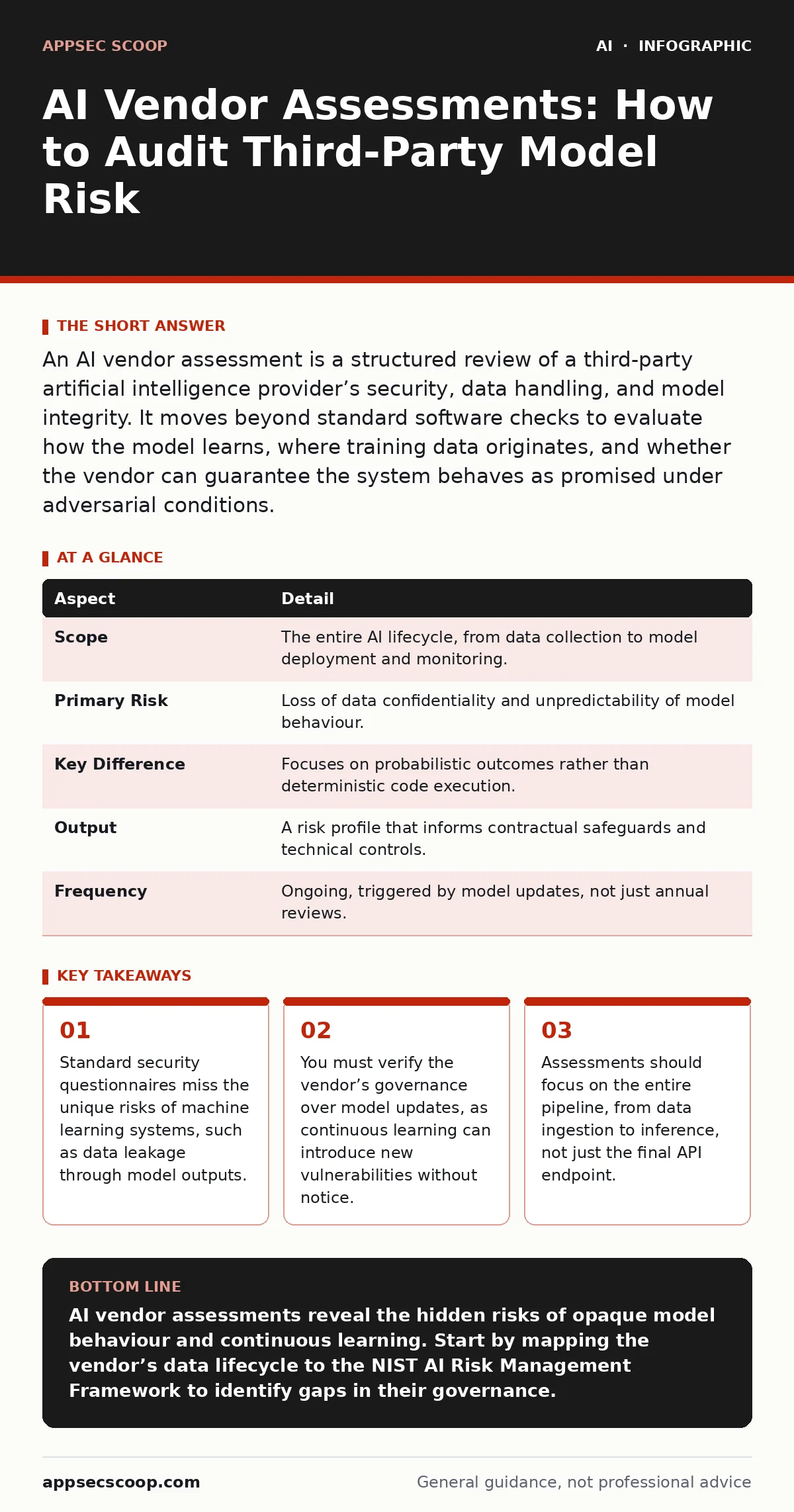
An AI vendor assessment is a structured review of a third-party artificial intelligence provider’s security, data handling, and model integrity. It moves beyond standard software checks to evaluate how the model learns, where training data originates, and whether the vendor can guarantee the system behaves as promised under adversarial conditions.
The Black Box Analogy
Imagine hiring a translator who refuses to show you their source texts. You trust them to convert documents accurately, but you have no idea if they are adding their own commentary, omitting sensitive details, or using your confidential files to improve their skill for other clients. This is the fundamental dilemma of adopting third-party artificial intelligence. You consume the output, but the mechanism that generates it remains opaque. Traditional software vendors provide documentation for every function. AI vendors often provide only an application programming interface, leaving the internal logic hidden.
What AI Vendor Assessments Actually Solve
The primary problem these assessments address is the loss of control. When you deploy a commercial AI model, you cannot inspect the code for vulnerabilities in the traditional sense. You cannot patch the model yourself. If the vendor updates the model, your application might suddenly behave differently, or the model might expose training data it was never meant to share. An AI vendor assessment establishes a baseline of trust. It forces the vendor to articulate their controls over data privacy, model integrity, and operational resilience. It shifts the burden of proof from your assumption of safety to their demonstrated compliance.
| Aspect | Detail |
|---|---|
| Scope | The entire AI lifecycle, from data collection to model deployment and monitoring. |
| Primary Risk | Loss of data confidentiality and unpredictability of model behaviour. |
| Key Difference | Focuses on probabilistic outcomes rather than deterministic code execution. |
| Output | A risk profile that informs contractual safeguards and technical controls. |
| Frequency | Ongoing, triggered by model updates, not just annual reviews. |
Beyond Standard Security Questionnaires
Most security teams begin with a standard vendor risk questionnaire. These forms ask about encryption, access controls, and incident response. They are necessary but insufficient for AI. They do not ask how the model handles adversarial inputs. They do not ask whether the training data contains personally identifiable information that could be reverse-engineered. You need to augment standard checks with questions specific to machine learning.
Ask about data retention policies after training. Ask how the vendor prevents model inversion attacks, where an attacker queries the system repeatedly to reconstruct the training data. Ask about the provenance of the data used to train the model. If the data is scraped from the public web, the model may have learned biases or copyrighted material that creates legal and reputational risk for you.
The Hidden Cost of Continuous Learning
Many vendors market their models as "continuously learning" systems. This implies the model improves over time by ingesting new data. For a security assessment, this is a red flag. A model that changes its behaviour without your knowledge is difficult to audit. You cannot certify a system that is constantly rewriting its own rules.
You must determine if the vendor uses a static model for inference, with periodic updates that you can review and test. If the model updates in real time, you lose the ability to predict its outputs. This unpredictability makes it hard to detect when the model has been compromised or is generating harmful content. The trade-off is clear: dynamic improvement versus static verifiability. Most enterprise security requirements favour the latter.
Mapping to Established Frameworks
You do not need to invent your own assessment criteria. Public frameworks provide a structured approach to evaluating AI risks. The NIST AI Risk Management Framework offers a comprehensive set of guidelines for managing AI risks across the lifecycle. It helps you categorise risks into four areas: mapping, measuring, managing, and governing. While the framework is extensive, you can extract specific controls relevant to vendor assessments.
For instance, the mapping function helps you identify where the vendor’s model intersects with your critical data. The measuring function helps you define what acceptable performance looks like, including safety thresholds. Referencing this framework in your assessment request signals to the vendor that you understand the nuance of AI risk, not just generic IT security.
See also: Training Data Leakage Explained: How AI Memorises Your Secrets · AI-Generated Phishing: Risks and Protection for Small Businesses
What People Usually Get Wrong
A common mistake is focusing solely on the model’s accuracy. Vendors will proudly share benchmark scores on standard datasets. These scores tell you nothing about security. A model can be highly accurate at summarising text while simultaneously leaking sensitive data from its training set. Another error is assuming that the vendor’s security team is responsible for AI-specific risks.
Traditional security teams often lack the expertise to evaluate machine learning threats. You must ask specifically who is responsible for model governance and whether they have dedicated resources for AI safety. Finally, many teams neglect the inference environment. Even if the model is secure, the API endpoint that serves it might be vulnerable to injection attacks or denial of service. The assessment must cover the infrastructure, not just the algorithm.
Integrating with Your Defence Strategy
AI vendor assessments do not replace your other security controls. They complement them. You still need to monitor network traffic, enforce least privilege access, and maintain incident response plans. However, the insights from an AI assessment change how you apply these controls. For example, knowing that a model might generate unexpected outputs means you should implement output filtering before the data reaches your users.
Knowing that the model might be vulnerable to prompt injection means you should treat untrusted input as hostile, even if it comes from a trusted vendor. This aligns with the broader shift towards machine learning in cybersecurity, where automated systems are used to detect threats, but also introduce new attack surfaces. You must assess the vendor as you would any other critical infrastructure provider, but with a deeper focus on data lineage and model behaviour.
The Role of Human Oversight
No assessment can guarantee that an AI model will never cause harm. Models are probabilistic, meaning they generate likely outputs, not certain ones. There will always be edge cases where the model fails. Your assessment should therefore include a review of the vendor’s human oversight mechanisms. Does the vendor have a process for reviewing flagged outputs? Can they quickly roll back a model update if it causes issues? Is there a clear channel for reporting safety concerns?
Human oversight is not a technical control, but it is a critical safety net. It ensures that when the model makes a mistake, there is a process to correct it. This is particularly relevant when considering issues like deepfake fraud or voice cloning scams, where the output of the model can be used to impersonate individuals. The vendor must demonstrate that they have safeguards against such misuse.
Final Considerations for Procurement
When you negotiate contracts with AI vendors, use the assessment findings to define specific service level agreements. Include clauses that require the vendor to notify you of any security incidents related to the model. Include requirements for regular security testing and reporting. Specify that you have the right to audit the vendor’s AI governance processes. These contractual safeguards provide a legal remedy if the vendor fails to meet their security obligations.
They also encourage the vendor to maintain high security standards, as they are financially liable for breaches. The goal is not to achieve perfect security, which is impossible, but to establish a clear line of responsibility and a mechanism for accountability. By treating AI vendors as critical partners rather than simple software providers, you reduce the risk of unexpected failures and data breaches.
Key takeaways
- Standard security questionnaires miss the unique risks of machine learning systems, such as data leakage through model outputs.
- You must verify the vendor’s governance over model updates, as continuous learning can introduce new vulnerabilities without notice.
- Assessments should focus on the entire pipeline, from data ingestion to inference, not just the final API endpoint.
AI vendor assessments reveal the hidden risks of opaque model behaviour and continuous learning. Start by mapping the vendor’s data lifecycle to the NIST AI Risk Management Framework to identify gaps in their governance.
Frequently asked questions
How often should I reassess an AI vendor?
Reassess annually and whenever the vendor releases a major model update. Continuous learning models require more frequent monitoring of output behaviour.
Can I use the MITRE ATLAS framework for vendor assessments?
Yes, MITRE ATLAS provides a catalogue of AI-specific adversary tactics. Use it to understand how attackers might exploit the vendor’s model and to check if the vendor has mitigations for these tactics.
What is the difference between AI content detection and vendor assessment?
AI content detection tools identify if content was generated by AI. Vendor assessments evaluate the security and reliability of the AI provider itself. They address different stages of the risk lifecycle.
Do I need to assess vendors for open-source models?
If you host the model yourself, you assess your own implementation. If you use a vendor-hosted open-source model, you assess the vendor’s infrastructure and data handling, not the model code itself.
How this guide was produced: written by the AppSec Scoop editorial team with AI assistance, checked against the public references listed below, and reviewed when the facts change. See our editorial policy or report an error.