
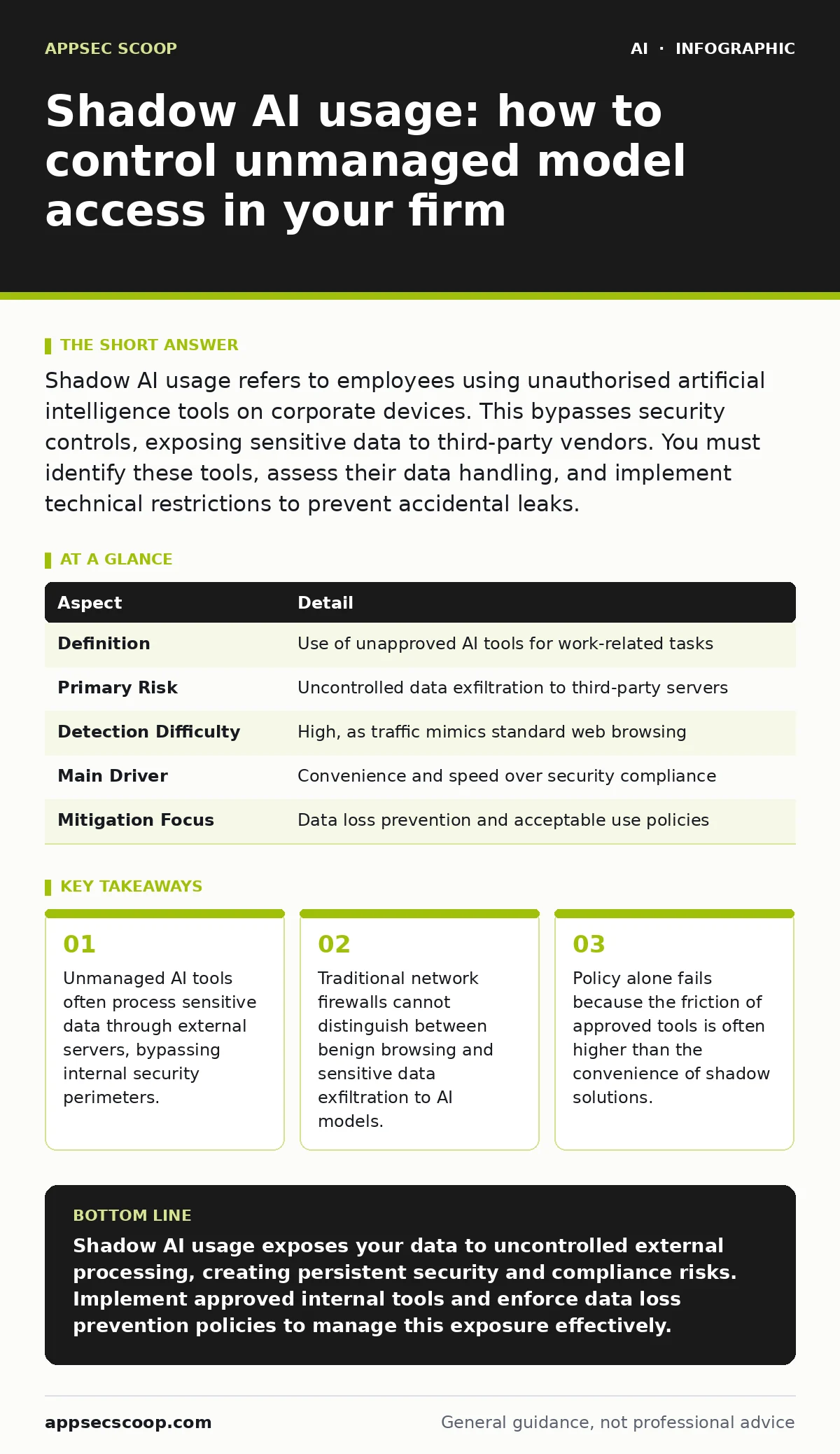
Shadow AI usage refers to employees using unauthorised artificial intelligence tools on corporate devices. This bypasses security controls, exposing sensitive data to third-party vendors. You must identify these tools, assess their data handling, and implement technical restrictions to prevent accidental leaks.
What is shadow AI usage
Shadow AI usage occurs when staff use artificial intelligence applications that lack official organisational approval or oversight. These tools operate outside the standard security framework, creating blind spots in data protection. The term extends beyond large language models to include any automated system that processes corporate data without explicit vendor assessment.
The core issue is data flow. When an employee pastes internal code, customer records or strategic plans into a public chat interface, that data often leaves the organisational network. The vendor may retain this input for model improvement, logging, or debugging. This creates a permanent external record of internal information that IT cannot audit, delete or monitor.
| Aspect | Detail |
|---|---|
| Definition | Use of unapproved AI tools for work-related tasks |
| Primary Risk | Uncontrolled data exfiltration to third-party servers |
| Detection Difficulty | High, as traffic mimics standard web browsing |
| Main Driver | Convenience and speed over security compliance |
| Mitigation Focus | Data loss prevention and acceptable use policies |
How shadow AI works in practice
The mechanism is straightforward but technically opaque to traditional security stacks. An employee accesses a web-based AI interface using a corporate browser. The browser encrypts the connection to the vendor’s server using standard HTTPS protocols. From the network’s perspective, this looks like routine web traffic. No deep packet inspection is usually performed on encrypted HTTPS streams due to privacy and performance constraints.
Imagine a developer struggling with a complex bug. Instead of consulting internal documentation, they copy the error log and relevant code snippets into a public coding assistant. The assistant provides a fix. The developer gains speed, but the vendor now possesses a copy of proprietary logic. The local endpoint logs show only a connection to a cloud service, not the content transmitted. This decoupling of context from traffic is the primary technical challenge.
Who is affected by unmanaged AI
The impact extends far beyond the individual user. The most immediate risk is intellectual property theft. Code, design documents and strategic plans become part of the vendor’s training corpus. This is not always malicious; it is often a default feature of free or low-cost tiers. The organisation loses exclusive rights to its own innovations.
Legal and compliance teams face significant exposure. Many industries have strict regulations regarding data residency and processing. Sending personal data to an unvetted AI provider may violate data protection laws. The organisation cannot guarantee the vendor’s security posture, their sub-processors or their data retention policies. This creates liability that is difficult to quantify until a breach occurs.
Security operations teams lose visibility. Traditional endpoint detection and response tools may flag the process, but they often lack the context to determine if the data being sent is sensitive. Without application-layer inspection, the security team is flying blind. This gap allows sensitive data to persist in external systems indefinitely, compounding the risk over time.
What people usually get wrong
Many organisations believe that banning AI tools is a sufficient control. This approach fails because it ignores the human factor. Employees will find ways to access these tools via personal devices or mobile data connections. Prohibition drives the behaviour underground, making it harder to detect and control. The tool becomes a black box, operating entirely outside the organisational perimeter.
Another common error is assuming that privacy settings are enough. Vendors often provide toggles to opt out of training data usage. However, these settings can be changed, misunderstood or overridden by account administrators. Furthermore, even if training is disabled, the data may still be logged for support, abuse detection or service improvement. Trusting a vendor’s privacy promise without independent verification is a significant risk.
How to detect shadow AI usage
Detection requires moving beyond simple URL blocking. Since many AI tools operate over standard HTTPS, you need application-aware filtering. This involves identifying the unique signatures of AI service providers at the network level. Look for connections to known AI infrastructure domains and cloud service provider APIs commonly used by these platforms.
Endpoint monitoring is equally critical. Look for unusual clipboard activity or high-volume text selections. Security tools can flag when large blocks of text are copied from internal applications and pasted into web browsers. This behaviour pattern is a strong indicator of potential data exfiltration. Combine this with process monitoring to identify unknown or unauthorised applications running on corporate devices.
Regular audits of cloud storage and collaboration platforms can also reveal AI usage. Employees may share AI-generated content in internal chats or documents. Searching for specific watermarks, formatting styles or disclaimers common to AI outputs can help identify where these tools are being used. This passive detection method provides a broader view of adoption patterns without relying solely on network logs.
See also: AI-Generated Phishing: Risks and Protection for Small Businesses · AI Vendor Assessments: How to Audit Third-Party Model Risk
What to do about shadow AI
The most effective strategy is to replace, not just restrict. Provide approved, secure AI tools that meet the same functional needs as the shadow alternatives. If the internal solution is easier to use and offers equivalent capabilities, employees will naturally migrate. This reduces the incentive to seek out unmanaged tools. Ensure the approved solution has clear data governance, such as no-training-by-default policies and local processing options.
Implement technical controls to enforce data handling policies. Data loss prevention solutions can be configured to block the transmission of sensitive patterns, such as code snippets or personally identifiable information, to external AI services. This creates a safety net that prevents accidental leaks even if an employee bypasses policy. Regularly update these rules to match the evolving landscape of AI providers and their endpoints.
Education must focus on the specific risks of data context. Explain how pasting internal context into public models creates external records. Use concrete examples to illustrate the potential consequences, such as intellectual property loss or regulatory fines. Make it clear that the organisation is providing tools to help, not just to hinder. This collaborative approach builds trust and encourages responsible usage.
Aligning with broader AI risk frameworks
Managing shadow AI is not an isolated task. It fits within the broader context of AI supply chain risks. Every external tool is a dependency that introduces potential vulnerabilities. Treat AI vendors with the same rigour as software suppliers. Evaluate their security practices, data handling procedures and incident response capabilities.
Consider the implications for deepfake fraud and AI-generated phishing. Unmanaged AI tools can be used to create sophisticated social engineering attacks. If employees are accustomed to using AI for content generation, they may be more likely to trust AI-generated communications from attackers. Training must address these adjacent threats to provide a holistic defence.
Refer to established frameworks like the NIST AI Risk Management Framework for structured guidance. These frameworks provide a systematic approach to identifying, assessing and mitigating AI risks. They help ensure that your controls are proportionate to the risk and aligned with industry best practices. This structured approach is more sustainable than ad-hoc reactions to emerging tools.
Key takeaways
- Unmanaged AI tools often process sensitive data through external servers, bypassing internal security perimeters.
- Traditional network firewalls cannot distinguish between benign browsing and sensitive data exfiltration to AI models.
- Policy alone fails because the friction of approved tools is often higher than the convenience of shadow solutions.
Shadow AI usage exposes your data to uncontrolled external processing, creating persistent security and compliance risks. Implement approved internal tools and enforce data loss prevention policies to manage this exposure effectively.
Frequently asked questions
Can I use a personal AI account for work if I don't paste sensitive data?
This is risky because you may misjudge what constitutes sensitive data. Contextual information can be as valuable as explicit secrets. Use only approved organisational accounts to ensure consistent security controls.
How do I block AI tools without disrupting normal work?
Use application-aware filtering to block specific AI services while allowing general web access. Combine this with data loss prevention to stop sensitive data from leaving the network, rather than blocking all outbound traffic.
What is the difference between shadow AI and rogue AI?
Shadow AI refers to unapproved but potentially benign tools used by employees. Rogue AI implies malicious intent or tools designed to cause harm. Both pose security risks, but shadow AI is primarily a data governance issue.
Does using an enterprise AI plan eliminate shadow AI risks?
Not entirely. Employees may still use other unapproved tools for specific tasks not covered by the enterprise solution. Continuous monitoring and regular user education are necessary to maintain control over AI usage.
How this guide was produced: written by the AppSec Scoop editorial team with AI assistance, checked against the public references listed below, and reviewed when the facts change. See our editorial policy or report an error.