
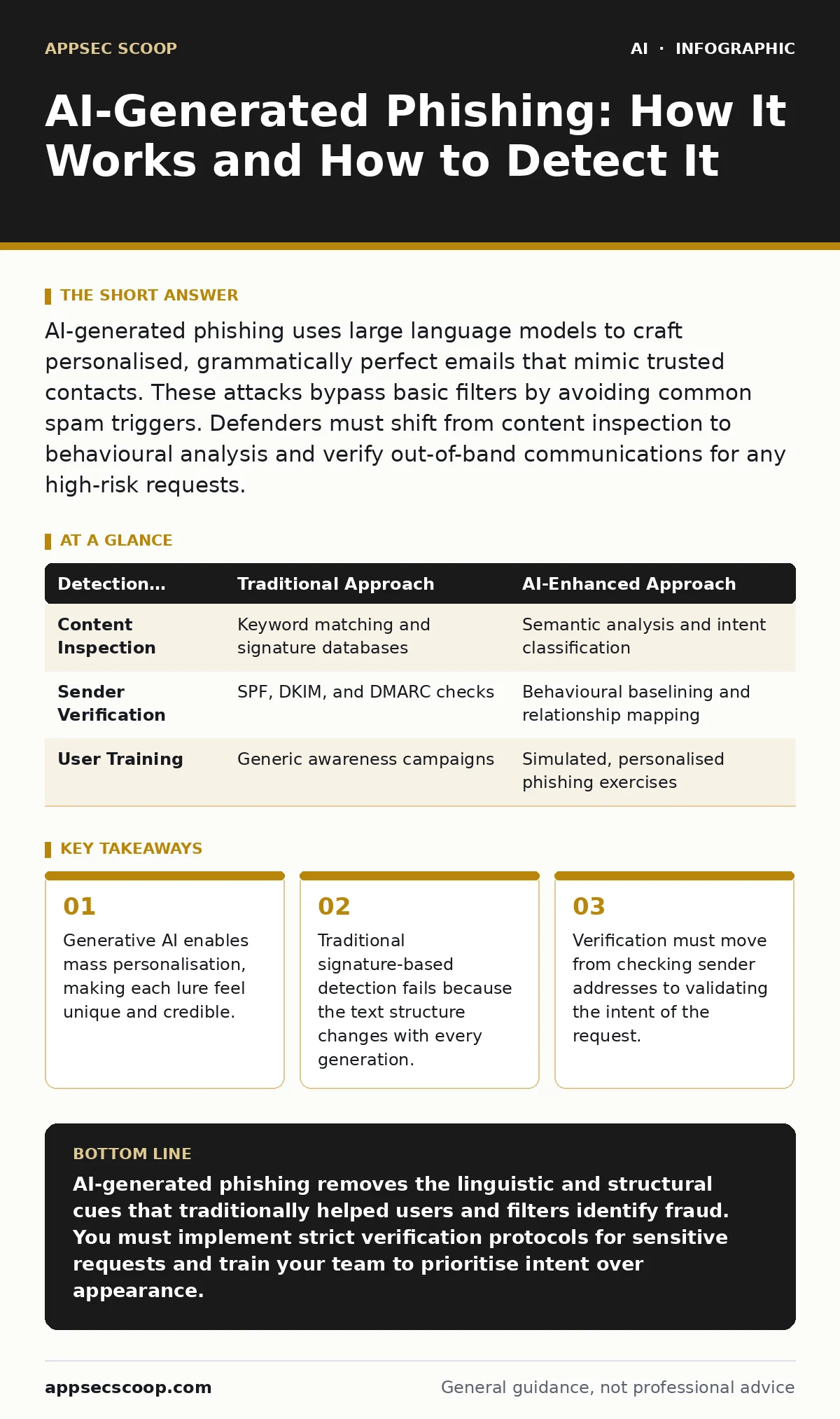
AI-generated phishing uses large language models to craft personalised, grammatically perfect emails that mimic trusted contacts. These attacks bypass basic filters by avoiding common spam triggers. Defenders must shift from content inspection to behavioural analysis and verify out-of-band communications for any high-risk requests.
What makes AI-generated phishing different from traditional spam?
Traditional spam relies on broad, generic templates with poor grammar and urgent, generic threats. AI-generated phishing uses large language models to create bespoke messages tailored to the recipient’s role, recent activities, or known contacts. This personalisation removes the obvious linguistic errors that users and filters traditionally rely upon to identify fraud. The result is a lure that reads naturally and aligns with the victim’s immediate context.
Can AI write code for phishing pages?
Yes, generative models can produce functional HTML, CSS, and JavaScript that replicate the visual identity of legitimate login portals. These models understand design patterns and can clone the aesthetic of banking or cloud service interfaces without human intervention. The generated code often includes obfuscation techniques to hide malicious scripts from static analysis tools. This lowers the barrier for attackers who lack web development skills to create convincing fake sites.
How does this affect email security gateways?
Email security gateways often struggle because they depend on known bad indicators, such as blacklisted domains or specific malicious strings. AI-generated content is novel; it does not match existing signatures in threat intelligence databases. The text is syntactically correct and semantically coherent, which reduces its spam score. Defenders must supplement signature matching with semantic analysis that evaluates the intent and context of the message rather than just its keywords.
Does AI improve the targeting of social engineering?
AI allows attackers to analyse public data from social media and corporate directories to build detailed profiles of targets. This data informs the generation of messages that reference specific projects, colleagues, or recent events. The attack becomes a conversation starter rather than a generic broadcast. This technique, known as spear phishing, gains significant credibility when the attacker demonstrates knowledge of internal workflows or personal details.
How do generative models bypass spam filters?
Spam filters look for patterns associated with known malicious campaigns, such as specific phrases or formatting anomalies. Generative models can paraphrase malicious intent using varied vocabulary and sentence structures while preserving the core request. This variation ensures that each email appears statistically unique to the filter. The model can also adjust the tone to match the expected communication style of the purported sender, further evading heuristic detection.
See also: Callback Phishing: Risks and Protection for Small Businesses · Implement Email Attachment Scanning: A Step-by-Step Technical Guide
What is the role of image generation in these attacks?
Adversaries use image generation models to create fake headshots or logos for fake employee profiles or company pages. These images appear realistic but contain subtle artefacts, such as inconsistent lighting or distorted background elements. Attackers embed these images in phishing emails to lend visual credibility to the sender’s identity. Verifying the authenticity of profile pictures requires more than a casual glance, as the fidelity is often high enough to deceive human observers.
How can defenders detect these sophisticated lures?
Detection requires a shift from inspecting the content to analysing the behaviour and context of the communication. Security teams should monitor for anomalies in sender behaviour, such as unexpected requests for credentials or financial data. Implementing strict verification protocols for high-risk actions, such as wire transfers or password resets, adds a layer of defence. These protocols should require out-of-band confirmation through a separate communication channel.
| Detection Method | Traditional Approach | AI-Enhanced Approach |
|---|---|---|
| Content Inspection | Keyword matching and signature databases | Semantic analysis and intent classification |
| Sender Verification | SPF, DKIM, and DMARC checks | Behavioural baselining and relationship mapping |
| User Training | Generic awareness campaigns | Simulated, personalised phishing exercises |
Why is user training less effective now?
Traditional training teaches users to spot red flags like poor grammar or suspicious links. AI-generated phishing removes these cues, making the lures indistinguishable from legitimate communications to the untrained eye. Relying on user vigilance alone is insufficient because the cognitive load required to verify every request is too high. Training must evolve to emphasise verification procedures rather than just identification of suspicious content.
How does this relate to broader AI security risks?
The ability to generate persuasive text is one facet of a larger set of risks involving artificial intelligence. Understanding how tokens in language models function helps explain why models can be prompted to produce varied outputs. Similarly, training data leakage can expose sensitive information that attackers use to craft more convincing lures. The intersection of these risks highlights the need for a holistic approach to AI security, as discussed in our guide on sensitive data leaks through AI chatbots.
What is the long-term outlook for phishing defence?
The arms race between attackers and defenders will continue as AI capabilities improve. Defenders will increasingly use AI to detect anomalies in communication patterns and user behaviour. This mirrors the use of machine learning in cybersecurity for threat detection, but applied specifically to the social engineering vector. The focus will shift towards zero-trust architectures where no communication is trusted by default, regardless of its source or content.
Key takeaways
- Generative AI enables mass personalisation, making each lure feel unique and credible.
- Traditional signature-based detection fails because the text structure changes with every generation.
- Verification must move from checking sender addresses to validating the intent of the request.
AI-generated phishing removes the linguistic and structural cues that traditionally helped users and filters identify fraud. You must implement strict verification protocols for sensitive requests and train your team to prioritise intent over appearance.
Frequently asked questions
Can AI detect AI-generated phishing emails?
Yes, but it requires advanced semantic analysis rather than simple keyword matching. The detection model must understand the context and intent of the message to identify subtle manipulations.
Is it possible to watermark AI-generated text?
Some providers implement invisible watermarks, but these can be removed or bypassed by attackers. Relying on watermarks for security is unreliable as they are not a standard feature across all models.
How do I verify a suspicious email from a colleague?
Contact the sender through a different channel, such as a phone call or an internal messaging platform. Do not reply to the email or click any links within it until the request is confirmed.
Does using AI for phishing detection increase false positives?
It can, if the model is not properly tuned. Overly sensitive semantic analysis may flag legitimate urgent communications as malicious. Regular tuning and human review are necessary to balance security and usability.
How this guide was produced: written by the AppSec Scoop editorial team with AI assistance, checked against the public references listed below, and reviewed when the facts change. See our editorial policy or report an error.