
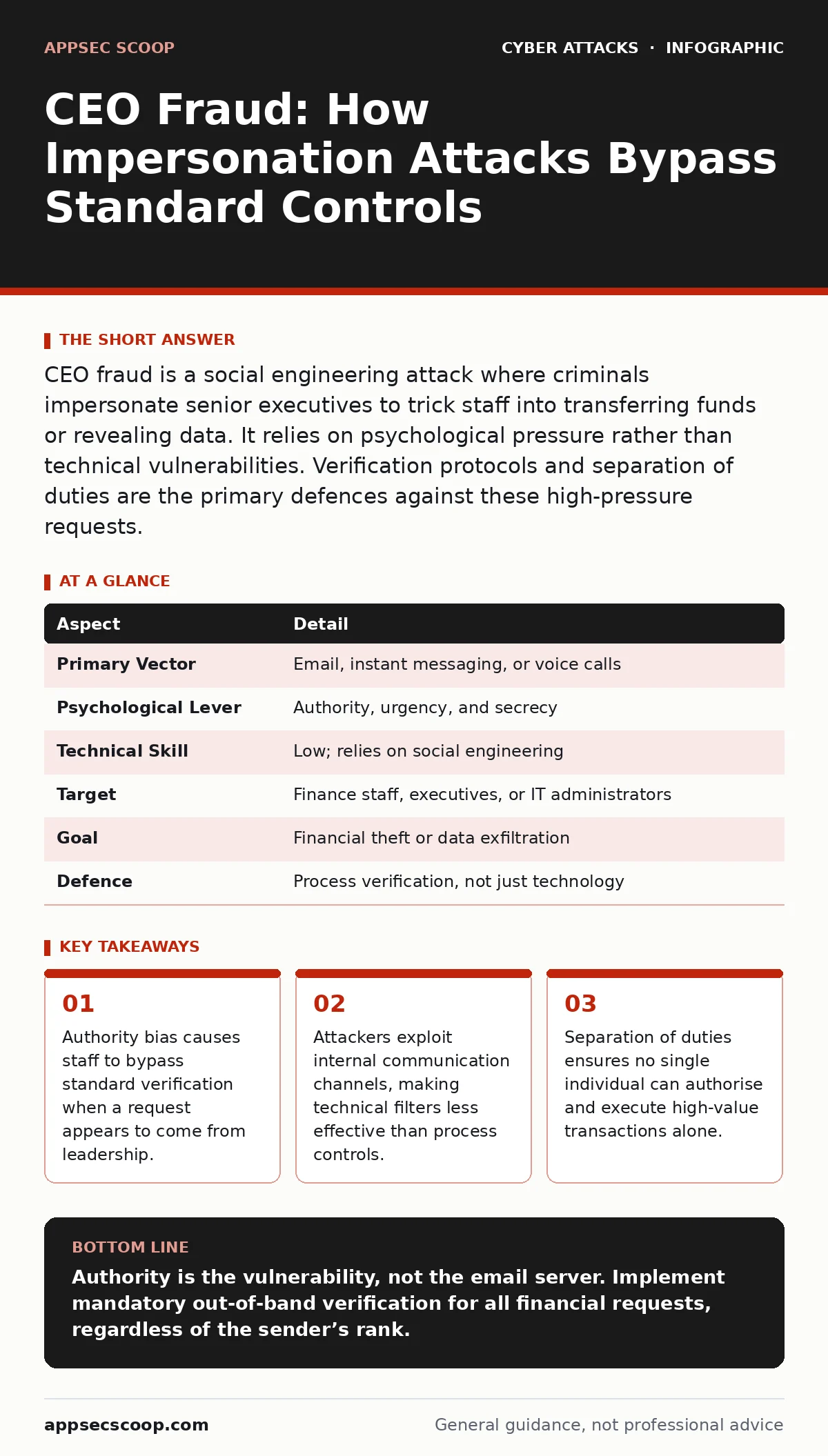
CEO fraud is a social engineering attack where criminals impersonate senior executives to trick staff into transferring funds or revealing data. It relies on psychological pressure rather than technical vulnerabilities. Verification protocols and separation of duties are the primary defences against these high-pressure requests.
The Illusion of Authority
Imagine receiving a request from your manager to complete an urgent task. You act quickly because you trust the source. Now imagine that request came from a stranger who merely copied your manager’s email signature. This is the core mechanism of CEO fraud, also known as business email compromise. It is not a technical hack. It is a manipulation of human psychology and organisational hierarchy.
The attacker does not need to break into your network. They only need to convince you that they are someone you obey. This distinction matters because traditional security tools often look for malicious code or unusual network traffic. They rarely flag a polite request for a wire transfer, even if it is fraudulent. The threat is invisible to machines that only understand data, not context.
| Aspect | Detail |
|---|---|
| Primary Vector | Email, instant messaging, or voice calls |
| Psychological Lever | Authority, urgency, and secrecy |
| Technical Skill | Low; relies on social engineering |
| Target | Finance staff, executives, or IT administrators |
| Goal | Financial theft or data exfiltration |
| Defence | Process verification, not just technology |
How the Manipulation Works
The attack begins with reconnaissance. The attacker gathers information about your company’s structure, naming conventions, and recent activities. This data is often public. Press releases, social media profiles, and conference listings provide enough detail to construct a convincing persona. The attacker then creates a look-alike email address or spoofs an existing one.
Spoofing involves manipulating the header of an email to make it appear as if it originated from a trusted domain. Many email servers accept these messages because the technical validation passes. The attacker then sends a message that creates a sense of urgency. They might claim a vendor is waiting for payment or that a legal deadline is approaching. This urgency discourages you from following standard verification procedures.
The request usually involves a deviation from normal workflow. Perhaps the executive asks for a gift card purchase instead of a bank transfer. Or they ask you to bypass the usual approval chain because they are in a meeting. These deviations are the red flags. They signal that the request is outside the established safety boundaries of your organisation.
Common Variations of the Attack
While the core premise remains the same, the execution varies. In email-based attacks, the attacker sends a direct message to the finance department. They often use a subject line that references a real project or invoice. This makes the request blend in with legitimate business correspondence. The attacker may also reply to an existing email thread, which increases the perceived legitimacy of the request.
Phone-based variants, sometimes called vishing, involve the attacker calling an employee. They may use caller ID spoofing to display the executive’s number. This adds a layer of realism that is difficult to challenge. The attacker might ask the employee to stay on the line while they "transfer" the call to the executive, who is actually another attacker. This creates a seamless narrative that reinforces the authority of the request.
Instant messaging platforms are increasingly used for these attacks. The informal nature of chat reduces the likelihood of formal verification. An attacker might send a message from a compromised executive account, asking for immediate action. The speed of the conversation leaves little time for reflection. This format exploits the casual trust that exists in daily workplace communication.
Who Is Vulnerable
Any organisation with a hierarchical structure is a target. Small businesses are often preferred because they have fewer controls and less complex verification processes. A request from the owner or director carries significant weight. Employees are less likely to question the boss in a small team than in a large corporation with multiple layers of management.
However, large enterprises are not immune. The volume of communications in large organisations creates noise. Legitimate requests from executives are frequent, so employees develop a habit of compliance. This habit becomes a vulnerability. Attackers exploit the expectation that senior leaders are busy and unavailable for verification. They count on the staff’s reluctance to interrupt a superior.
Remote work environments increase the risk. When teams are dispersed, face-to-face verification is impossible. Communication happens through digital channels, which are easier to spoof. The lack of physical presence removes a natural layer of security. You cannot see the executive’s hesitation or hear the accent that might reveal a fraudster.
What People Usually Get Wrong
Many organisations believe that technical filters are sufficient. They invest in advanced email security gateways that scan for malware and phishing links. These tools are useful for stopping malicious email attachments, but they do not stop a plain text request for money. The content of a CEO fraud email is often harmless. It contains no links, no attachments, and no malicious code. It is just a request.
Another common mistake is relying on staff awareness alone. Training sessions teach employees to look for spelling errors or unusual signatures. Sophisticated attackers do not make these mistakes. They use clean, professional language. They mimic the executive’s tone and style. Expecting staff to spot subtle inconsistencies under pressure is unrealistic. The psychological pressure of authority overrides the training.
Some teams assume that if the email arrives in the inbox, it is legitimate. They do not check the actual sender address. Many email clients hide the full address, showing only the display name. A message from "John Smith" might actually come from "[email protected]". This slight difference is easy to miss, especially when the recipient is rushing to comply with an urgent request.
See also: Callback Phishing: Risks and Protection for Small Businesses · Implement Email Attachment Scanning: A Step-by-Step Technical Guide
Reducing the Risk Through Process
The most effective defence is procedural. Establish a verification protocol for all financial transactions and sensitive data requests. This protocol should require out-of-band verification. If a request comes via email, verify it via phone. If it comes via phone, verify it via email or in person. Use a known, trusted contact method, not one provided in the request.
Separation of duties is critical. No single individual should have the authority to both initiate and approve a payment. This ensures that even if one person is manipulated, the transaction cannot proceed without a second party’s involvement. The second party provides a fresh perspective, free from the pressure applied to the first.
Regular tabletop exercises can help teams practice these responses. Simulate a CEO fraud scenario during a meeting. Discuss how the team would react, what questions they would ask, and how they would verify the request. This builds muscle memory for the correct response. It reduces the panic and hesitation that attackers exploit.
Integrating with Broader Security
CEO fraud is part of a larger ecosystem of social engineering. It often overlaps with spear phishing, where attackers target specific individuals with tailored messages. Understanding the techniques used in spear phishing can help you recognise the early stages of a CEO fraud attempt. Both rely on detailed knowledge of the target.
Maintaining good cyber hygiene reduces the overall attack surface. This includes keeping software updated, using strong authentication, and monitoring account activity. While these measures do not stop social engineering, they prevent attackers from gaining the initial access needed for more sophisticated attacks. A secure environment makes it harder for attackers to gather the intelligence they need.
Intrusion detection systems can alert you to unusual email patterns, such as a sudden spike in messages from an executive account. These alerts can serve as an early warning. However, they are not a substitute for human verification. The technology flags the anomaly; the process resolves it. Combining technical alerts with strict procedures creates a layered defence.
Key takeaways
- Authority bias causes staff to bypass standard verification when a request appears to come from leadership.
- Attackers exploit internal communication channels, making technical filters less effective than process controls.
- Separation of duties ensures no single individual can authorise and execute high-value transactions alone.
Authority is the vulnerability, not the email server. Implement mandatory out-of-band verification for all financial requests, regardless of the sender’s rank.
Frequently asked questions
Can email encryption prevent CEO fraud?
No. Encryption protects the content of the message during transit. It does not verify the identity of the sender or the legitimacy of the request. A fraudulent request can be encrypted just as easily as a legitimate one.
What should I do if I suspect a request is fake?
Stop the process immediately. Do not respond to the request. Contact the purported sender through a known, trusted channel, such as a phone number from your internal directory. Verify the request directly with them.
Is it safe to use the reply function to verify?
No. Replying to the suspicious message may send your response to the attacker. Always use a separate communication channel to verify. Use a phone number or email address that you have previously confirmed as belonging to the executive.
How often should we update our verification procedures?
Review and test your procedures regularly. Social engineering tactics evolve. Regular reviews ensure that your protocols remain effective against new methods. Conduct tabletop exercises at least annually to keep the team prepared.
How this guide was produced: written by the AppSec Scoop editorial team with AI assistance, checked against the public references listed below, and reviewed when the facts change. See our editorial policy or report an error.