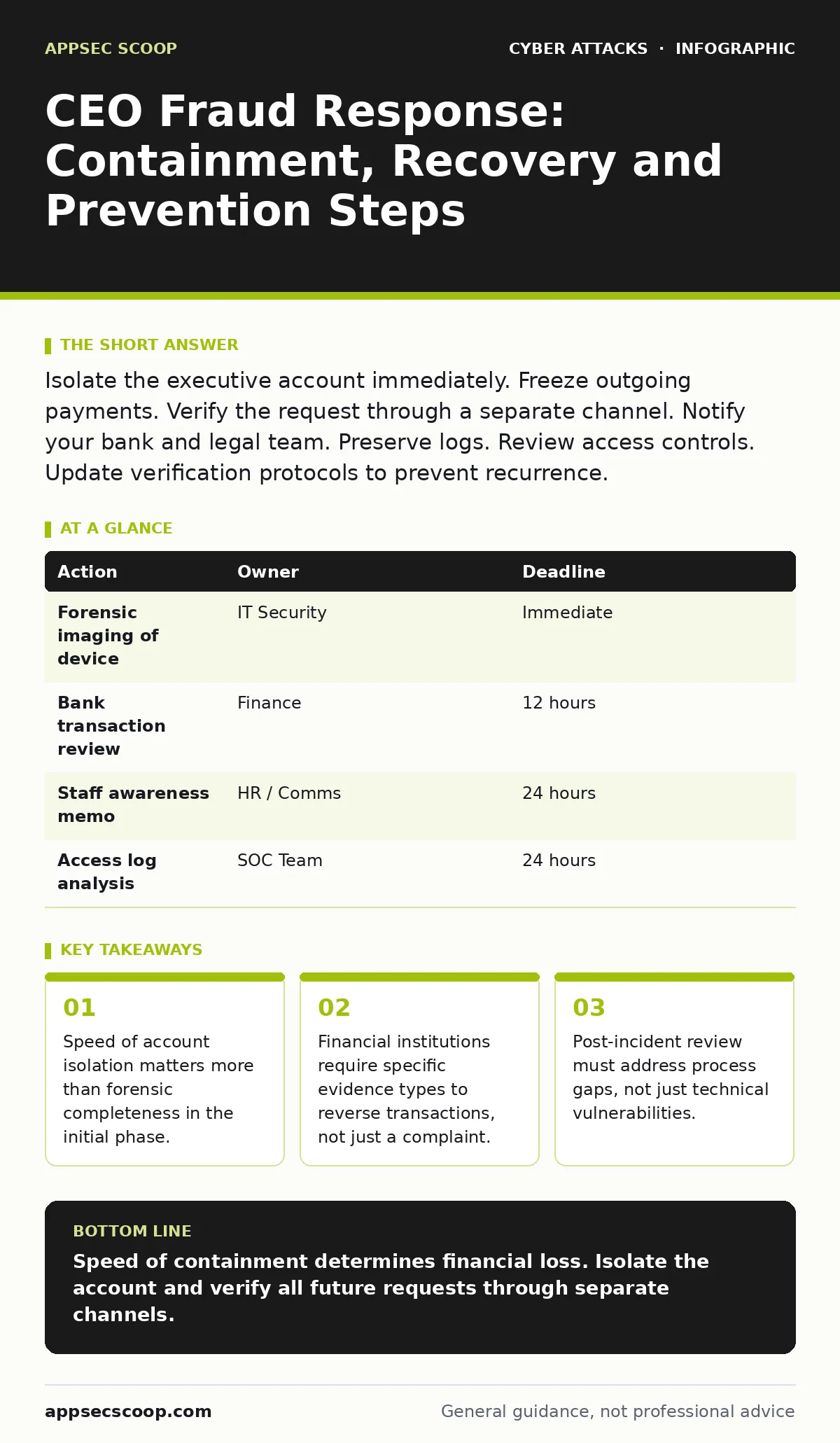
Isolate the executive account immediately. Freeze outgoing payments. Verify the request through a separate channel. Notify your bank and legal team. Preserve logs. Review access controls. Update verification protocols to prevent recurrence.
### First hour
The initial response determines whether you lose money or merely data. You must act before the attacker moves funds to a secondary account or offshore wallet.
- Identify the compromised executive account.
- Disable the account credentials and force a password reset.
- Block all outgoing email from that account.
- Notify the finance department to halt all pending transfers.
- Contact your primary banking relationship to flag the account.
- Preserve email headers and transaction logs.
You need to determine the scope of the breach. Did the attacker access only email, or did they compromise the entire workstation? If the attack involved spear phishing, the attacker may have established persistence on the device. This means they can return even after you change the password. You must treat the device as hostile until proven otherwise.
Check for unusual login locations. Most identity providers log the geographic origin of access. A login from a country where the executive has no business ties is a strong indicator of compromise. Do not rely on the content of the email alone. Attackers use AI to mimic tone and style perfectly. The vector is often callback phishing, where they trick the victim into revealing credentials rather than guessing them.
### First day
You have stopped the immediate bleed. Now you must assess the damage and begin containment. The attacker may have accessed other systems using the stolen credentials.
Review the executive’s calendar and file access logs. Attackers often look for sensitive documents to support future extortion or further fraud. Check for new administrators or service accounts created in the last 24 hours. These are often backdoors for persistent access.
If you use endpoint protection, run a full scan on the compromised device. Look for unusual processes or scheduled tasks. These indicators may reveal malware that survived the initial password change. Do not assume the threat is gone because the email is blocked. The attacker may have accessed shared drives or cloud storage.
Coordinate with your legal counsel. They will advise on regulatory notification requirements. Some jurisdictions mandate reporting within a specific timeframe. Legal teams also guide communication with shareholders and clients. Transparency is difficult, but silence can lead to greater liability.
| Action | Owner | Deadline |
|---|---|---|
| Forensic imaging of device | IT Security | Immediate |
| Bank transaction review | Finance | 12 hours |
| Staff awareness memo | HR / Comms | 24 hours |
| Access log analysis | SOC Team | 24 hours |
You must also consider the human element. The executive may feel embarrassed or ashamed. This can lead to delays in reporting. Foster a culture where reporting incidents is safe. If staff fear blame, they will hide future incidents, allowing attackers more time to operate.
### First week
Recovery begins once containment is confirmed. You must restore access securely and review your defenses. The goal is to prevent a repeat attack while maintaining business continuity.
Reset all credentials for the compromised executive. This includes email, CRM, ERP and any other systems. Do not reuse old passwords. Use a password manager to generate unique, complex credentials. Enable multi-factor authentication if it is not already active. This adds a layer of security that passwords alone cannot provide.
Review your email security settings. Many attacks succeed because of misconfigured rules. Attackers may have created forwarding rules to send copies of all emails to an external address. Check for these rules in both the web interface and the client application. Delete any unfamiliar rules.
Conduct a thorough review of your cyber hygiene. This includes patching systems, updating antivirus definitions and reviewing user permissions. Attackers exploit weak points. A single unpatched system can compromise the entire network.
| System | Action | Status |
|---|---|---|
| Email Server | Audit forwarding rules | Complete |
| Cloud Storage | Review shared links | In Progress |
| User Accounts | Remove unused privileges | Pending |
You should also review your vendor list. Did the attacker compromise a third party to reach the executive? If so, you need to notify that vendor. They may have other clients at risk. Supply chain attacks are common. A weak link in a partner’s security can become your weakness.
Who to tell
Communication is critical. You must inform the right people at the right time. Silence can be interpreted as negligence.
Tell the executive’s direct reports. They need to know not to trust emails from their boss until further notice. Tell the finance team. They are the gatekeepers of your money. Tell your legal team. They manage liability and regulatory compliance.
Do not broadcast the incident to all staff immediately. This can cause panic and make social engineering easier. Attackers may use the news of a breach to send fake "security update" emails. Instead, send a targeted advisory to those who interact with the executive or handle finances.
Consider notifying your insurance provider. Cyber insurance policies often have strict reporting deadlines. Failure to report within the window can void coverage. Check your policy terms before making public statements.
How to stop a repeat
Technical fixes are necessary but insufficient. You must change how your organisation verifies requests.
Implement a dual-approval process for high-value transactions. No single person should be able to authorise large payments. This creates a check and balance. If one person is compromised, the other can stop the transfer.
Use out-of-band verification. If an executive requests a wire transfer via email, verify it via phone or in person. Do not use the phone number in the email. Use a known, trusted number. This defeats the attacker’s ability to spoof the request.
Regularly test your procedures with tabletop exercises. These simulations help teams practice their response under pressure. They reveal gaps in communication and decision-making. You will learn where the process breaks down before a real attack occurs.
Be aware of HTML smuggling. Attackers embed payloads in HTML that are only visible in certain browsers. Standard email filters may miss these. Ensure your email gateway inspects HTML content deeply.
See also: How Malicious Email Attachments Work: The Execution Chain
Lessons for the future
Every incident is a learning opportunity. Document what happened, what worked and what failed.
Review your intrusion detection systems. Did they alert on the suspicious activity? If not, tune the rules. If yes, why was the alert ignored? False positives lead to alert fatigue. Staff stop looking at alerts if they are mostly noise.
Train staff to recognise the signs of CEO fraud. This includes urgency, secrecy and requests for deviation from normal procedure. Attackers create a sense of emergency to bypass normal controls. Train staff to pause and verify.
Remember that technology alone cannot stop social engineering. The human element is always the weakest link. Combine technical controls with strong policies and regular training. This layered approach reduces risk significantly.
Key takeaways
- Speed of account isolation matters more than forensic completeness in the initial phase.
- Financial institutions require specific evidence types to reverse transactions, not just a complaint.
- Post-incident review must address process gaps, not just technical vulnerabilities.
Speed of containment determines financial loss. Isolate the account and verify all future requests through separate channels.
Frequently asked questions
How long does it take to recover from CEO fraud?
Technical recovery takes days. Financial recovery can take weeks or months, depending on the bank and legal proceedings.
Can we get the money back?
Sometimes. Banks may reverse transactions if notified quickly, but there is no guarantee. Legal action is often required.
How this guide was produced: written by the AppSec Scoop editorial team with AI assistance, checked against the public references listed below, and reviewed when the facts change. See our editorial policy or report an error.