
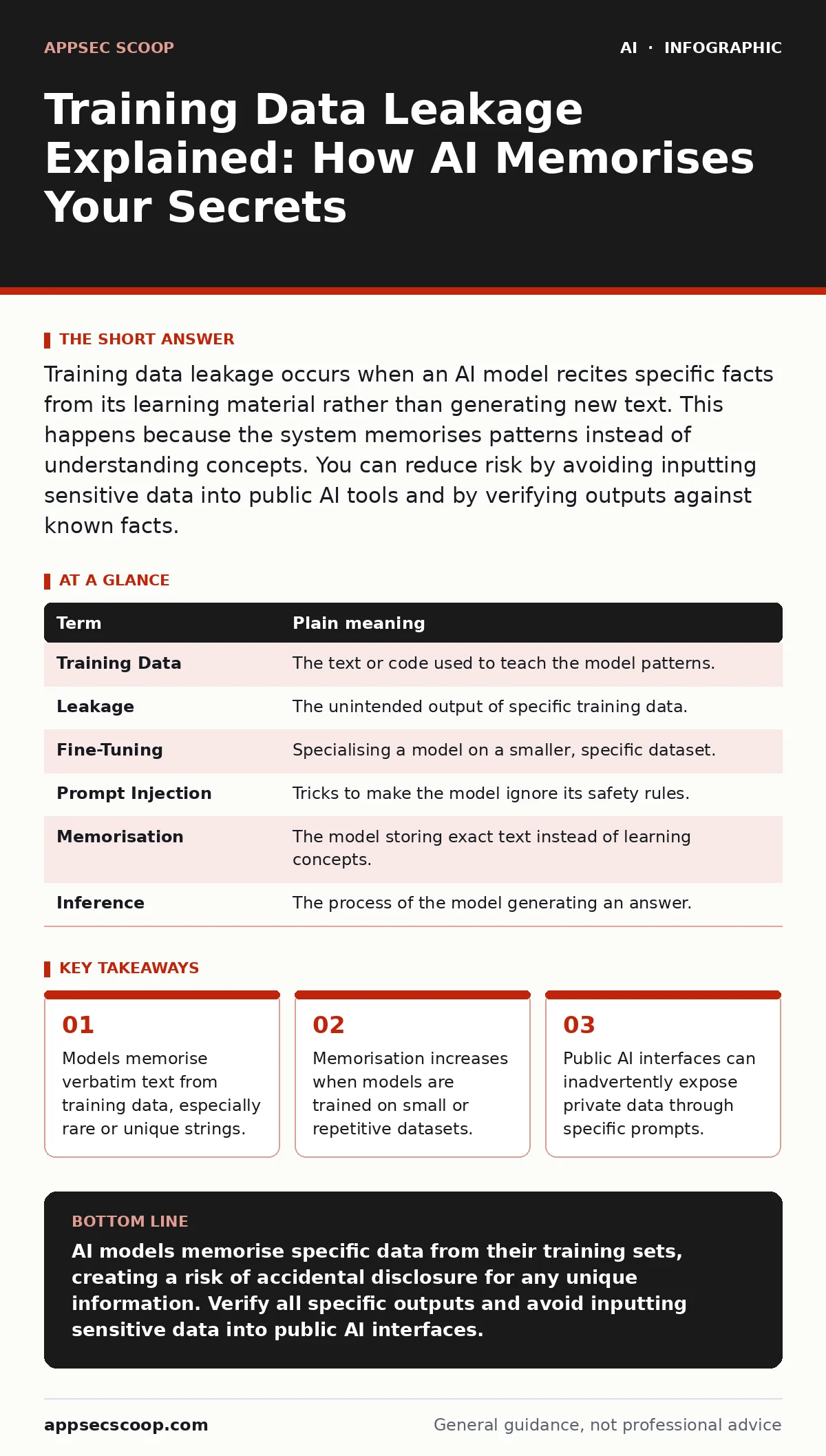
Training data leakage occurs when an AI model recites specific facts from its learning material rather than generating new text. This happens because the system memorises patterns instead of understanding concepts. You can reduce risk by avoiding inputting sensitive data into public AI tools and by verifying outputs against known facts.
The Library That Never Forgets
Imagine a student preparing for an exam by reading thousands of books. Most students understand the concepts and write answers in their own words. Some students, however, copy entire paragraphs from the textbooks. If you ask the copying student a very specific question about a obscure footnote, they might recite the exact sentence. They did not understand the context. They simply repeated what they had seen.
This is how training data leakage works. The AI model is the student. The internet and corporate documents are the textbooks. When the model outputs information it has memorised rather than synthesised, you have a leakage event.
How Memorisation Happens
Large language models learn by predicting the next word in a sequence. They process vast amounts of text to find statistical patterns. Ideally, they learn the structure of language and general knowledge. In practice, they also memorise specific sequences of words that appear frequently or are unique in the training data.
This is not a bug in the traditional sense. It is a side effect of how neural networks optimise for accuracy. The model lowers its error rate by remembering exact matches. If a particular email address or code snippet appears in the training data without sufficient variation, the model treats it as a fact to be recalled, not a pattern to be abstracted.
The Role of Fine-Tuning
Fine-tuning is the process of adapting a general model to a specific task using a smaller, specialised dataset. This is where leakage risks concentrate. A general model trained on the whole web has diluted memory of any single document. A model fine-tuned on internal company logs has high exposure to those logs.
Suppose you fine-tune a model on customer support tickets to automate responses. The model sees thousands of tickets containing names, addresses and complaint details. It learns to answer questions by mimicking these tickets. If you ask it to "write a sample ticket," it may output a real one. The model does not distinguish between a template and a record. It only sees probability.
| Term | Plain meaning |
|---|---|
| Training Data | The text or code used to teach the model patterns. |
| Leakage | The unintended output of specific training data. |
| Fine-Tuning | Specialising a model on a smaller, specific dataset. |
| Prompt Injection | Tricks to make the model ignore its safety rules. |
| Memorisation | The model storing exact text instead of learning concepts. |
| Inference | The process of the model generating an answer. |
Why Ordinary Users Are Exposed
You might think leakage only affects corporations. It affects anyone who uses public AI services. These services often use data collected from the open web. That web includes forums, bug bounty reports and leaked databases. If your personal details were part of a past breach that ended up in a training dataset, a model might be able to recite them.
This is not the same as AI-generated phishing or deepfake fraud. Those are active attacks. Leakage is a passive risk. It is the system handing you information it should have forgotten. The danger lies in the assumption that the AI generates new content. It often just rearranges old content. If that old content contains private secrets, those secrets become visible.
The Hidden Cost of Safety
Developers try to prevent leakage by filtering outputs or removing sensitive data from training sets. This has a hidden cost. Removing data reduces the model's ability to learn certain patterns. If you remove all phone numbers, the model may struggle to understand text that discusses phone numbers. You trade safety for capability.
This is a key insight for security teams. You cannot simply sanitize data and expect normal performance. The model needs enough context to understand the structure of the information. If you strip too much, the model becomes useless. If you strip too little, it leaks. Finding the balance requires rigorous testing, not just good intentions.
See also: AI-Generated Phishing: Risks and Protection for Small Businesses · AI Vendor Assessments: How to Audit Third-Party Model Risk
Simple Safety Habits
You can protect yourself with three simple steps. These do not require technical expertise. They require a change in how you interact with AI tools.
- Treat public AI inputs as public broadcasts. Do not paste code, logs or personal details into free online chatbots. Assume everything you type is added to a future training set.
- Verify specific outputs. If the model gives you a specific fact, code snippet or contact detail, check it against your own sources. Do not trust the model's confidence. It is often confident in its errors.
- Use local or private instances for sensitive work. If you must use AI with private data, ensure the provider guarantees no data retention for training. This aligns with principles in the NIST AI Risk Management Framework.
Understanding the Limits
Tokens in language models are the basic units of text the model processes. A token can be a word or part of a word. The model predicts the next token based on the previous ones. Leakage often occurs when a sequence of tokens is unique. Common phrases are safe. Unique identifiers are not.
This is why machine learning in cybersecurity is complex. You are using probabilistic systems to manage deterministic risks. A file either contains a secret or it does not. The model only deals in likelihoods. You must bridge that gap with strict controls.
Key takeaways
- Models memorise verbatim text from training data, especially rare or unique strings.
- Memorisation increases when models are trained on small or repetitive datasets.
- Public AI interfaces can inadvertently expose private data through specific prompts.
AI models memorise specific data from their training sets, creating a risk of accidental disclosure for any unique information. Verify all specific outputs and avoid inputting sensitive data into public AI interfaces.
Frequently asked questions
Can an AI model reveal my private email if I never shared it?
Yes, if your email was part of a public dataset used to train the model, such as a leaked database or a public forum post.
Does deleting data from the web stop leakage?
No, because the model has already learned from the data during its training phase. You must retrain the model to forget it.
Is fine-tuning always dangerous?
No, but it increases the risk of leakage because the model focuses on a smaller, more specific dataset. Proper data sanitisation is required.
How do I know if an output is leaked data?
You cannot tell for sure. Always treat specific facts, code or identifiers from an AI as potentially real and verify them independently.
How this guide was produced: written by the AppSec Scoop editorial team with AI assistance, checked against the public references listed below, and reviewed when the facts change. See our editorial policy or report an error.