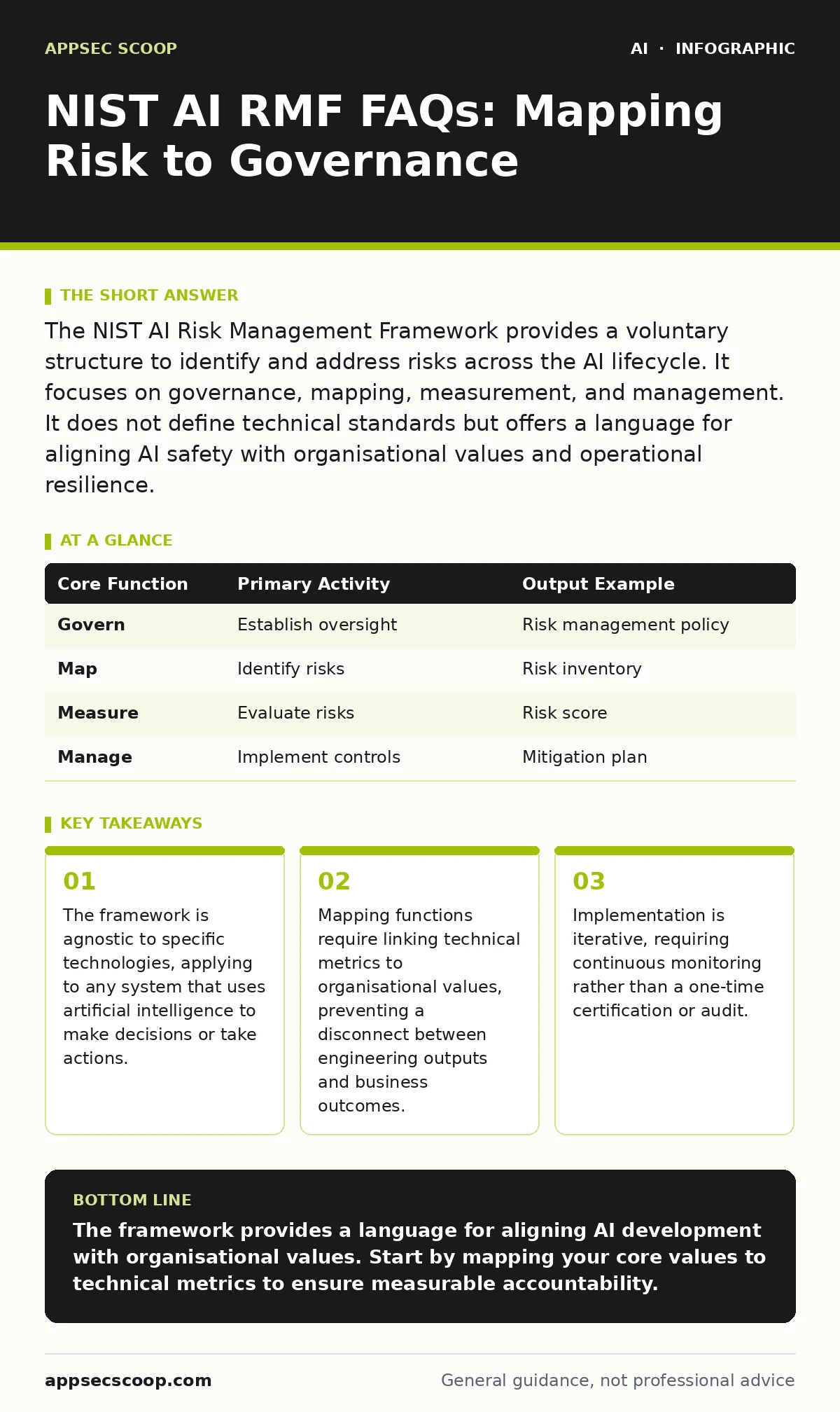
The NIST AI Risk Management Framework provides a voluntary structure to identify and address risks across the AI lifecycle. It focuses on governance, mapping, measurement, and management. It does not define technical standards but offers a language for aligning AI safety with organisational values and operational resilience.
Is the framework mandatory for UK organisations?
No, the framework is voluntary. It offers a structured approach to managing risks associated with AI systems, but adoption is not legally required. Organisations choose to align with it to demonstrate due diligence and improve their security posture. This voluntariness allows flexibility, enabling teams to adapt the framework to their specific operational context without facing immediate regulatory penalties for non-compliance.
How does it differ from ISO standards?
The framework focuses on the process of risk management rather than defining specific technical controls or certification criteria. ISO standards often provide detailed requirements for quality or information security management systems. This framework provides a language and structure for understanding AI-specific risks, such as bias or robustness, which traditional standards may not cover in depth. It complements existing standards by addressing the unique uncertainties inherent in machine learning models.
What are the core functions?
The framework consists of four core functions: Govern, Map, Measure, and Manage. Govern establishes organisational policies and culture. Map identifies and characterises risks. Measure evaluates the severity and likelihood of those risks. Manage implements controls and monitors performance. These functions are not linear steps but interconnected activities that cycle throughout the AI system’s lifecycle. Understanding this structure helps teams avoid treating risk management as a final stage in development.
How do I map values to technical metrics?
Mapping requires linking abstract organisational values, such as fairness or transparency, to measurable technical indicators. You must define what a value means in your specific context before selecting metrics. For example, fairness might translate to equal error rates across demographic groups. This step prevents the common mistake of assuming technical neutrality equates to ethical alignment. It forces a conversation between legal, ethical, and technical teams early in the process.
| Core Function | Primary Activity | Output Example |
|---|---|---|
| Govern | Establish oversight | Risk management policy |
| Map | Identify risks | Risk inventory |
| Measure | Evaluate risks | Risk score |
| Manage | Implement controls | Mitigation plan |
Can I use it for legacy systems?
Yes, the framework applies to any system using AI, regardless of when it was built. Legacy systems often lack documentation, making the Map function particularly challenging. You may need to reverse-engineer data lineage or model behaviour to identify risks. This reveals hidden dependencies that were not apparent during initial deployment. Applying the framework to older systems can uncover vulnerabilities that modern development practices might have avoided.
Who is responsible for implementation?
Responsibility lies with the organisation deploying the AI system, not the vendor. While vendors provide technical details, the deployer understands the operational context and potential impact. This distinction is vital for accountability. Teams must assign clear roles for risk management, ensuring that technical, legal, and operational perspectives are integrated. Shared responsibility models can dilute accountability if not clearly defined.
How does it handle adversarial attacks?
The framework includes robustness as a key risk category, which covers adversarial attacks. You must assess how inputs can be manipulated to cause incorrect outputs. This involves testing models against perturbed data and monitoring for anomalous behaviour in production. Adversarial risk is dynamic, requiring continuous evaluation as new attack techniques emerge. Ignoring this dimension leaves systems vulnerable to targeted manipulation.
Does it cover generative AI?
Yes, the framework applies to all AI technologies, including generative models. Generative AI introduces specific risks, such as the production of synthetic media or hallucinated content. You must map these risks to your organisational values, such as authenticity or accuracy. The framework helps you decide when generative AI is appropriate and what controls are necessary. It does not provide technical solutions but guides the risk assessment process.
How does it integrate with existing security programmes?
The framework is designed to integrate with existing risk management practices, such as those for information security or safety. You should align AI risk categories with your existing taxonomies. This avoids creating siloed processes and reduces operational overhead. For instance, data privacy risks in AI can map to existing GDPR compliance efforts. Integration ensures that AI risks are treated with the same rigour as other operational risks.
What is the role of documentation?
Documentation is central to the Map and Measure functions. You must record data provenance, model architecture, and decision logic. This documentation supports transparency and facilitates audits. It also aids in debugging and improving model performance. Without clear documentation, it is difficult to trace the source of errors or biases. This traceability is essential for maintaining trust and accountability.
How do I measure effectiveness?
Effectiveness is measured by the reduction of identified risks to acceptable levels. You must define what acceptable risk means for your organisation. Metrics should track both technical performance and operational impact. Regular reviews ensure that controls remain effective as the system and environment evolve. Measuring effectiveness prevents the framework from becoming a static set of checkboxes.
Does it replace human judgment?
No, the framework supports human decision-making by providing structured information. It highlights uncertainties and potential failures, allowing humans to intervene. Automation does not eliminate the need for oversight. Human judgment remains critical for interpreting risk assessments and making ethical decisions. The framework enhances rather than replaces human expertise.
Key takeaways
- The framework is agnostic to specific technologies, applying to any system that uses artificial intelligence to make decisions or take actions.
- Mapping functions require linking technical metrics to organisational values, preventing a disconnect between engineering outputs and business outcomes.
- Implementation is iterative, requiring continuous monitoring rather than a one-time certification or audit.
The framework provides a language for aligning AI development with organisational values. Start by mapping your core values to technical metrics to ensure measurable accountability.
Frequently asked questions
Can small teams use this framework?
Yes, the framework is scalable. Small teams can focus on high-impact risks and simplify documentation while maintaining the core principles of governance and measurement.
Does it address supply chain risks?
Yes, the Map function includes identifying risks from third-party components. You must assess the security and reliability of external models and data sources.
How often should I review my risk map?
Reviews should be continuous, triggered by significant changes in the model, data, or operational environment. Regular periodic reviews also ensure alignment with evolving organisational goals.
Is there a certification for compliance?
No, there is no official certification. Organisations self-assess their alignment with the framework. External audits may verify specific controls, but the framework itself is not a certifiable standard.
How this guide was produced: written by the AppSec Scoop editorial team with AI assistance, checked against the public references listed below, and reviewed when the facts change. See our editorial policy or report an error.