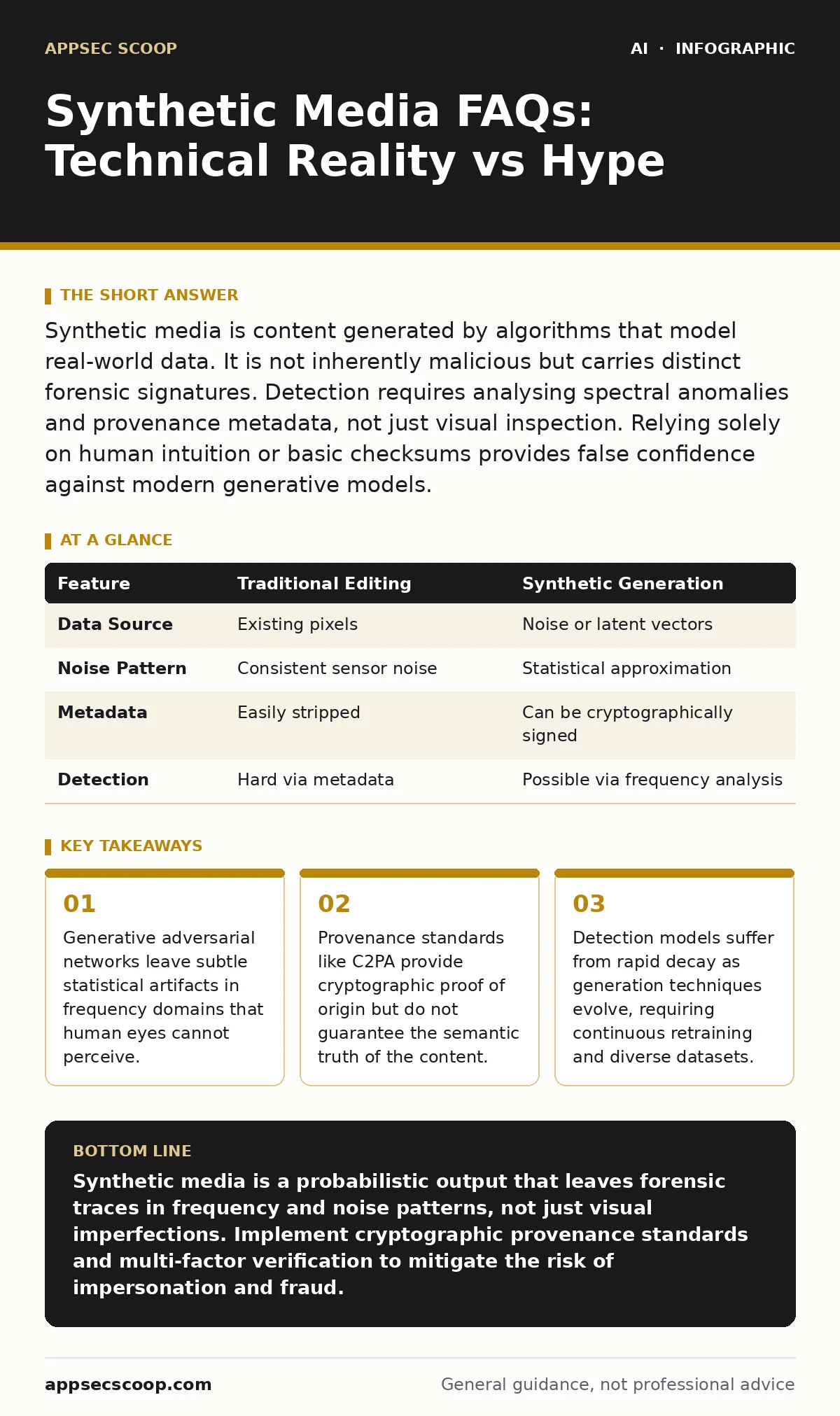
Synthetic media is content generated by algorithms that model real-world data. It is not inherently malicious but carries distinct forensic signatures. Detection requires analysing spectral anomalies and provenance metadata, not just visual inspection. Relying solely on human intuition or basic checksums provides false confidence against modern generative models.
What distinguishes synthetic media from traditional digital manipulation?
Traditional manipulation alters existing pixels through editing software, whereas synthetic media generates entirely new pixel data from noise or text prompts. This fundamental difference means synthetic content often lacks the consistent noise patterns found in camera sensors. You cannot rely on metadata alone, as headers can be stripped or forged with trivial effort. The distinction lies in the statistical distribution of the data, not the visual outcome.
How do generative adversarial networks create realistic imagery?
A generative adversarial network consists of two neural networks competing against each other: a generator creates fake data, while a discriminator tries to spot it. This adversarial process forces the generator to produce increasingly realistic outputs to fool the discriminator. The result is media that mimics the statistical properties of real data. However, this competition often leaves subtle inconsistencies in high-frequency details.
Can you detect AI-generated content with the naked eye?
No. Modern synthesis tools produce output that is visually indistinguishable from reality for most observers. Human vision is poor at detecting the subtle statistical anomalies that characterise synthetic media. Relying on visual inspection creates a dangerous false sense of security. Automated analysis tools that examine pixel-level noise and compression artefacts are required for reliable identification.
Why do commercial detection tools often fail?
Detection models are trained on specific versions of generation software and degrade rapidly as those tools update. This is a classic arms race where the defender must cover all possible generation methods while the attacker only needs one. Many detectors suffer from high false-positive rates when applied to real media that uses unusual compression or lighting. They are probabilistic tools, not definitive truth machines.
What is the role of provenance standards like C2PA?
Content Authenticity and Provenance Alliance standards attach cryptographic signatures to media files, recording their origin and edit history. This allows you to verify that a file has not been altered since it left a trusted source. It does not prove the content is true, only that it is authentic to its stated origin. If the original source was synthetic, the signature merely certifies that fact.
| Feature | Traditional Editing | Synthetic Generation |
|---|---|---|
| Data Source | Existing pixels | Noise or latent vectors |
| Noise Pattern | Consistent sensor noise | Statistical approximation |
| Metadata | Easily stripped | Can be cryptographically signed |
| Detection | Hard via metadata | Possible via frequency analysis |
See also: Shadow AI usage: how to control unmanaged model access in your firm · AI Vendor Assessments: Technical Checks for Secure Procurement
How does training data leakage impact synthetic models?
If a model is trained on private or proprietary data, it may memorise and reproduce that information in its output. This is not a bug but a consequence of how neural networks minimise error. You can mitigate this by using differential privacy techniques during training, which add noise to prevent memorisation. However, this trade-off reduces the fidelity and realism of the generated output.
What are the limitations of watermarking synthetic media?
Invisible watermarks embed hidden signals into the media to flag it as synthetic. These signals are fragile and can be removed by simple operations like cropping, resizing, or re-encoding. Attackers can also train models to generate content that specifically avoids these watermark patterns. Watermarking is a deterrent, not a reliable detection mechanism.
How does synthetic media affect identity verification systems?
Deepfakes can bypass liveness detection by mimicking facial movements and textures in real-time. Static photo attacks are easily defeated, but video injection attacks pose a significant risk. Systems must challenge the user with unpredictable movements or analyse blood flow signals via remote photoplethysmography. These physiological signals are difficult for current synthesis tools to replicate accurately.
What is the current state of audio synthesis?
Voice cloning requires only a few seconds of sample audio to replicate timbre and accent. This capability allows attackers to impersonate individuals in phone calls or video conferences. Detection relies on analysing the spectrogram for inconsistencies in pitch and formant transitions. Human listeners are surprisingly susceptible to these auditory illusions, even when they suspect fraud.
How should organisations integrate detection into their workflows?
Detection should be one layer in a defence-in-depth strategy, not a single point of failure. Combine technical analysis with procedural controls, such as out-of-band verification for sensitive requests. Use frameworks like MITRE ATLAS to map potential attack vectors and tailor your detection logic accordingly. Regularly test your detection systems against new generation techniques to ensure they remain effective.
Key takeaways
- Generative adversarial networks leave subtle statistical artifacts in frequency domains that human eyes cannot perceive.
- Provenance standards like C2PA provide cryptographic proof of origin but do not guarantee the semantic truth of the content.
- Detection models suffer from rapid decay as generation techniques evolve, requiring continuous retraining and diverse datasets.
Synthetic media is a probabilistic output that leaves forensic traces in frequency and noise patterns, not just visual imperfections. Implement cryptographic provenance standards and multi-factor verification to mitigate the risk of impersonation and fraud.
Frequently asked questions
Can blockchain verify if a video is real?
Blockchain can verify that a file has not changed since it was recorded, but it cannot verify the content's truthfulness if the original recording was synthetic.
Is it legal to create deepfakes?
Legality varies by jurisdiction, but creating non-consensual sexual imagery or fraudulent impersonation is illegal in many regions. Always consult local laws.
How do I protect my voice from cloning?
Limit the amount of high-quality audio you share publicly. Use watermarked audio for sensitive communications and verify requests through secondary channels.
Will AI detection become obsolete?
Detection will evolve alongside generation. As tools become more sophisticated, detection will rely more on provenance and cryptographic verification than on pixel analysis.
How this guide was produced: written by the AppSec Scoop editorial team with AI assistance, checked against the public references listed below, and reviewed when the facts change. See our editorial policy or report an error.