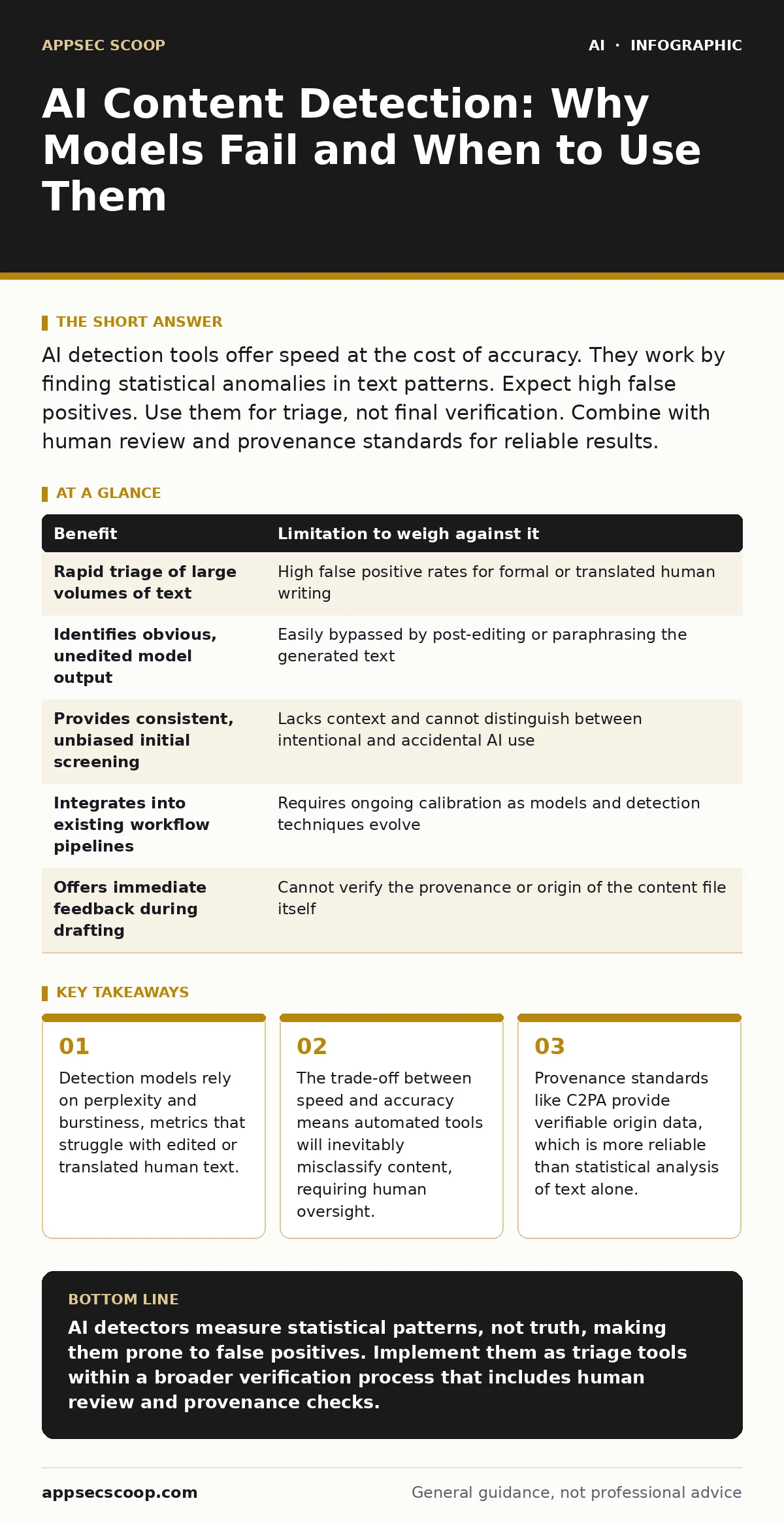
AI detection tools offer speed at the cost of accuracy. They work by finding statistical anomalies in text patterns. Expect high false positives. Use them for triage, not final verification. Combine with human review and provenance standards for reliable results.
The Mechanics of Statistical Guessing
AI content detection does not look for watermarks or hidden signatures. Instead, it analyses the probability of word choices. Large language models predict the next likely word in a sequence. Human writers often choose unexpected words or vary sentence structure in ways that deviate from these predictions. Detectors measure this deviation using metrics like perplexity, which gauges how surprised the model is by the text, and burstiness, which measures variation in sentence length and complexity.
This approach assumes that human writing is inherently less predictable than machine-generated text. That assumption holds some weight for raw, unedited output. It fails when a human deliberately writes in a uniform, academic style. It also fails when a machine model is prompted to write creatively or irregularly. The detector is not reading the text; it is calculating the likelihood that the text originated from a specific class of probability distribution.
The Cost of False Positives
The most significant limitation of current detection technology is the rate of false positives. Academic writing, technical documentation, and translated texts often exhibit low burstiness and low perplexity. These traits match the statistical profile of AI-generated text. Consequently, detectors frequently flag human-authored professional content as synthetic. This creates a hidden cost for organisations. Staff must spend time manually reviewing flagged documents to correct the tool's errors.
Imagine a university using an automated detector to screen student submissions. The system flags a large portion of essays from non-native speakers, whose writing style is often formal and repetitive. The institution must then deploy human reviewers to verify each case. This process consumes resources and risks unfair treatment of specific demographic groups. The tool promises efficiency but delivers administrative overhead.
Weighing Benefits Against Limitations
To understand the utility of these tools, you must compare their operational benefits against their inherent flaws. The table below outlines the primary trade-offs.
| Benefit | Limitation to weigh against it |
|---|---|
| Rapid triage of large volumes of text | High false positive rates for formal or translated human writing |
| Identifies obvious, unedited model output | Easily bypassed by post-editing or paraphrasing the generated text |
| Provides consistent, unbiased initial screening | Lacks context and cannot distinguish between intentional and accidental AI use |
| Integrates into existing workflow pipelines | Requires ongoing calibration as models and detection techniques evolve |
| Offers immediate feedback during drafting | Cannot verify the provenance or origin of the content file itself |
The benefit of speed is real. Processing thousands of documents manually is impractical. However, the limitation of accuracy means the tool cannot operate in isolation. It functions best as a filter, not a judge. You gain time on the initial pass but lose time correcting errors on the second pass. The net gain depends entirely on the quality of the subsequent human review.
When It Is Worth It
AI content detection is worth deploying when the volume of content exceeds human capacity for initial review. In high-throughput environments, such as news aggregators or large-scale educational platforms, the tool serves as a sorting mechanism. It groups content into buckets of likely human, likely synthetic, and uncertain. This allows reviewers to focus their attention on the uncertain bucket and the synthetic bucket, ignoring the clearly human content.
It is also valuable for identifying low-effort synthetic spam. Bots often generate text without subsequent editing. This raw output retains the statistical signatures that detectors are designed to find. In these cases, the detector acts as a noise filter, removing obvious machine-generated content before it reaches human eyes. This application aligns with the principles found in the AI-assisted threat detection guide, where automation handles volume while humans handle nuance.
When It Is Not Worth It
Do not use AI detectors for high-stakes decisions where accuracy is paramount. If a single false positive could result in job loss, academic expulsion, or legal liability, the risk is too high. The technology is not reliable enough to serve as the sole basis for punitive action. In these scenarios, the cost of error outweighs the benefit of speed. You should instead rely on process-based verification, such as requiring drafts, version histories, or oral defence of the work.
Detectors are also ineffective against sophisticated synthetic media. If an attacker or user edits the generated text to improve its burstiness, the statistical signature changes. The text may look more human to the detector while remaining largely machine-generated. For verifying the authenticity of images or video, statistical text analysis is irrelevant. You need to consult the synthetic media guide for techniques related to visual and auditory verification, which rely on different forensic methods.
The Role of Provenance Standards
Statistical detection is a reactive measure. It tries to infer origin after the content has been created. A more robust approach is proactive provenance. Standards like the Content Authenticity Initiative's C2PA (Coalition for Content Provenance and Authenticity) embed cryptographic signatures into files at the point of creation. This allows a receiver to verify the origin and history of the content.
Unlike statistical detection, provenance does not guess. It provides a verifiable chain of custody. However, adoption is not universal. You cannot rely on provenance metadata if the creator did not use compatible tools. In the absence of provenance, you fall back to statistical detection, with all its limitations. The NIST AI Risk Management Framework suggests using multiple layers of verification, combining technical controls like provenance with process controls like human review.
Integrating Detection into Workflow
To use these tools effectively, you must integrate them into a broader verification workflow. Do not treat the detector as a black box. Configure it to highlight uncertain results rather than binary pass/fail outcomes. Train your staff to understand the difference between tokens in language models and actual meaning. A detector might flag a paragraph because it uses common token sequences, not because it lacks meaning.
Regularly audit the tool's performance. Test it against known human and synthetic samples to monitor drift. As language models improve, their output becomes more human-like, changing the statistical landscape. A detector that worked last year may be obsolete today. This continuous calibration is part of AI transparency efforts, ensuring that you understand what the tool is actually measuring and where its boundaries lie.
Key takeaways
- Detection models rely on perplexity and burstiness, metrics that struggle with edited or translated human text.
- The trade-off between speed and accuracy means automated tools will inevitably misclassify content, requiring human oversight.
- Provenance standards like C2PA provide verifiable origin data, which is more reliable than statistical analysis of text alone.
AI detectors measure statistical patterns, not truth, making them prone to false positives. Implement them as triage tools within a broader verification process that includes human review and provenance checks.
Frequently asked questions
Can AI detectors reliably identify text written by non-native speakers?
No. Non-native speakers often write in formal, repetitive styles that resemble machine-generated text, leading to high false positive rates for this demographic.
Do AI detectors look for hidden watermarks in text?
Most current detectors do not rely on watermarks. They analyse statistical patterns like word choice probability and sentence variation to guess the origin of the text.
How can I reduce false positives in my detection workflow?
Use the detector for initial sorting rather than final judgment. Combine it with human review and require provenance metadata where possible to verify content origin.
Is AI content detection effective against edited machine-generated text?
Editing significantly reduces the statistical signatures of synthetic text. Detectors struggle to identify content that has been paraphrased or rewritten by a human after generation.
How this guide was produced: written by the AppSec Scoop editorial team with AI assistance, checked against the public references listed below, and reviewed when the facts change. See our editorial policy or report an error.