Small organisations face deepfake fraud because attackers use synthetic audio and video to mimic authority figures. Protection requires out-of-band verification for all financial requests. Implement a strict policy where any change to banking details is confirmed via a separate, pre-established communication channel.
The Illusion of Authority
Small organisations are exposed not because they lack firewalls, but because they rely on social trust. Attackers use generative artificial intelligence to create synthetic media that mimics known voices or faces. This synthetic media is artificial content generated by algorithms, designed to deceive human perception.
In a large enterprise, protocols often mandate dual approval for payments. In a smaller team, speed and convenience override caution. You operate in an environment where everyone knows each other. An attacker exploits this familiarity. They do not need to hack your server. They only need to convince one person to act against standard procedure.
The risk is not the technology itself. The risk is the assumption that seeing or hearing a colleague guarantees authenticity. This assumption fails when the source is a model trained on public data.
Why Technical Defences Fall Short
Traditional cybersecurity focuses on perimeter defence. Firewalls and intrusion detection systems monitor network traffic. They look for malicious code or known bad signatures. Deepfake fraud operates outside these boundaries. The attack vector is human psychology, not software vulnerability.
Email filters may catch phishing links. They cannot easily distinguish a genuine request from a sophisticated synthetic audio file attached to a legitimate-looking message. Even if the email is clean, the content within it can still manipulate you. This is a fundamental limitation of current security stacks.
You cannot patch a human being. You can only change the process. Relying solely on technology to detect fakes is a flawed strategy. Detection tools are always slightly behind generation tools. The cat-and-mouse game ensures that false negatives will always exist.
Low-Cost Procedural Controls
The most effective protections cost nothing but require discipline. You must introduce friction into high-risk workflows. Friction here means adding steps that slow down immediate action, allowing time for verification.
Establish an out-of-band verification protocol. This means confirming sensitive requests through a different channel than the one used for the request. If a request comes via video call, verify it via text. If it comes via text, verify it via a phone call to a known number. Do not use the number provided in the message.
Train staff to expect friction. Normalise the behaviour of questioning authority. In a small team, this can feel rude. It must be reframed as a standard operational procedure. The person asking for the transfer should welcome the verification step. If they pressure you to skip it, that is the alert signal.
Detection Tools and Limitations
While procedures are primary, tools can provide a secondary layer. AI content detection software analyses digital files for artefacts left by generation models. These artefacts are subtle inconsistencies in pixel patterns or audio frequencies.
However, these tools are not infallible. They produce false positives and false negatives. A high-fidelity fake may pass detection. A genuine video compressed heavily may fail it. You must treat detection scores as indicators, not verdicts.
Consider the trade-off. Implementing advanced detection may slow down legitimate communications. If every video call is scanned and flagged, productivity suffers. You must balance security with operational efficiency. Use detection for high-value transactions, not for routine chats.
Protection Matrix
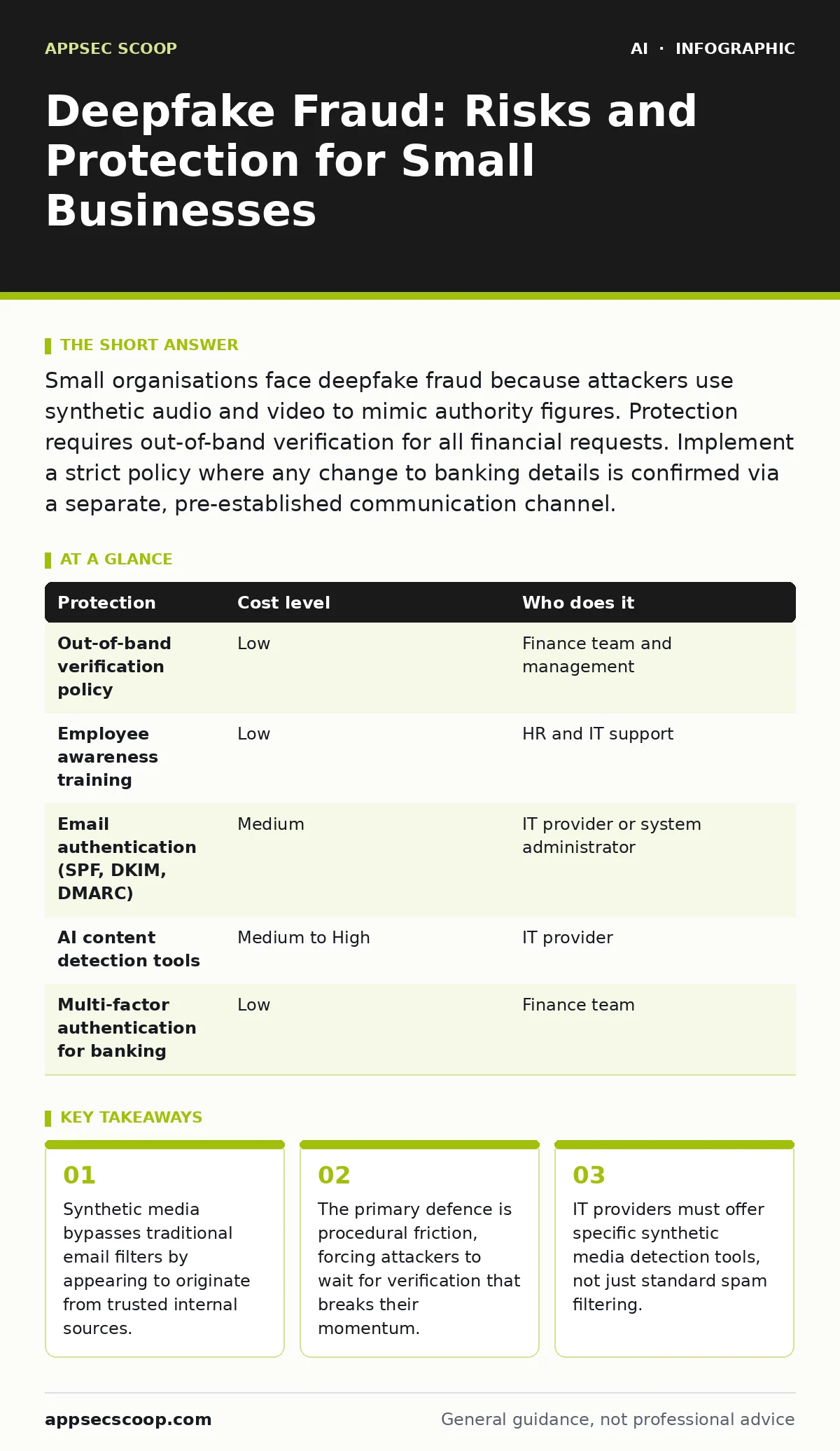
The table below outlines specific measures, their approximate cost, and responsible parties.
| Protection | Cost level | Who does it |
|---|---|---|
| Out-of-band verification policy | Low | Finance team and management |
| Employee awareness training | Low | HR and IT support |
| Email authentication (SPF, DKIM, DMARC) | Medium | IT provider or system administrator |
| AI content detection tools | Medium to High | IT provider |
| Multi-factor authentication for banking | Low | Finance team |
See also: Bootkits: Risks and Protection for Small Businesses · Callback Phishing: Risks and Protection for Small Businesses
Email Authentication as a Baseline
Before worrying about video fakes, ensure your email infrastructure is secure. Attackers often use spoofed emails to introduce synthetic media. If an email appears to come from your domain but is generated externally, your authentication settings should block or flag it.
SPF, DKIM, and DMARC are open standards that verify email origin. SPF specifies which servers can send email for your domain. DKIM adds a digital signature to messages. DMARC tells receiving servers what to do if a message fails these checks.
Without these, an attacker can easily forge a sender address. This makes the subsequent deepfake more credible. Implementing these standards is a prerequisite for any advanced defence. It removes a layer of trust that attackers abuse.
Questions for Your IT Provider
You cannot protect yourself if your provider lacks expertise in synthetic media. Ask specific questions to assess their capability. Do not accept vague answers about "advanced security".
- How do you detect synthetic audio or video attachments in emails?
- What is the false positive rate for your AI content detection tools?
- Can you implement strict DMARC policies to prevent domain spoofing?
- How do you log and alert on unusual login patterns for financial accounts?
- What training materials do you provide for staff regarding social engineering?
Integrating with Broader Security
Deepfake fraud does not exist in isolation. It often accompanies AI-generated phishing campaigns. These emails use natural language processing to craft convincing messages. You must treat synthetic media as part of a broader social engineering attack.
Refer to the NIST AI Risk Management Framework for structural guidance. This framework helps you identify and manage risks associated with AI systems. It provides a methodical approach to evaluating new tools.
Consider AI-assisted threat detection for your network. While it does not stop deepfakes, it can identify compromised accounts used to launch them. If an account starts sending unusual volumes of data, detection systems may flag it.
For voice-specific threats, review the risks of voice cloning scams. These are a subset of deepfake fraud. They require specific countermeasures, such as voice biometrics for authentication.
Final Considerations
The goal is not to eliminate risk. It is to make the attack difficult and slow. Attackers prefer easy targets. By adding verification steps, you move yourself out of the "easy" category.
Implement these measures incrementally. Start with the verification policy. Then add email authentication. Finally, consider detection tools. Monitor the impact on your workflow. Adjust as needed.
Key takeaways
- Synthetic media bypasses traditional email filters by appearing to originate from trusted internal sources.
- The primary defence is procedural friction, forcing attackers to wait for verification that breaks their momentum.
- IT providers must offer specific synthetic media detection tools, not just standard spam filtering.
Frequently asked questions
Can antivirus software stop deepfake attacks?
No, because deepfakes are social engineering attacks, not malware. Antivirus scans for malicious code, not for deceptive human behaviour or content.
How do I verify a caller if they spoof my phone number?
Hang up and call the person back using a number from your internal directory or a previous, verified email. Do not use any number provided in the spoofed call.
Is AI content detection reliable enough to rely on?
No, it is currently an imperfect science. It should be used as a secondary alert, not a primary gatekeeper. Human verification remains the final step.
What should I do if I fall for a deepfake scam?
Contact your bank immediately to attempt a recall. Report the incident to your IT provider and update your internal procedures to prevent recurrence.
How this guide was produced: written by the AppSec Scoop editorial team with AI assistance, checked against the public references listed below, and reviewed when the facts change. See our editorial policy or report an error.