
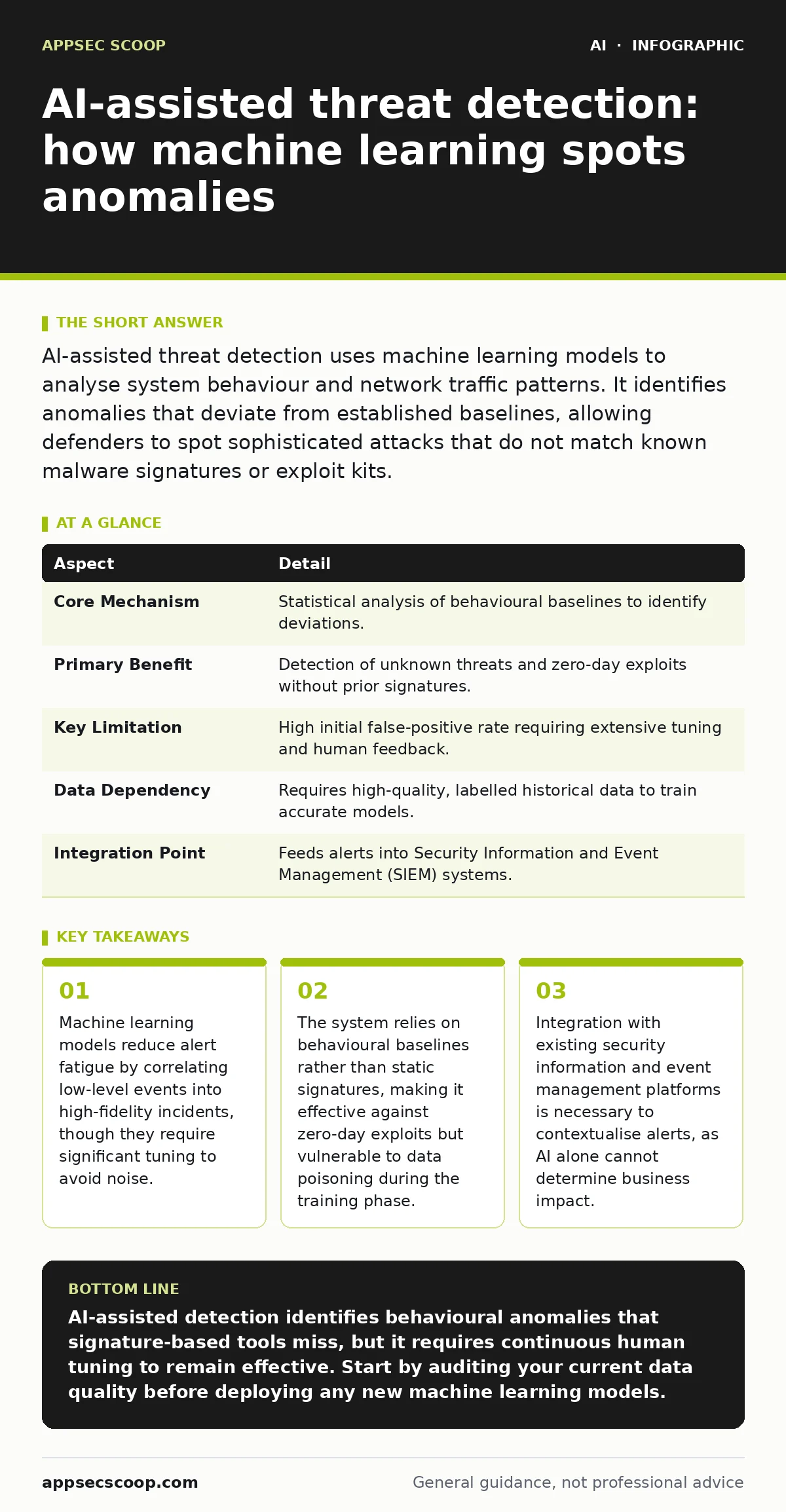
AI-assisted threat detection uses machine learning models to analyse system behaviour and network traffic patterns. It identifies anomalies that deviate from established baselines, allowing defenders to spot sophisticated attacks that do not match known malware signatures or exploit kits.
The Signal Amidst The Noise
Imagine a library where a single librarian must check every book returned for damage. Most books are fine, but a few have torn pages or missing covers. The librarian becomes exhausted, missing subtle tears because they are overwhelmed by the sheer volume of books. AI-assisted threat detection acts as an automated sorting system. It does not read every page, but it learns what a normal return looks like. When a book arrives with unusual wear patterns, the system flags it for human review. This analogy illustrates the core problem in modern security operations: volume.
Traditional security tools rely on signatures. A signature is a unique identifier, like a fingerprint, for known malicious software. If the software changes its code slightly, the signature no longer matches, and the tool misses the threat. This approach fails against polymorphic malware, which alters its appearance while retaining its harmful function. Artificial intelligence addresses this by looking for behaviour rather than identity. It asks whether the action makes sense, not whether the actor is known.
What It Actually Solves
The primary function of AI-assisted detection is anomaly detection. An anomaly is any event that deviates significantly from a established baseline of normal activity. In a corporate network, normal activity might include employees accessing file servers between nine and five. If a user account downloads terabytes of data at three in the morning, the system flags this as anomalous. This capability is critical because attackers often use legitimate tools to move laterally within a network. These living-off-the-land techniques leave no traditional malware signatures behind.
Consider the challenge of insider threats. A disgruntled employee might access files they are authorised to view, but they do so in a pattern that suggests data exfiltration rather than work. Rule-based systems cannot easily distinguish between a busy worker and a thief if both have valid credentials. Machine learning models can analyse the sequence, timing, and volume of access requests. They identify patterns that human analysts might miss due to cognitive bias or fatigue. This shifts the defensive posture from reactive to predictive, allowing teams to investigate before data leaves the perimeter.
| Aspect | Detail |
|---|---|
| Core Mechanism | Statistical analysis of behavioural baselines to identify deviations. |
| Primary Benefit | Detection of unknown threats and zero-day exploits without prior signatures. |
| Key Limitation | High initial false-positive rate requiring extensive tuning and human feedback. |
| Data Dependency | Requires high-quality, labelled historical data to train accurate models. |
| Integration Point | Feeds alerts into Security Information and Event Management (SIEM) systems. |
The Anatomical Parts of the System
An AI-assisted detection system is not a single black box. It consists of distinct components that work in sequence. The first part is data ingestion. The system collects logs, network flows, and endpoint telemetry from across the environment. Without comprehensive data, the model cannot build an accurate baseline. The second part is feature engineering. This process transforms raw data into meaningful signals, such as the number of failed login attempts per hour or the entropy of a file name.
The third component is the machine learning model itself. This could be a supervised model, trained on labelled examples of attacks and normal behaviour, or an unsupervised model, which learns normal behaviour and flags anything that does not fit. The fourth part is the feedback loop. When analysts investigate an alert, they label it as true or false. This label is fed back into the model to improve its accuracy. This continuous learning process is vital for reducing noise over time. Without it, the model degrades as the environment changes.
Where It Fits in the Defence Stack
AI-assisted detection does not replace traditional tools; it augments them. It sits alongside intrusion detection systems, firewalls, and endpoint protection platforms. These traditional tools act as the first line of defence, blocking known threats. The AI layer acts as a second opinion, catching what the first line misses. This layered approach is known as defence in depth. Each layer adds a barrier that an attacker must breach. If one layer fails, the next may still stop the intrusion.
However, the AI component requires context that other tools do not provide. A firewall sees a connection; the AI system sees the connection in the context of the user’s role, time of day, and previous activity. This contextual awareness is what allows it to distinguish between a legitimate administrative task and a malicious lateral movement attempt. For this reason, integration with identity management systems is often necessary. The AI needs to know who the user is and what they are allowed to do. Without this identity context, the behavioural analysis lacks precision.
Common Misconceptions and Pitfalls
One widespread error is assuming that AI is fully autonomous. Many organisations deploy these systems expecting them to block threats without human intervention. This is dangerous. AI systems generate probabilities, not certainties. A high score indicates a likely anomaly, but it does not confirm malicious intent. Human analysts must investigate and validate these alerts. Over-reliance on automation can lead to missed nuances that a human would catch, such as a legitimate emergency procedure that looks like an attack.
Another misconception is that more data always equals better detection. In reality, poor quality data leads to poor models. If the training data contains biases, such as over-representing certain types of attacks, the model will be blind to others. This relates to the risks discussed in guides on training data leakage, where sensitive information inadvertently influences the model’s behaviour.
Furthermore, attackers are aware of these systems. They may use techniques to poison the training data or craft attacks that mimic normal behaviour, a concept explored in MITRE ATLAS. This adversarial AI landscape means that the model must be continuously monitored and updated.
See also: Adversarial Examples in the Physical World: How Noise Defeats AI · Training Data Leakage Explained: How AI Memorises Your Secrets
The Hidden Costs of Implementation
The financial cost of licensing is only a small part of the expense. The real cost is operational. Tuning an AI detection system requires skilled personnel who understand both security and data science. These professionals are in short supply. Additionally, the system requires significant compute resources to process real-time data streams. This infrastructure cost can be substantial, especially for large organisations with high data volumes.
There is also the cost of false positives. Every incorrect alert consumes analyst time. If the system generates ten false alerts for every true one, the team becomes desensitised. They may start ignoring alerts altogether, creating a security gap. Reducing this ratio requires constant refinement and feedback. This is not a set-and-forget solution. It demands ongoing investment in training and process improvement. Organisations must weigh the benefit of detecting advanced threats against the resource drain of managing the system.
Future Considerations and Frameworks
As these systems evolve, they will likely become more integrated with automated response capabilities. This raises questions about accountability and control. If an AI system blocks a legitimate business transaction, who is responsible? Frameworks like the NIST AI Risk Management Framework provide guidance on managing these risks. They emphasise transparency, explainability, and human oversight. Organisations should adopt these principles early in the deployment process.
The rise of AI agents that can act autonomously within networks will further complicate this landscape. These agents may interact with detection systems in ways that are not yet understood. Defenders must prepare for a future where both attackers and defenders use AI. The advantage will not go to the side with the best AI, but to the side with the best data and the most rigorous processes for validating results. Staying ahead requires a focus on fundamentals: clean data, clear baselines, and human-in-the-loop validation.
Key takeaways
- Machine learning models reduce alert fatigue by correlating low-level events into high-fidelity incidents, though they require significant tuning to avoid noise.
- The system relies on behavioural baselines rather than static signatures, making it effective against zero-day exploits but vulnerable to data poisoning during the training phase.
- Integration with existing security information and event management platforms is necessary to contextualise alerts, as AI alone cannot determine business impact.
AI-assisted detection identifies behavioural anomalies that signature-based tools miss, but it requires continuous human tuning to remain effective. Start by auditing your current data quality before deploying any new machine learning models.
Frequently asked questions
Does AI replace the need for security analysts?
No, AI reduces the volume of noise but requires human experts to validate alerts, tune models, and investigate complex incidents that the system cannot fully understand.
What is the biggest risk of using AI for detection?
The biggest risk is adversarial manipulation, where attackers tailor their behaviour to mimic normal activity, thereby evading detection by the machine learning models.
How this guide was produced: written by the AppSec Scoop editorial team with AI assistance, checked against the public references listed below, and reviewed when the facts change. See our editorial policy or report an error.