
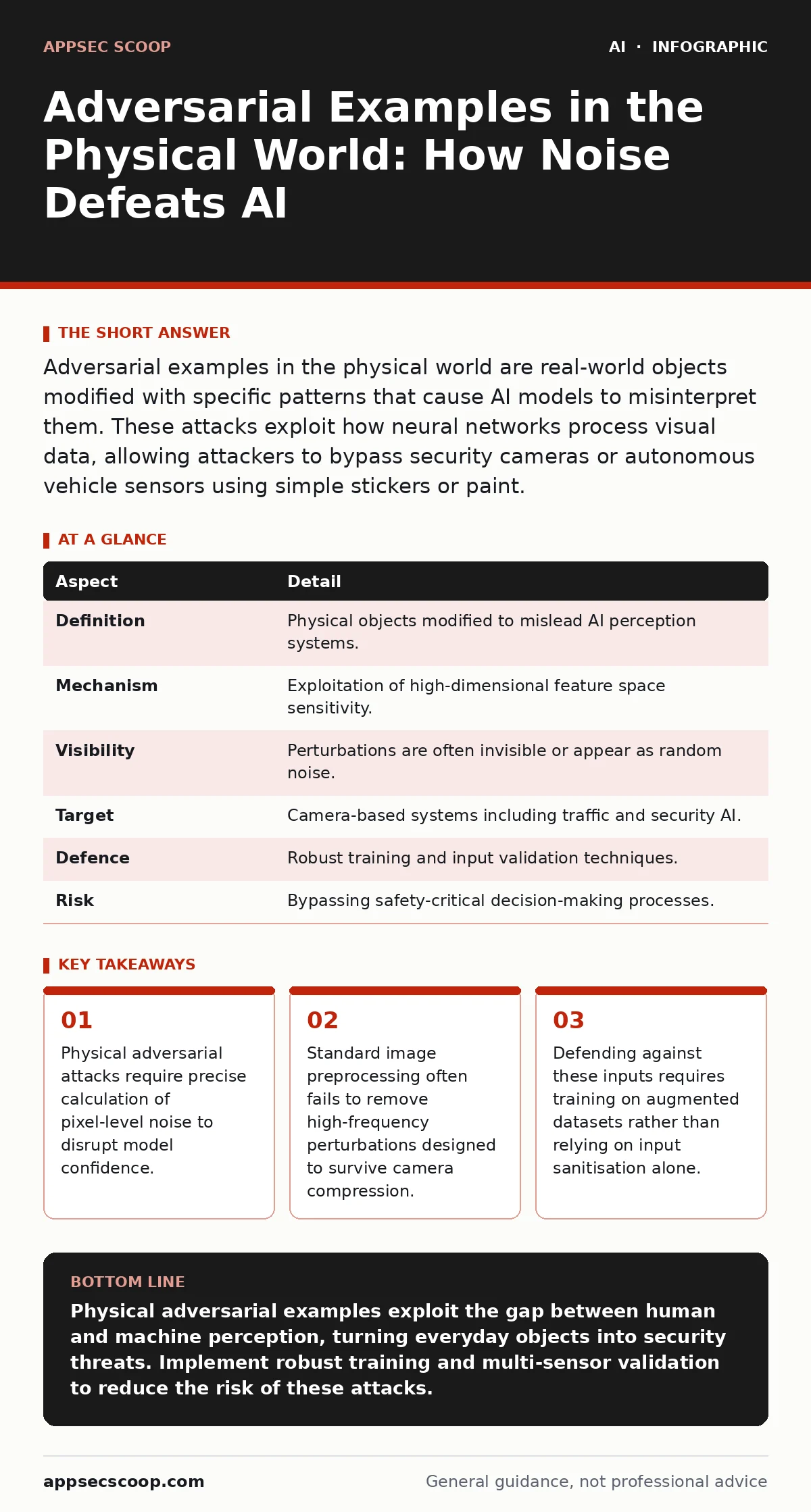
Adversarial examples in the physical world are real-world objects modified with specific patterns that cause AI models to misinterpret them. These attacks exploit how neural networks process visual data, allowing attackers to bypass security cameras or autonomous vehicle sensors using simple stickers or paint.
What Are Adversarial Examples in the Physical World
Adversarial examples are inputs deliberately crafted to cause a machine learning model to make an error. In the physical world, these are tangible objects modified with specific visual patterns that confuse computer vision systems. The modification is often imperceptible to the human eye but catastrophic for the algorithm. This phenomenon bridges the gap between digital theory and physical security. It demonstrates that software vulnerabilities can be exploited through hardware interactions.
Imagine a stop sign. To a human driver, it is a clear instruction to halt. To a neural network trained on standard datasets, it is a pattern of red octagons. If an attacker applies a specific arrangement of white stickers to the sign, the network may classify it as a speed limit sign. The physical object has not changed its legal meaning, only its digital interpretation. This mismatch creates a dangerous operational gap.
| Aspect | Detail |
|---|---|
| Definition | Physical objects modified to mislead AI perception systems. |
| Mechanism | Exploitation of high-dimensional feature space sensitivity. |
| Visibility | Perturbations are often invisible or appear as random noise. |
| Target | Camera-based systems including traffic and security AI. |
| Defence | Robust training and input validation techniques. |
| Risk | Bypassing safety-critical decision-making processes. |
How These Attacks Work
Neural networks map inputs to outputs through millions of parameters. These models learn correlations rather than causal understanding. An adversarial example exploits this by finding a direction in the input space that leads to a wrong output. In the physical world, this requires solving an optimisation problem. The attacker must calculate perturbations that survive real-world conditions. Lighting, distance, and angle distort the pattern. The attack must remain effective despite these variables.
The process begins with a digital simulation. The attacker generates a pattern that fools the model on a computer. They then test this pattern on a physical object. Iterations refine the pattern until it works in the real world. This trial-and-error approach is computationally expensive but feasible. The key insight is that the model’s decision boundary is fragile. Small changes in input can cause large swings in output probability.
Who Is Affected by Physical Adversarial Attacks
Any organisation relying on computer vision for safety or security is at risk. Autonomous vehicles are primary targets. Traffic sign spoofing can cause a vehicle to accelerate instead of braking. Industrial robots may ignore safety barriers if their vision systems are deceived. Retail stores using automated checkout systems face inventory loss. Security firms using perimeter monitoring risk undetected intrusions.
The impact extends beyond direct financial loss. Safety-critical systems can cause physical harm. A misclassified pedestrian can lead to accidents. The psychological impact on users is also significant. Trust in automated systems erodes when they fail unpredictably. Organisations must consider the broader implications of AI dependency. The attack surface includes any camera lens exposed to the public.
Common Misconceptions About Physical Attacks
Many assume that physical attacks are difficult to execute. This is incorrect. While they require more effort than digital attacks, the barrier to entry is lowering. Open-source tools allow attackers to generate adversarial patterns. Printing these patterns on standard materials is trivial. The misconception that only sophisticated actors can perform these attacks leads to under-preparation.
Another error is believing that image filtering solves the problem. Standard denoising filters remove random noise. Adversarial patterns are structured to survive these filters. They mimic natural textures or shadows. Filters may even enhance the adversarial signal by removing competing features. Relying on legacy image processing techniques provides false security. The threat persists despite standard cleaning protocols.
Mitigation Strategies for Physical Adversarial Examples
Defending against these attacks requires a multi-layered approach. Input sanitisation is the first line of defence. Techniques like JPEG compression can reduce high-frequency noise. However, this must be balanced against image quality loss. Over-compression can degrade legitimate recognition accuracy. The goal is to remove adversarial signals without harming useful features.
Training data augmentation is the most effective long-term strategy. Models must be trained on examples that include adversarial patterns. This teaches the network to ignore irrelevant noise. The training process becomes more computationally intensive. It requires generating thousands of adversarial examples. The resulting model is more robust but may be slower. This trade-off must be managed carefully.
Regular model updates are necessary. Attackers continuously refine their techniques. A model trained on today’s threats may be vulnerable tomorrow. Continuous learning pipelines can help. They incorporate new data and retrain models periodically. This ensures the system adapts to evolving attack methods. Static models become obsolete quickly.
See also: Training Data Leakage Explained: How AI Memorises Your Secrets · AI versus Machine Learning: Which Technology Fits Your Security Needs?
Integrating Defences into Security Operations
Security teams must treat AI systems as dynamic assets. They require continuous monitoring and validation. Performance metrics should include robustness testing. Regular audits can identify vulnerabilities before attackers exploit them. These audits should simulate real-world conditions. Testing in a controlled environment may miss physical variables.
Collaboration with AI developers is key. Operations teams need visibility into model updates. They should understand the training data sources. This transparency helps identify potential weaknesses. Knowledge of the model’s architecture informs defensive strategies. It allows teams to anticipate where attacks might succeed.
Related topics such as AI vendor assessments provide frameworks for evaluating third-party AI solutions. Understanding AI transparency helps teams interpret model behaviour. These guides offer deeper insights into governance. They complement technical defences with policy measures. Integrating these practices creates a holistic security posture.
The Future of Physical Adversarial Research
Research into physical adversarial examples is accelerating. New techniques are emerging that require less computational power. Transferable attacks allow patterns generated on one model to work on others. This increases the risk of widespread exploitation. Defenders must stay ahead of these developments.
The field is moving towards more generalisable defences. Researchers are exploring methods that do not require retraining. These include input transformation techniques. They modify the input before it reaches the model. This adds a layer of protection without changing the core algorithm. However, these methods are not yet mature. They require further validation in production environments.
Organisations should prepare for a future where physical attacks are common. Proactive defence is better than reactive mitigation. Investing in robust AI infrastructure pays off. It reduces the risk of costly breaches. It maintains trust in automated systems. The cost of inaction is high.
Practical Steps for Immediate Implementation
Start by auditing your current AI systems. Identify which models rely on visual input. Assess their exposure to the public. Prioritise systems that impact safety or security. Implement basic input sanitisation. Test these systems with known adversarial patterns. Measure the drop in accuracy. Use this data to justify further investment.
Engage with your AI providers. Ask about their robustness testing. Request details on their training data. Ensure they have a process for handling new threats. Document these findings. Use them to update your risk assessments. This documentation supports compliance efforts. It also informs future procurement decisions.
Key takeaways
- Physical adversarial attacks require precise calculation of pixel-level noise to disrupt model confidence.
- Standard image preprocessing often fails to remove high-frequency perturbations designed to survive camera compression.
- Defending against these inputs requires training on augmented datasets rather than relying on input sanitisation alone.
Physical adversarial examples exploit the gap between human and machine perception, turning everyday objects into security threats. Implement robust training and multi-sensor validation to reduce the risk of these attacks.
Frequently asked questions
Can adversarial examples affect audio-based AI systems?
Yes, audio adversarial examples can trick speech recognition systems. These attacks use inaudible frequencies to alter transcription results.
How do I detect an ongoing physical adversarial attack?
Monitor for unusual classification confidence scores. Sudden drops in confidence may indicate an adversarial input.
Are there legal restrictions on creating adversarial examples?
Laws vary by jurisdiction. Creating attacks for research is often permitted. Using them to breach security is illegal.
Does encryption protect against physical adversarial examples?
No, encryption protects data in transit. Adversarial examples attack the perception layer before encryption occurs.
How this guide was produced: written by the AppSec Scoop editorial team with AI assistance, checked against the public references listed below, and reviewed when the facts change. See our editorial policy or report an error.