
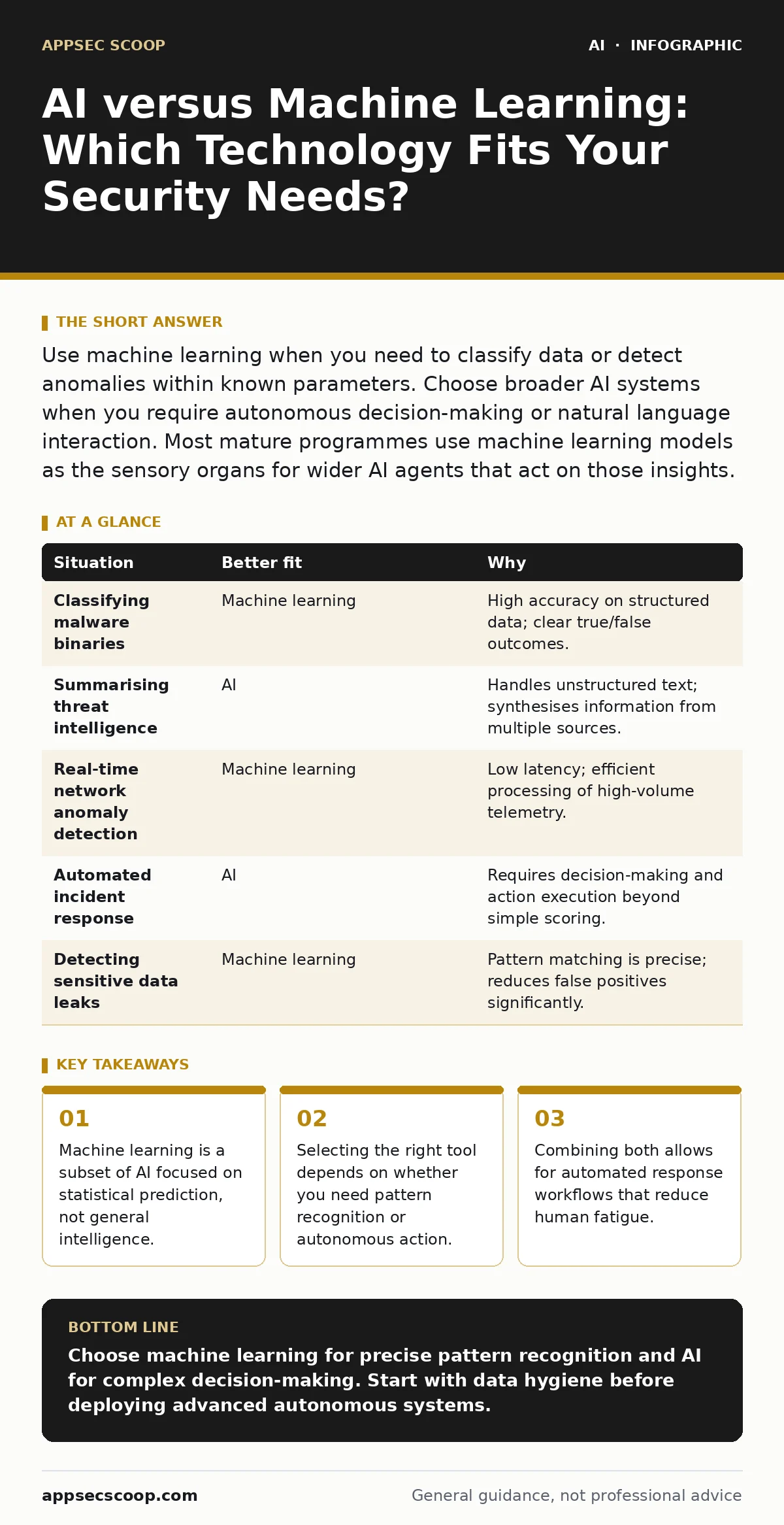
Use machine learning when you need to classify data or detect anomalies within known parameters. Choose broader AI systems when you require autonomous decision-making or natural language interaction. Most mature programmes use machine learning models as the sensory organs for wider AI agents that act on those insights.
Do you need prediction or action?
The distinction often confuses engineering teams. Machine learning refers to algorithms that improve at a specific task through exposure to data, without explicit programming for every rule. It predicts outcomes based on historical patterns. Artificial intelligence is the broader field of creating systems capable of performing tasks that typically require human cognition.
If your goal is to flag suspicious login attempts based on time and location, you need machine learning. The model learns what "normal" looks like and flags deviations. If your goal is to have a system investigate that flag, query other logs, and decide whether to block the account, you are entering the territory of AI agents.
Can you define the boundaries of success?
Machine learning models require well-defined objectives. You must be able to measure accuracy, precision, and recall. If you cannot define what a "correct" answer looks like, training a model becomes difficult. The model needs labelled data to learn from, meaning you must know the ground truth for past events.
AI systems, particularly those using large language models, operate with looser boundaries. They generate responses based on probability rather than strict classification. This makes them useful for summarising incident reports or drafting policy updates, but dangerous for security decisions where a false positive has severe consequences.
Suppose you want to filter phishing emails. A machine learning classifier can achieve high accuracy because "phishing" has clear features. Suppose you want to negotiate with a attacker in a chat room. That requires generative AI capabilities that understand context and nuance, not just binary classification.
How much interpretability do you require?
Security operations demand accountability. When a machine learning model blocks a transaction, you can often trace the decision to specific feature weights. This transparency helps auditors and investigators understand why a decision was made. This field is known as explainable AI, focusing on making model decisions understandable to humans.
Generative AI systems often function as black boxes. They provide an answer but rarely explain the logical steps taken to reach it. This lack of transparency creates liability risks. If an AI agent denies a legitimate user access based on a hallucinated rule, you have little recourse to correct the logic immediately.
| Situation | Better fit | Why |
|---|---|---|
| Classifying malware binaries | Machine learning | High accuracy on structured data; clear true/false outcomes. |
| Summarising threat intelligence | AI | Handles unstructured text; synthesises information from multiple sources. |
| Real-time network anomaly detection | Machine learning | Low latency; efficient processing of high-volume telemetry. |
| Automated incident response | AI | Requires decision-making and action execution beyond simple scoring. |
| Detecting sensitive data leaks | Machine learning | Pattern matching is precise; reduces false positives significantly. |
When should you combine both approaches?
Rarely should you use only one in isolation for mature operations. Machine learning models excel at perception, while AI agents excel at reasoning. A common architecture uses machine learning to process raw telemetry, such as packet captures or log files. These models identify anomalies and assign risk scores.
The AI layer then consumes these scores. It correlates multiple low-risk events that individually look benign but together indicate a coordinated attack. This hybrid approach reduces noise. It prevents alert fatigue by only escalating complex, multi-stage incidents to human analysts.
Imagine a system where a machine learning model detects unusual data exfiltration volumes. It flags the event but does not block it. An AI agent reviews the user’s recent activity, checks for authorised transfers, and queries HR records. If the user is a contractor whose contract ended, the agent blocks the account. This combination provides depth that neither system could achieve alone.
What are the hidden costs of each?
Machine learning requires significant data hygiene. Garbage in, garbage out. If your labels are inconsistent, your model will learn incorrect patterns. Maintaining these datasets is a continuous operational cost. Models also drift over time as attacker tactics change, requiring regular retraining and validation.
AI systems, particularly generative ones, introduce different risks. They can hallucinate facts, creating false intelligence. They are also susceptible to prompt injection, where attackers manipulate the system’s instructions. You must implement strict guardrails and input validation. See our guide on sensitive data leaks through AI chatbots for details on containment strategies.
How do you handle adversarial adaptation?
Attackers actively try to break machine learning models. They use adversarial attacks, adding subtle noise to inputs that humans cannot see but that confuse the model. A model trained to recognise malicious code might be fooled by slightly obfuscated variants. This requires continuous monitoring and adversarial training.
AI systems face different adversarial pressures. Social engineering attacks target the reasoning capabilities of large language models. Attackers craft prompts that bypass safety filters. This necessitates rigorous red-teaming and constant evaluation of the model’s response to malicious inputs. Understanding AI transparency helps in auditing these systems for bias or vulnerability.
What is your operational maturity?
Start with machine learning for well-defined problems. If you lack clean data, invest in data collection and labelling first. Jumping straight to complex AI agents without a foundation in reliable data processing leads to fragile systems.
As your data infrastructure matures, introduce AI layers for orchestration and decision support. This incremental approach allows you to validate each component independently. It ensures that your security posture improves steadily, rather than collapsing under the weight of untested complexity. For further reading on implementation, consult our guide on machine learning in cybersecurity.
Key takeaways
- Machine learning is a subset of AI focused on statistical prediction, not general intelligence.
- Selecting the right tool depends on whether you need pattern recognition or autonomous action.
- Combining both allows for automated response workflows that reduce human fatigue.
Choose machine learning for precise pattern recognition and AI for complex decision-making. Start with data hygiene before deploying advanced autonomous systems.
Frequently asked questions
Can machine learning replace human analysts?
No, it augments them by filtering noise. Human judgment remains necessary for context, ethics, and complex incident response decisions.
Is AI more accurate than machine learning?
Not necessarily. Machine learning is often more accurate for specific, narrow tasks. AI provides broader utility but may lack precision in structured data classification.
How do I prevent AI from leaking sensitive data?
Implement strict data filtering, use private instances where possible, and regularly audit inputs and outputs. Refer to our guide on sensitive data leaks through AI chatbots.
What is the biggest risk of using AI in security?
False confidence in automated decisions. AI can make plausible-sounding errors that go unnoticed without rigorous human verification.
How this guide was produced: written by the AppSec Scoop editorial team with AI assistance, checked against the public references listed below, and reviewed when the facts change. See our editorial policy or report an error.