
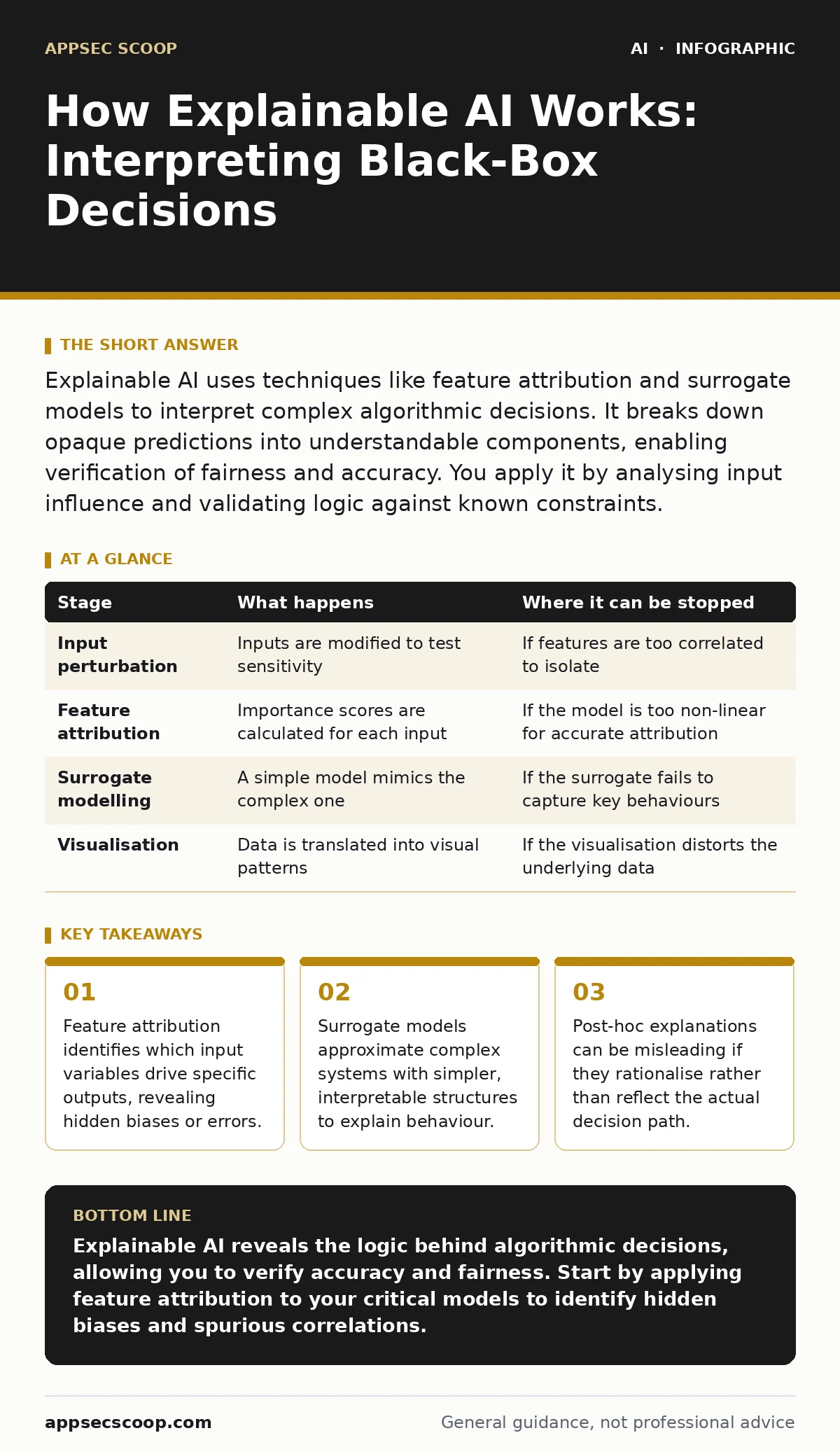
Explainable AI uses techniques like feature attribution and surrogate models to interpret complex algorithmic decisions. It breaks down opaque predictions into understandable components, enabling verification of fairness and accuracy. You apply it by analysing input influence and validating logic against known constraints.
The opacity of modern models
Modern machine learning systems often operate as black boxes. They ingest vast amounts of data and produce predictions with high accuracy, yet their internal reasoning remains invisible. This opacity creates a trust gap. You cannot verify why a system denied a transaction or flagged an anomaly if you cannot see the logic. Explainable AI, often abbreviated as XAI, addresses this gap. It provides methods to interpret, understand, and trust the decisions made by these systems. It does not make the model simpler; it makes the output comprehensible.
The goal is not to replace the complex model with a simple one. Simple models often lack the predictive power needed for complex tasks. Instead, XAI adds a layer of interpretation. This layer bridges the divide between raw algorithmic output and human understanding. It allows security teams to audit decisions for fairness, accuracy, and compliance. Without this layer, you are relying on faith rather than evidence.
The spectrum of interpretability
Interpretability exists on a spectrum. At one end are inherently interpretable models, such as linear regression or decision trees. You can read their logic directly. At the other end are opaque models, such as deep neural networks. These contain millions of parameters that interact in non-linear ways. XAI techniques fall into two main categories: intrinsic and post-hoc. Intrinsic interpretability is built into the model structure. Post-hoc interpretability is applied after the model has made a prediction. Most advanced systems require post-hoc methods because their complexity defies intrinsic explanation.
Understanding where a model sits on this spectrum determines your approach. If a model is inherently interpretable, you inspect its weights or rules. If it is opaque, you must use external tools to probe its behaviour. This distinction matters for audit trails and regulatory compliance. You cannot audit what you cannot see, and post-hoc methods provide that visibility.
### Stage 1: Input perturbation
The first stage in many XAI techniques involves perturbing the input. You take the original data point that triggered a prediction and modify it slightly. Then you observe how the prediction changes. This process reveals which features the model relies on. If changing a single variable causes the output to flip, that variable is influential. This method is known as sensitivity analysis. It helps you identify the boundaries of the model’s decision space.
Imagine a system that flags network traffic as malicious. You alter the packet size in the test data. If the flag remains, size is not the deciding factor. If the flag drops, size is critical. This stage isolates variables. It strips away noise and highlights the signals the model actually uses. It is a foundational step for more complex attribution methods.
### Stage 2: Feature attribution
Feature attribution assigns importance scores to each input variable. It answers the question: how much did this specific input contribute to the final output? Techniques like SHAP (SHapley Additive exPlanations) use game theory to distribute credit among features. They calculate the marginal contribution of each feature across all possible combinations. This provides a global view of model behaviour and a local view for individual predictions.
This stage is where you uncover bias. If a model consistently attributes high importance to a protected characteristic, such as location or age, it may be unfair. Feature attribution makes this visible. It allows you to challenge the model’s logic. You can see if the model is using proxies for sensitive data. This transparency is vital for ethical AI deployment.
### Stage 3: Surrogate modelling
When feature attribution is insufficient, you may use a surrogate model. This is a simpler, interpretable model trained to mimic the predictions of the complex black box. For example, you might train a decision tree to replicate the output of a neural network. The decision tree is easy to read. It shows the rules the black box appears to follow. This technique is known as model-agnostic explanation. It works regardless of the underlying algorithm.
The surrogate model does not reveal the true inner workings of the black box. It only approximates its behaviour. This is a critical limitation. The surrogate might be correct for the data you tested but fail elsewhere. You must validate the surrogate’s fidelity. If it does not match the black box closely, its explanations are unreliable. This stage trades accuracy for clarity.
### Stage 4: Visualisation and narrative
The final stage involves presenting the findings. Raw numbers and scores are difficult to digest. Visualisations, such as heatmaps or partial dependence plots, translate data into patterns. Heatmaps show which parts of an image or text influenced the decision. Partial dependence plots show how the output changes as one variable varies. These visuals create a narrative. They tell the story of the model’s reasoning.
This stage is not just about aesthetics. It is about communication. You need to explain the model’s decisions to stakeholders who may not be technical. Clear visuals build trust. They allow for faster identification of errors. If a heatmap highlights irrelevant features, you know the model is flawed. This stage closes the loop between analysis and action.
Reading the explanations
Interpreting XAI outputs requires caution. Explanations are approximations, not truths. They reflect the model’s behaviour at a specific point in time. They may not generalise. You must look for consistency. If the explanation changes wildly with small input variations, the model is unstable. You should also check for spurious correlations. The model might rely on a feature that is statistically linked to the outcome but causally irrelevant.
For instance, a model might associate a specific background colour with a threat. This is a spurious correlation. It will fail in new environments. XAI helps you spot these flaws. It allows you to question the model’s assumptions. You must treat explanations as hypotheses, not facts. Verify them with domain knowledge and additional testing.
| Stage | What happens | Where it can be stopped |
|---|---|---|
| Input perturbation | Inputs are modified to test sensitivity | If features are too correlated to isolate |
| Feature attribution | Importance scores are calculated for each input | If the model is too non-linear for accurate attribution |
| Surrogate modelling | A simple model mimics the complex one | If the surrogate fails to capture key behaviours |
| Visualisation | Data is translated into visual patterns | If the visualisation distorts the underlying data |
Applying XAI in practice
Integrating XAI into your workflow requires discipline. You cannot apply it ad hoc. It must be part of the model development lifecycle. Start with simple models where possible. Use XAI to validate complex models. Document the explanations. Store them alongside the model logs. This creates an audit trail. It allows you to revisit decisions and understand their basis.
You should also consider the trade-offs. XAI adds computational overhead. It slows down the prediction process. In real-time systems, this delay may be unacceptable. You must balance interpretability with performance. Choose techniques that fit your constraints. Post-hoc methods are often lighter than retraining surrogate models.
The limits of explanation
No XAI technique provides a complete picture. They all involve approximations. SHAP values assume feature independence, which is rarely true in real data. Surrogate models only approximate local behaviour. Visualisations can be misleading if not designed carefully. You must understand the limitations of each method. Blind trust in explanations is dangerous.
Furthermore, XAI does not guarantee fairness or accuracy. It only reveals the model’s logic. If the logic is flawed, XAI will show you that flaw. It does not fix it. You must use the insights to improve the model. Retrain it with better data or adjust the features. XAI is a diagnostic tool, not a cure.
Integrating with broader security
Explainable AI fits into a larger security framework. It complements other measures. For instance, it can help detect AI-generated phishing by analysing the linguistic features that trigger alerts. It can also assist in identifying sensitive data leaks through AI chatbots by tracing which inputs caused the leak. Understanding the model’s logic helps you tighten controls.
It also relates to AI transparency initiatives. Transparency is not just about disclosure; it is about understanding. XAI provides the technical basis for transparency. It allows you to verify claims about model behaviour. This is particularly relevant for AI agents that make autonomous decisions. You need to know why an agent took a specific action.
Key takeaways
- Feature attribution identifies which input variables drive specific outputs, revealing hidden biases or errors.
- Surrogate models approximate complex systems with simpler, interpretable structures to explain behaviour.
- Post-hoc explanations can be misleading if they rationalise rather than reflect the actual decision path.
Explainable AI reveals the logic behind algorithmic decisions, allowing you to verify accuracy and fairness. Start by applying feature attribution to your critical models to identify hidden biases and spurious correlations.
Frequently asked questions
Does explainable AI make models less accurate?
No, XAI does not change the model’s accuracy. It adds an interpretation layer that may add computational cost but does not alter the prediction itself.
Can XAI detect bias in machine learning models?
Yes, by revealing which features drive decisions, XAI can highlight reliance on protected or irrelevant characteristics, indicating potential bias.
Is XAI suitable for real-time systems?
It depends on the technique. Lightweight methods like feature attribution can be used in real-time, while surrogate modelling may add too much latency.
How does XAI relate to AI transparency?
XAI provides the technical means to achieve transparency by making model decisions interpretable to humans, supporting accountability and trust.
How this guide was produced: written by the AppSec Scoop editorial team with AI assistance, checked against the public references listed below, and reviewed when the facts change. See our editorial policy or report an error.