
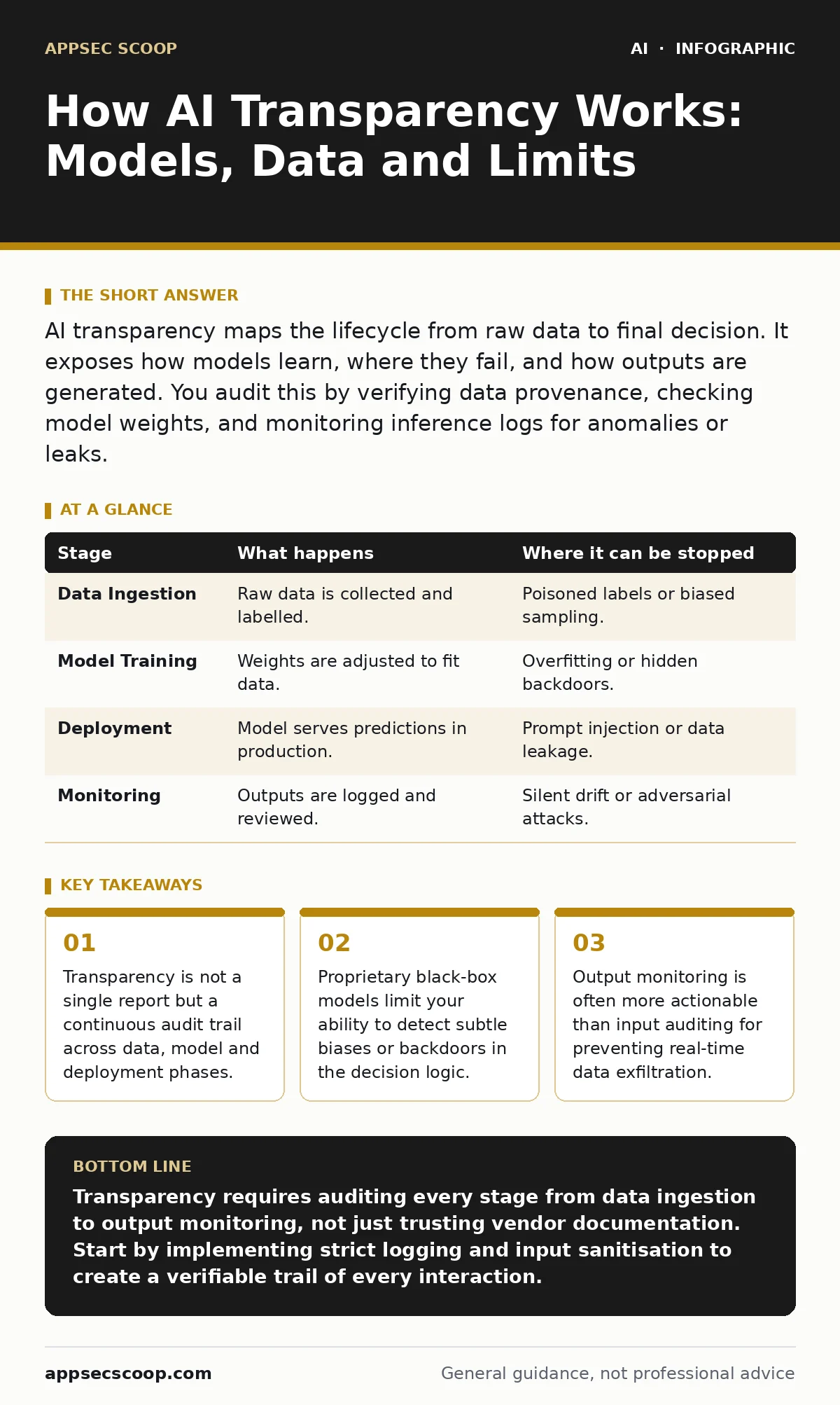
AI transparency maps the lifecycle from raw data to final decision. It exposes how models learn, where they fail, and how outputs are generated. You audit this by verifying data provenance, checking model weights, and monitoring inference logs for anomalies or leaks.
Defining the Scope of Visibility
AI transparency is not a marketing claim. It is the technical capacity to trace how a system transforms input into output. Most organisations assume that if a vendor provides documentation, the system is transparent. This assumption fails when the underlying mechanics remain hidden behind proprietary interfaces. You must distinguish between explainability, which describes why a specific decision was made, and interpretability, which describes how the entire model functions.
True transparency requires access to the data lineage, the model architecture and the inference logs. Without these three pillars, you are operating in a blind spot. The opacity of modern neural networks means that even the creators often cannot explain specific weight interactions. You must therefore build your own verification layer on top of whatever documentation the provider supplies.
The Stages of AI Auditing
You cannot audit an AI system as a monolith. You must break it down into discrete stages. Each stage introduces unique risks and requires specific verification methods. The table below outlines the standard lifecycle and where control can be lost.
| Stage | What happens | Where it can be stopped |
|---|---|---|
| Data Ingestion | Raw data is collected and labelled. | Poisoned labels or biased sampling. |
| Model Training | Weights are adjusted to fit data. | Overfitting or hidden backdoors. |
| Deployment | Model serves predictions in production. | Prompt injection or data leakage. |
| Monitoring | Outputs are logged and reviewed. | Silent drift or adversarial attacks. |
Stage 1: Data Provenance and Hygiene
The first point of failure is the training data. If the input contains historical bias, the model will encode that bias into its weights. You must verify the source of every dataset. This includes checking for copyright violations, personally identifiable information and skewed representations.
Imagine a hiring tool trained on resumes from a single decade. It will inevitably favour the language and career paths of that era. Transparency here means having a manifest of the data sources. You should demand to see the data processing pipeline. If the vendor cannot show you how data was cleaned, you cannot trust the neutrality of the model.
Stage 2: Model Architecture and Weights
The model itself is a complex mathematical structure. In open-source models, you can inspect the weights and biases. In proprietary models, you cannot. This distinction dictates your risk posture. When you cannot see the weights, you must treat the model as an untrusted oracle.
You should focus on the model’s architecture type. Transformer-based models, for instance, have specific attention mechanisms that can be analysed for focus points. Understanding the architecture helps you anticipate failure modes. If you are using a black-box model, you must rely on rigorous output testing rather than internal inspection. This is where the concepts in tokens in language models become relevant, as tokenisation choices affect how the model perceives input.
Stage 3: Inference and Prompt Handling
Inference is the stage where the model generates a response to a new input. This is where most real-time attacks occur. Prompt injection attacks trick the model into ignoring its safety instructions. You must assume that any input from an untrusted source could contain malicious instructions.
Transparency at this stage means logging every prompt and every response. You need to see exactly what the model saw and what it decided to output. This allows you to detect when the model deviates from its expected behaviour. Without these logs, you cannot prove that the model followed its constraints.
See also: Training Data Leakage Explained: How AI Memorises Your Secrets · AI-Generated Phishing: Risks and Protection for Small Businesses
Stage 4: Output Monitoring and Feedback
The final stage is monitoring the outputs in production. Models can drift over time as the nature of the input data changes. This drift can lead to degraded performance or new biases. You must establish baseline metrics for acceptable output quality and safety.
Automated monitoring tools can flag anomalous responses. However, you still require human review for edge cases. The feedback loop from monitoring back to training is critical. If you detect a failure mode, you must have a process to update the model or adjust the prompts. This continuous cycle is the only way to maintain transparency over time.
Applying Transparency Frameworks
You do not need to build this audit trail from scratch. Frameworks like MITRE ATLAS provide a structured approach to mapping AI threats. These frameworks help you identify specific attack vectors at each stage of the lifecycle. Using a standard framework ensures that you are not missing common failure modes.
You should also consider the implications of fine-tuning. When you fine-tune a base model on your own data, you introduce new variables. The transparency of the base model does not guarantee the transparency of the fine-tuned version. You must audit the fine-tuning process separately.
The Limits of Vendor Documentation
Vendor documentation is often a legal shield rather than a technical manual. It rarely reveals the specific mechanisms that lead to edge-case failures. You must treat vendor claims with scepticism. Independent verification is the only way to confirm that a model behaves as described.
This is where AI vendor assessments become critical. You need to evaluate the vendor’s own security practices and their commitment to transparency. If the vendor cannot provide detailed answers about their data sources or model architecture, you should assume the worst. The burden of proof lies with the provider, not the consumer.
Building Your Own Verification Layer
Since you cannot always trust the model’s internal logic, you must build an external verification layer. This layer sits between the user and the model. It sanitises inputs, monitors outputs and enforces policy constraints. This adds latency and cost, but it is necessary for security.
You should also prepare for the possibility of AI-generated phishing attacks that exploit the model’s outputs. If your model generates text, it could be used to craft convincing social engineering messages. Your verification layer must check for such patterns. Transparency is not just about understanding the model; it is about controlling its impact.
Key takeaways
- Transparency is not a single report but a continuous audit trail across data, model and deployment phases.
- Proprietary black-box models limit your ability to detect subtle biases or backdoors in the decision logic.
- Output monitoring is often more actionable than input auditing for preventing real-time data exfiltration.
Transparency requires auditing every stage from data ingestion to output monitoring, not just trusting vendor documentation. Start by implementing strict logging and input sanitisation to create a verifiable trail of every interaction.
Frequently asked questions
Can I trust open-source models for sensitive data?
Open-source models allow you to inspect the code and weights, reducing black-box risks. However, you must still audit the training data and monitor for data leakage in your specific deployment.
How do I detect prompt injection attacks?
Monitor for outputs that deviate from expected formats or contain instructions not present in the prompt. Implement input sanitisation to strip potential malicious commands before they reach the model.
Is fine-tuning safer than using a base model?
Fine-tuning allows you to align the model with your specific data and policies. However, it introduces new risks if the fine-tuning data is biased or contaminated. You must audit the fine-tuning process rigorously.
What is the role of MITRE ATLAS in transparency?
MITRE ATLAS provides a catalogue of AI attack techniques. It helps you identify specific threats at each stage of the AI lifecycle, allowing you to build targeted defences and monitoring checks.
How this guide was produced: written by the AppSec Scoop editorial team with AI assistance, checked against the public references listed below, and reviewed when the facts change. See our editorial policy or report an error.