
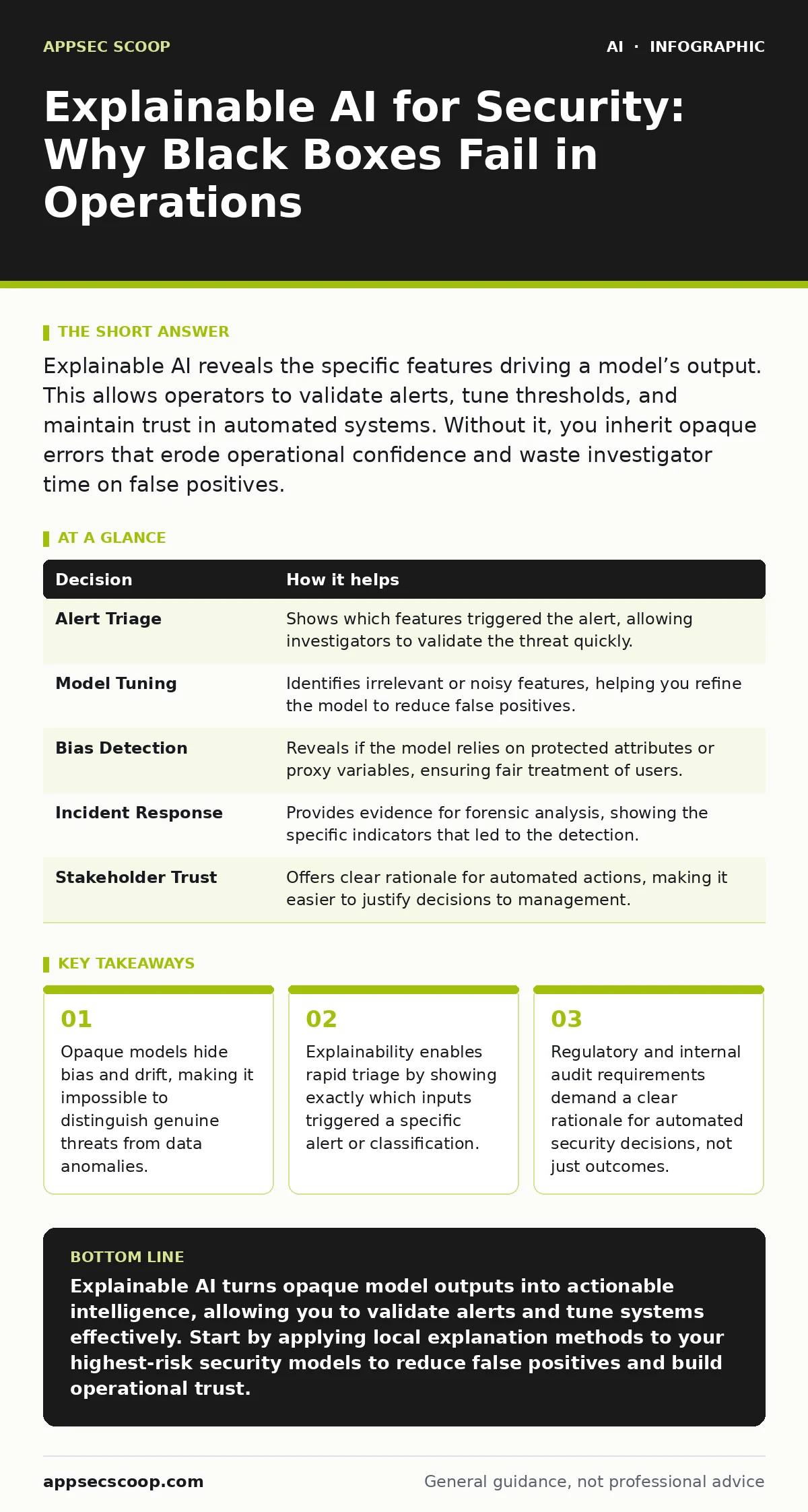
Explainable AI reveals the specific features driving a model’s output. This allows operators to validate alerts, tune thresholds, and maintain trust in automated systems. Without it, you inherit opaque errors that erode operational confidence and waste investigator time on false positives.
The Cost of Opacity in Security Operations
Security models are often treated as black boxes. You feed data in, and a decision comes out. This works until the model starts making errors. When a system flags a legitimate user as malicious, you need to know why. Without that insight, you are left guessing whether the model is broken, the data is stale, or the user is actually compromised.
The problem is not just incorrect outputs. It is the inability to debug them. A model might rely on a spurious correlation that holds true in training data but fails in production. For example, it might associate a specific software version with malware because that version was prevalent during a past outbreak. When that software updates, the model’s logic breaks, but you will not see it without explainability.
This opacity creates a hidden tax on your operations. Investigators spend hours verifying alerts that lack context. They cannot prioritise threats effectively because the system provides no rationale for its confidence level. Over time, this leads to alert fatigue. Teams begin to ignore the system entirely, reverting to manual processes that are slower and less consistent.
Mechanisms of Model Interpretation
Explainable AI (XAI) is not a single tool. It is a collection of techniques designed to make model decisions intelligible to humans. These methods fall into two categories: global and local explanations. Global explanations describe how the model behaves across all data. They show which features generally influence decisions. Local explanations focus on a single prediction. They tell you why a specific alert was generated.
Feature importance is a common global method. It ranks input variables by their impact on the model’s output. This helps you understand the model’s general strategy. However, it does not explain individual cases. A feature might be important overall but irrelevant for a specific user.
For individual alerts, you need local methods like SHAP (SHapley Additive exPlanations) or LIME (Local Interpretable Model-agnostic Explanations). These techniques approximate the model’s behaviour around a specific data point. They show which inputs pushed the prediction toward a positive or negative outcome. This is critical for triage. An investigator can look at the contributing factors and decide if they make sense.
Contrasting Operational Realities
The difference between using XAI and ignoring it is visible in daily workflows. Consider two teams facing a surge in anomalous login attempts. The first team uses a black-box model. They see a spike in alerts but no context. They must manually review every case, looking for patterns. This is slow and error-prone. They might miss a subtle attack because they do not know what to look for.
The second team uses an explainable model. The system highlights that the alerts are driven by unusual geolocation combined with a rare device fingerprint. The team can immediately investigate this specific combination. They can rule out false positives caused by travel or new hardware. They can also adjust the model to reduce noise from these benign patterns.
Decision Support in Practice
Explainability transforms how you interact with security models. It moves you from passive monitoring to active management. You can make informed decisions about tuning, deployment, and response. The table below outlines key decisions and how XAI supports them.
| Decision | How it helps |
|---|---|
| Alert Triage | Shows which features triggered the alert, allowing investigators to validate the threat quickly. |
| Model Tuning | Identifies irrelevant or noisy features, helping you refine the model to reduce false positives. |
| Bias Detection | Reveals if the model relies on protected attributes or proxy variables, ensuring fair treatment of users. |
| Incident Response | Provides evidence for forensic analysis, showing the specific indicators that led to the detection. |
| Stakeholder Trust | Offers clear rationale for automated actions, making it easier to justify decisions to management. |
This support is not just about efficiency. It is about accuracy. When you understand why a model makes a decision, you can spot when it is wrong. You can intervene before a false positive causes disruption or a false negative allows a breach.
Integration with Existing Frameworks
Explainability does not exist in a vacuum. It fits into broader governance and operational structures. The NIST AI Risk Management Framework provides a structured approach to managing AI risks. Explainability addresses the "map" and "measure" functions by providing visibility into model behaviour. It helps you map the model’s decision boundaries and measure its performance against expected outcomes.
You should also consider how XAI interacts with other AI technologies. For instance, AI agents that act autonomously require high levels of transparency. If an agent blocks a user account, you need to know why. Similarly, when using machine learning in cybersecurity for threat hunting, explainability helps hunters understand the patterns the model has found. This can lead to new hypotheses and improved detection rules.
Hidden Costs and Limitations
Explainability is not free. It requires additional compute resources and storage. Generating explanations for every prediction can slow down your system. You must balance the need for transparency with performance requirements. In high-throughput environments, you might only generate explanations for high-confidence alerts or random samples.
There is also a risk of misleading explanations. Some explanation methods are approximations. They might show features that are not actually used by the model. This can give you a false sense of security. Always validate explanations against the model’s actual behaviour. If the explanation does not match your domain knowledge, investigate further.
Finally, explainability does not guarantee correctness. A model can be perfectly explained and still be wrong. It can be biased, outdated, or poorly trained. XAI helps you detect these issues, but it does not fix them. You still need robust data pipelines, regular retraining, and human oversight.
Building a Culture of Transparency
Adopting explainable AI requires a shift in mindset. You must move from trusting the model to verifying the model. This means investing in tools that provide clear, actionable insights. It means training your team to interpret these insights and act on them. It means building processes that incorporate explainability into every stage of the model lifecycle.
Start by identifying your highest-risk models. These are the models that make decisions with significant operational impact. Apply explainability techniques to these models first. Use the insights to improve performance and build trust. As you gain experience, expand your use of XAI to other models.
The goal is not just to meet compliance requirements. It is to build better security systems. Systems that are accurate, fair, and reliable. Systems that your team can trust and use effectively. Explainability is the key to unlocking this potential.
Key takeaways
- Opaque models hide bias and drift, making it impossible to distinguish genuine threats from data anomalies.
- Explainability enables rapid triage by showing exactly which inputs triggered a specific alert or classification.
- Regulatory and internal audit requirements demand a clear rationale for automated security decisions, not just outcomes.
Explainable AI turns opaque model outputs into actionable intelligence, allowing you to validate alerts and tune systems effectively. Start by applying local explanation methods to your highest-risk security models to reduce false positives and build operational trust.
Frequently asked questions
Does explainable AI slow down real-time detection?
Yes, generating explanations adds computational overhead. Teams often use asynchronous processing or sample-based explanation to balance transparency with performance.
Can I use explainability to detect adversarial attacks?
Partially. Adversarial attacks often manipulate specific features to mislead the model. Explainability can highlight these unusual feature contributions, but it is not a dedicated defence against adversarial inputs.
How this guide was produced: written by the AppSec Scoop editorial team with AI assistance, checked against the public references listed below, and reviewed when the facts change. See our editorial policy or report an error.