
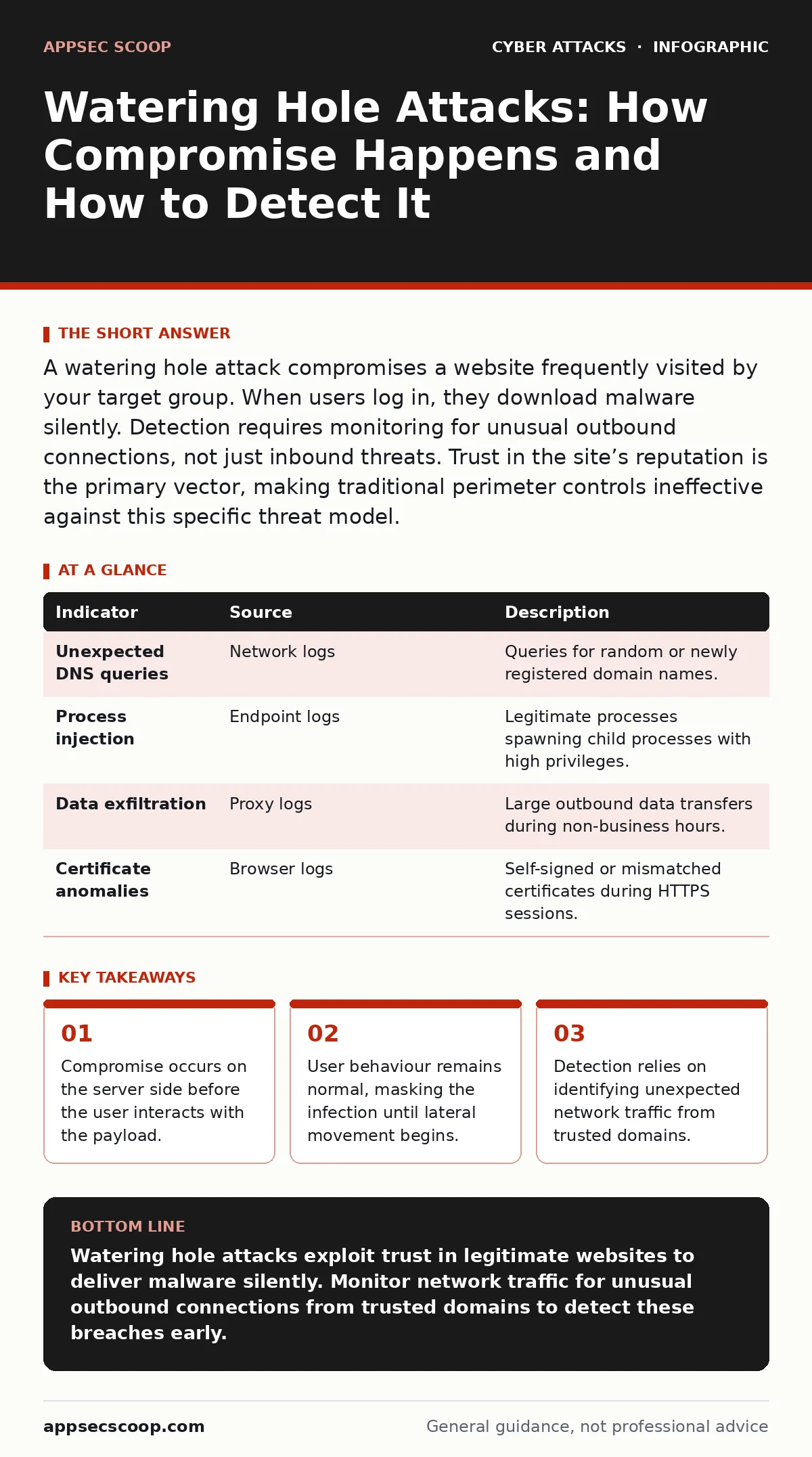
A watering hole attack compromises a website frequently visited by your target group. When users log in, they download malware silently. Detection requires monitoring for unusual outbound connections, not just inbound threats. Trust in the site’s reputation is the primary vector, making traditional perimeter controls ineffective against this specific threat model.
What defines a watering hole attack?
A watering hole attack involves compromising a legitimate website that a specific group of users visits regularly. The attacker injects malicious code into the site’s content, which executes when a victim loads the page. Unlike spam campaigns, this method targets a narrow audience with high precision. The site itself is not malicious; it is a trusted resource that has been hijacked.
How does the initial compromise occur?
The attacker typically exploits a vulnerability in the website’s content management system or third-party plugins. They gain write access to the server and insert a script into popular pages. This script often runs silently in the background of the victim’s browser. The user sees normal content while the malware downloads onto their device.
Why is user trust the primary weapon?
Security solutions often whitelist domains that are known and reputable. Users also lower their guard when visiting familiar industry forums or news outlets. This implicit trust bypasses psychological defences that might block suspicious links. The attack succeeds because the origin appears legitimate, both to the user and to automated filters.
Suppose an engineer visits a niche technical blog for updates. The blog has a long history and a strong reputation. When the engineer logs in, they do not suspect the site is compromised. This trust allows the payload to execute without triggering user-initiated blocks.
What happens after the user visits the site?
The injected code usually delivers a dropper, a small program that downloads the main malware payload. This secondary payload is often hosted on a different server to obscure the attack chain. The dropper may exploit a browser or plugin vulnerability to gain execution privileges. Once active, the malware attempts to establish persistence on the host machine.
How do attackers evade standard detection?
Standard intrusion detection systems focus on known signatures of malicious traffic. Watering hole attacks use clean domains and valid SSL certificates to appear normal. The malicious payload may be encrypted or obfuscated, hiding its true nature from static analysis. Because the traffic originates from a trusted source, it rarely triggers alerts.
This evasion technique makes the attack difficult to distinguish from normal browsing activity. The malware may also use domain generation algorithms to communicate with command and control servers. These domains change frequently, avoiding blacklist-based blocking.
See also: AI-assisted threat detection: how machine learning spots anomalies · Sandboxing: How Isolated Execution Stops Malware Before It Runs
What are the signs of a successful infection?
Early indicators are often subtle, such as increased CPU usage or unusual network connections. The malware may begin scanning the local network for other vulnerable hosts. Look for processes initiating connections to external IPs that are not part of normal business operations. Endpoint protection logs may show failed attempts to execute scripts from temporary directories.
| Indicator | Source | Description |
|---|---|---|
| Unexpected DNS queries | Network logs | Queries for random or newly registered domain names. |
| Process injection | Endpoint logs | Legitimate processes spawning child processes with high privileges. |
| Data exfiltration | Proxy logs | Large outbound data transfers during non-business hours. |
| Certificate anomalies | Browser logs | Self-signed or mismatched certificates during HTTPS sessions. |
Why is patching insufficient for prevention?
Patching fixes known vulnerabilities but does not address the trust model flaw. Attackers constantly discover new zero-day exploits that patches cannot prevent immediately. Relying solely on updates leaves a window of exposure where the site remains vulnerable. Furthermore, users may disable updates or run outdated software for compatibility reasons.
The real defence lies in reducing the attack surface and verifying the integrity of downloaded content. Even if a patch is missing, application control policies can prevent unknown executables from running. This shifts the focus from preventing entry to preventing execution.
How can organisations detect these attacks early?
Effective detection requires behavioural analysis rather than signature matching. Monitor for deviations in normal user browsing patterns and network traffic baselines. Look for multiple users accessing the same compromised resource around the same time. Correlate these events with alerts from endpoint detection systems.
Integrate threat intelligence feeds that track compromised domains in real time. However, be aware that these feeds may lag behind active attacks. Combine this with internal telemetry to identify anomalies that external sources miss.
What is the most effective response strategy?
Immediate isolation of affected hosts prevents lateral movement across the network. Revoke credentials for users who accessed the compromised site, as attackers may steal session tokens. Conduct a full forensic analysis to determine the scope of the breach. Update firewall rules to block communication with identified command and control servers.
Do not simply delete the malware; this leaves the persistence mechanisms intact. You must identify and remove all artifacts, including scheduled tasks and registry keys. Restore systems from known clean backups if the infection is deep.
How does this differ from spear phishing?
Spear phishing relies on deceptive emails to trick users into clicking malicious links. Watering hole attacks do not require user interaction beyond visiting a site. The email vector depends on social engineering, while the watering hole vector depends on server compromise. Both target specific groups, but the delivery mechanism is fundamentally different.
For deeper insights on email-based threats, see our guide on spear phishing. Understanding the distinction helps you tailor detection rules appropriately. Phishing detection focuses on email headers and link analysis, while watering hole detection focuses on web traffic and endpoint behaviour.
Key takeaways
- Compromise occurs on the server side before the user interacts with the payload.
- User behaviour remains normal, masking the infection until lateral movement begins.
- Detection relies on identifying unexpected network traffic from trusted domains.
Watering hole attacks exploit trust in legitimate websites to deliver malware silently. Monitor network traffic for unusual outbound connections from trusted domains to detect these breaches early.
Frequently asked questions
Can a VPN prevent a watering hole attack?
A VPN encrypts traffic but does not validate the safety of the destination. If the trusted site is compromised, the VPN will still transmit the malicious payload to your device.
How long does the malicious code stay on the site?
Attackers may keep the code active for weeks or months to maximize infections. They often change the injection point to avoid detection by site administrators.
Should I block all third-party scripts?
Blocking all third-party scripts breaks most modern websites. Instead, use strict Content Security Policies to allow only scripts from approved sources.
Is this similar to HTML smuggling?
HTML smuggling uses an innocent-looking page to trigger the download of a malicious payload. Watering holes inject this code directly into a trusted site’s infrastructure.
How this guide was produced: written by the AppSec Scoop editorial team with AI assistance, checked against the public references listed below, and reviewed when the facts change. See our editorial policy or report an error.