
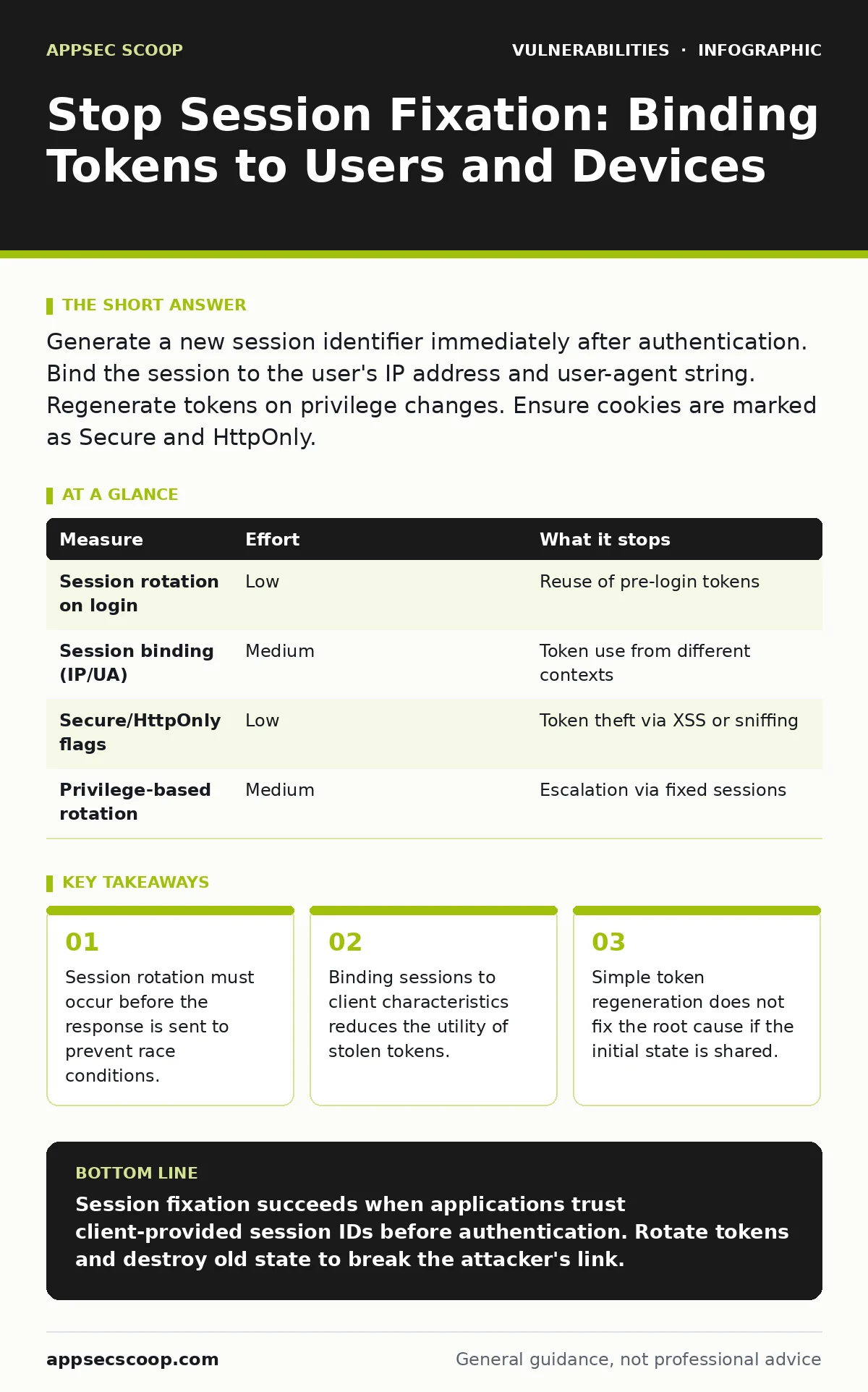
Generate a new session identifier immediately after authentication. Bind the session to the user's IP address and user-agent string. Regenerate tokens on privilege changes. Ensure cookies are marked as Secure and HttpOnly.
The Mechanism of State Hijacking
Session fixation exploits the trust an application places in a client-provided identifier. An attacker induces a victim to use a known session ID. When the victim authenticates, the application upgrades that known ID to an authenticated state. The attacker then uses the same ID to access the victim's account. This is distinct from session hijacking, where the attacker steals an already valid token. Here, the attacker sets the trap before the victim enters.
The vulnerability exists where the application accepts external input as the source of truth for session state. If your code allows a session_id parameter in the URL or accepts a cookie set by a third party, you open this door. The core failure is a lack of separation between unauthenticated and authenticated session spaces.
Why Rotation Alone Fails
Many teams believe that generating a new session ID upon login is sufficient. This measure is necessary but not sufficient. If the application logic reuses the same underlying session object or database record for both the pre-login and post-login states, the fix is incomplete. The attacker’s known ID remains valid because the backend never truly discarded the old state; it merely attached a new label to it.
Imagine a server that stores session data in memory. The user logs in. The server creates a new token but keeps the old session object alive for backward compatibility. The attacker still holds the key to that object. The new token is just a distraction. You must destroy the old session data entirely, not just rename it.
Binding Identity to Context
To reduce the value of a stolen or fixed token, you should bind the session to client-specific attributes. This includes the IP address and the user-agent string. If a request arrives with a valid session ID but a different IP or browser signature, the application should invalidate the session. This technique assumes the attacker is not on the same network as the victim and is using a different browser.
This binding introduces friction for legitimate users who switch networks or clear their browser cache. You must balance security with usability. A strict IP check may lock out mobile users who switch between Wi-Fi and cellular data. A user-agent check may fail if the browser updates automatically. Define acceptable tolerances for these changes before implementation.
Managing Privilege Escalation
Session fixation is not limited to the initial login event. Any change in user privilege level creates a similar risk. If a user moves from a viewer role to an administrator role, the session state changes. If the application does not regenerate the session ID at this point, an attacker who fixed the session during the viewer phase may gain administrative access.
You must treat privilege changes as authentication events. The same rotation logic applies. The old session, tied to lower privileges, must be terminated. A new session, tied to the higher privilege level, must begin. This prevents an attacker from leveraging a fixed low-privilege session to access high-privilege functions.
Cookie Configuration and Transport
The session identifier is usually stored in a cookie. If this cookie is sent over unencrypted HTTP, it is visible to anyone on the network. You must set the Secure flag, which instructs the browser to send the cookie only over HTTPS. You must also set the HttpOnly flag, which prevents client-side scripts from accessing the cookie. This mitigates cross-site scripting attacks that could steal the token.
However, these flags do not prevent session fixation. They only protect the token in transit and from local script access. If the attacker sets the cookie before the user logs in, these flags do not stop the fixation. They are a layer of defence in depth, not a solution to the state management flaw.
See also: Replay Attacks Example: How Stolen Data Becomes a Weapon · Password Hygiene: The Hidden Costs and Real Limits of Credential Care
What Does Not Work
Many proposed solutions are ineffective against determined attackers. Rate limiting login attempts stops brute force but does nothing for fixation. Captchas add friction but do not change the session state. Using complex token algorithms makes guessing harder but does not prevent the attacker from setting a known token.
The flaw is structural, not cryptographic. No amount of entropy in the token generation process fixes the issue if the application accepts a token from the attacker before the user authenticates. You must change how the application handles state transitions, not how it generates strings.
| Measure | Effort | What it stops |
|---|---|---|
| Session rotation on login | Low | Reuse of pre-login tokens |
| Session binding (IP/UA) | Medium | Token use from different contexts |
| Secure/HttpOnly flags | Low | Token theft via XSS or sniffing |
| Privilege-based rotation | Medium | Escalation via fixed sessions |
Implementation Checklist
You must verify your implementation against specific failure modes. The following checklist covers the most common gaps. These items address the structural weaknesses that allow fixation to succeed.
- Verify that the session ID changes immediately after authentication.
- Confirm that the old session data is deleted from the server.
- Check that session binding is enforced for critical operations.
Closing Actions
Session fixation persists because teams focus on token secrecy rather than state integrity. The token is not a secret; it is a handle. The security lies in ensuring that handle cannot be pre-registered by an adversary. You must audit your session management code for any path where an unauthenticated user can influence the session ID.
Review your software bill of materials (SBOM) to ensure your session management library is up to date. Older libraries often lack the strict state separation required to prevent this flaw. Understanding attack vectors in CVSS helps you prioritise this fix, as fixation often leads to full account takeover.
Key takeaways
- Session rotation must occur before the response is sent to prevent race conditions.
- Binding sessions to client characteristics reduces the utility of stolen tokens.
- Simple token regeneration does not fix the root cause if the initial state is shared.
Session fixation succeeds when applications trust client-provided session IDs before authentication. Rotate tokens and destroy old state to break the attacker's link.
Frequently asked questions
Does HTTPS prevent session fixation?
No. HTTPS encrypts the data in transit but does not prevent an attacker from setting a cookie before the user logs in.
Should I rotate sessions on every page load?
No. This is inefficient and may break functionality. Rotate on login, logout, and privilege changes.
Can I use IP binding for all users?
No. Mobile users and those behind NAT proxies will experience frequent lockouts. Use it selectively for high-risk actions.
Does a new token solve the problem?
Only if the old session data is destroyed. A new token with the old data still allows access via the fixed ID.
How this guide was produced: written by the AppSec Scoop editorial team with AI assistance, checked against the public references listed below, and reviewed when the facts change. See our editorial policy or report an error.