
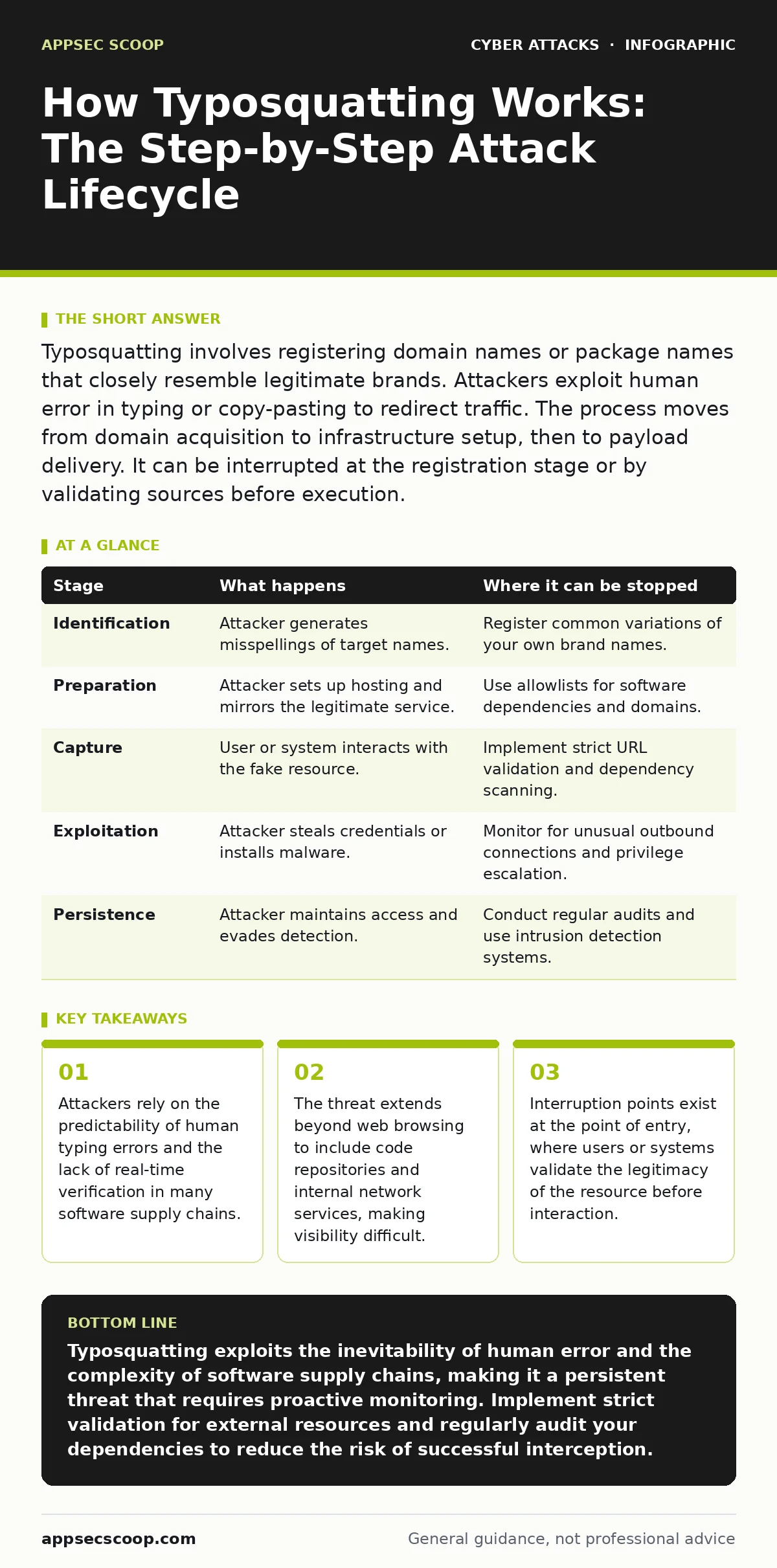
Typosquatting involves registering domain names or package names that closely resemble legitimate brands. Attackers exploit human error in typing or copy-pasting to redirect traffic. The process moves from domain acquisition to infrastructure setup, then to payload delivery. It can be interrupted at the registration stage or by validating sources before execution.
The Anatomy of a Misspelt Destination
Typosquatting is a form of cyber attack where an adversary registers a domain name, URL, or software package that is intentionally similar to a legitimate one. The goal is to capture traffic intended for the genuine service. This technique exploits the natural limitations of human memory and the mechanical errors inherent in typing.
The attacker does not need to force you to click a malicious link. They simply wait for you to make a mistake. When you type a web address or search for a library in your code editor, a single transposed letter or missing character can lead you astray. The success of this method relies entirely on the proximity of the fake resource to the real one in the digital namespace.
Stage 1: Target Identification and Domain Selection
The process begins with the attacker identifying high-value targets. These are usually widely used services, popular software libraries, or critical internal tools. The attacker uses algorithms to generate plausible misspellings of these targets. Common variations include swapping adjacent keys on a keyboard, doubling letters, or omitting vowels.
For example, a service named "cloudstorage" might have variants like "clouldstorage" or "cloudstorag". The attacker registers these variations across multiple top-level domains. This creates a wide net of potential entry points. The cost of registration is low, but the potential reward from capturing even a small fraction of traffic is high.
Stage 2: Infrastructure Preparation
Once the domains or package names are secured, the attacker sets up the hosting infrastructure. This often involves using compromised servers or bulletproof hosting providers that ignore abuse complaints. The attacker configures the web server or package repository to mirror the look and feel of the legitimate service.
In the case of code repositories, the attacker uploads a malicious version of a popular library. The code may appear identical to the legitimate version but contains hidden functions. These functions might exfiltrate environment variables or install backdoors. The infrastructure is designed to be persistent, allowing the attacker to update the payload without changing the domain name.
Stage 3: Traffic Capture and Redirection
The critical moment occurs when a user or automated system interacts with the typosquatted resource. This can happen through manual typing errors in a browser address bar. It can also occur through automated scripts that pull dependencies from a package manager. If the user types the wrong address, the browser connects to the attacker’s server.
The attacker’s server may immediately redirect the user to a phishing page. Alternatively, it may serve a malicious download. In software supply chains, the malicious package is installed alongside legitimate code. The attack remains silent until the malicious code is executed, often triggered by specific conditions such as a connection to a corporate network.
Stage 4: Exploitation and Data Exfiltration
Once the user is engaged, the attacker executes the payload. This stage varies depending on the initial vector. For web-based typosquatting, the attacker may present a login screen that looks identical to the legitimate service. When the user enters their credentials, the attacker captures them.
For software-based attacks, the malicious code may scan the local environment for sensitive files. It might access browser cookies, API keys, or configuration files. The data is then exfiltrated to a command and control server. The attacker may use this data for further attacks, such as CEO fraud or lateral movement within the network.
See also: How Malicious Email Attachments Work: The Execution Chain
Stage 5: Persistence and Evasion
Successful attackers do not rely on a single incident. They establish persistence to maintain access. This might involve installing additional malware or creating new user accounts. They also employ evasion techniques to avoid detection. This includes using encryption to hide network traffic and mimicking legitimate system processes.
The attacker may also rotate the infrastructure. If a domain is blocked, they switch to another registered variant. This makes tracking the threat difficult. The cycle of registration, hosting, and exploitation continues until the attacker is detected or the infrastructure is shut down.
| Stage | What happens | Where it can be stopped |
|---|---|---|
| Identification | Attacker generates misspellings of target names. | Register common variations of your own brand names. |
| Preparation | Attacker sets up hosting and mirrors the legitimate service. | Use allowlists for software dependencies and domains. |
| Capture | User or system interacts with the fake resource. | Implement strict URL validation and dependency scanning. |
| Exploitation | Attacker steals credentials or installs malware. | Monitor for unusual outbound connections and privilege escalation. |
| Persistence | Attacker maintains access and evades detection. | Conduct regular audits and use intrusion detection systems. |
Interruption Points and Defence Strategies
Defending against typosquatting requires a multi-layered approach. The most effective defence is prevention. Registering common misspellings of your domain names removes the attacker’s primary tool. However, this is not always feasible for large organisations.
Technical controls are equally important. Use domain name system filtering to block known malicious domains. Implement certificate transparency monitoring to detect unauthorized certificates issued for your brand. In software development, use lock files to pin dependencies to specific versions. This prevents accidental installation of malicious packages.
The Hidden Cost of Trust
Typosquatting succeeds because it exploits trust. Users trust that the address they typed is correct. Developers trust that the package they installed is legitimate. This trust is difficult to enforce technically. You cannot prevent a user from making a typo. You cannot always verify the integrity of third-party code.
The hidden cost is the constant vigilance required to maintain security. You must assume that any external input could be malicious. This mindset shift is challenging but necessary. It requires integrating security checks into every stage of the user journey and development lifecycle.
Integrating Typosquatting Awareness into Operations
To effectively manage this risk, you must integrate typosquatting awareness into your broader security operations. This goes beyond simple domain monitoring. It requires understanding how your users interact with external services. It also means recognising the signs of compromise in your software supply chain.
Consider how typosquatting fits into other attack vectors. It is often used in conjunction with watering hole attacks, where attackers compromise legitimate sites to infect visitors. It can also facilitate spear phishing, where the attacker uses a convincing domain to trick recipients. Understanding these connections helps you build a more resilient defence.
Your security posture should include regular tabletop exercises. These simulations help your team respond to incidents involving typosquatting. They reveal gaps in your detection and response capabilities. By practising these scenarios, you improve your ability to mitigate the impact of such attacks.
The Limits of Automation
While automation can help detect typosquatting, it has limits. Automated tools may flag false positives, blocking legitimate services. They may also miss novel variations that do not match known patterns. Human oversight is still required to validate findings and adjust strategies.
You must balance automation with manual review. Use automated tools to scan for potential threats, but involve security analysts in the decision-making process. This hybrid approach ensures that you do not miss subtle attacks while avoiding unnecessary disruptions to business operations.
Remember that typosquatting is a persistent threat. It will continue to evolve as new technologies emerge. Your defence must also evolve. Stay informed about new techniques and adjust your strategies accordingly. This ongoing effort is the only way to stay ahead of attackers.
Key takeaways
- Attackers rely on the predictability of human typing errors and the lack of real-time verification in many software supply chains.
- The threat extends beyond web browsing to include code repositories and internal network services, making visibility difficult.
- Interruption points exist at the point of entry, where users or systems validate the legitimacy of the resource before interaction.
Typosquatting exploits the inevitability of human error and the complexity of software supply chains, making it a persistent threat that requires proactive monitoring. Implement strict validation for external resources and regularly audit your dependencies to reduce the risk of successful interception.
Frequently asked questions
How do I know if a domain is a typosquat?
Compare the domain name carefully with the official address. Look for subtle differences in spelling, such as swapped letters or missing characters. Check the domain registration details and certificate information for inconsistencies.
Can typosquatting affect internal networks?
Yes, attackers can register domains that resemble internal services. If users type these addresses, they may connect to external malicious servers. This can lead to data exfiltration or malware installation within the internal network.
What is the difference between typosquatting and phishing?
Typosquatting relies on user error in typing or selecting a resource. Phishing relies on deception to trick the user into clicking a link. Both aim to steal credentials or install malware, but the initial vector differs.
How can I protect my software projects from typosquatting?
Use lock files to pin dependencies to specific versions. Verify the source of all packages before installation. Regularly audit your dependencies for unknown or suspicious packages. Implement automated scanning tools to detect potential threats.
How this guide was produced: written by the AppSec Scoop editorial team with AI assistance, checked against the public references listed below, and reviewed when the facts change. See our editorial policy or report an error.