
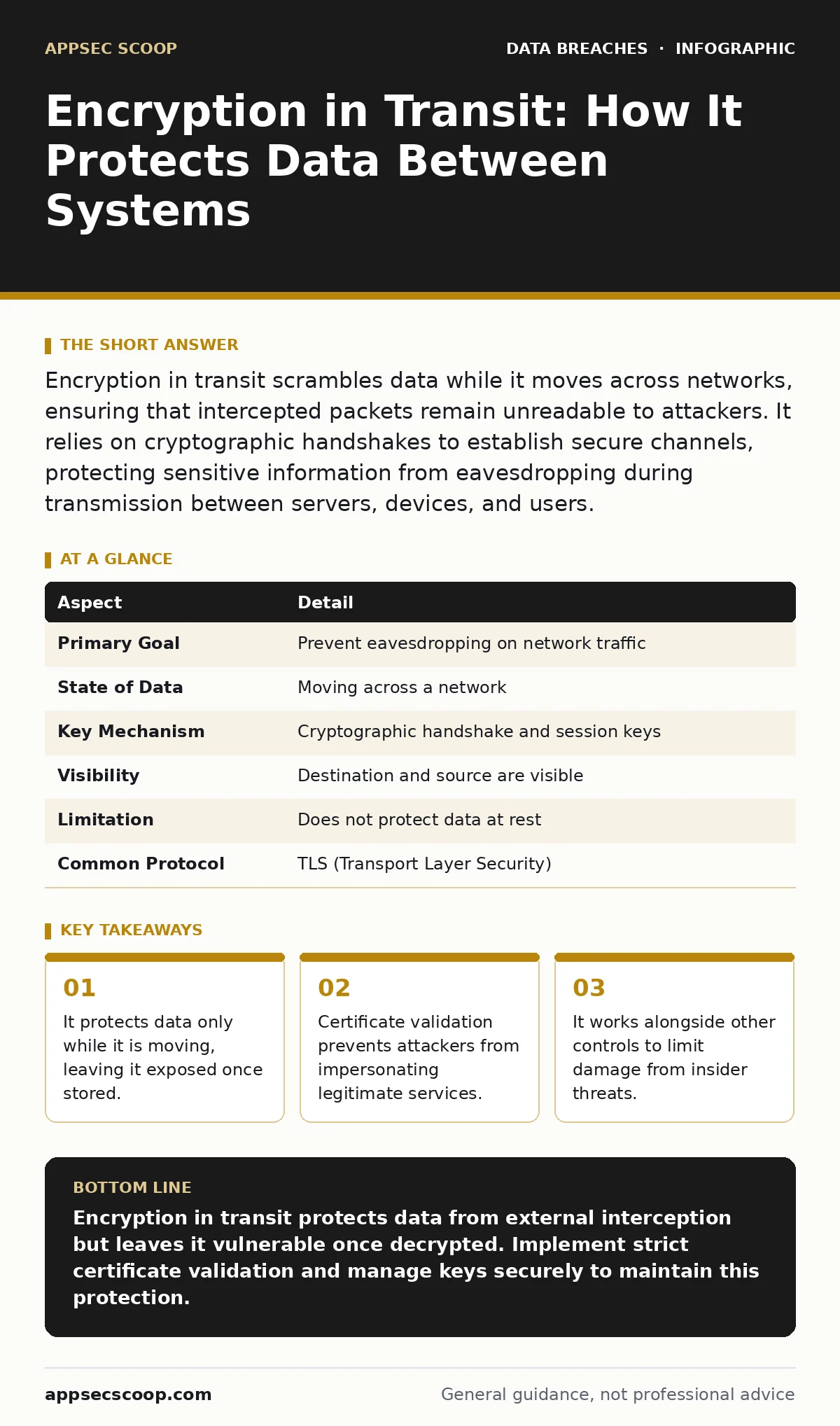
Encryption in transit scrambles data while it moves across networks, ensuring that intercepted packets remain unreadable to attackers. It relies on cryptographic handshakes to establish secure channels, protecting sensitive information from eavesdropping during transmission between servers, devices, and users.
The Postcard Analogy
Imagine sending a postcard. Anyone handling it can read the message. Encryption in transit is like placing that postcard inside a sealed, tamper-evident envelope. The postal worker can see the address, but not the contents. If someone intercepts the mail, they cannot read the message without the specific key to open the envelope.
This analogy highlights the core purpose. It does not hide where the data is going. It only hides what is inside. The destination remains visible to network observers, but the payload is obscured.
| Aspect | Detail |
|---|---|
| Primary Goal | Prevent eavesdropping on network traffic |
| State of Data | Moving across a network |
| Key Mechanism | Cryptographic handshake and session keys |
| Visibility | Destination and source are visible |
| Limitation | Does not protect data at rest |
| Common Protocol | TLS (Transport Layer Security) |
The Problem of Plain Text
Networks are inherently untrusted. Data travels through multiple routers, switches, and intermediate nodes before reaching its destination. Each hop is a potential point of interception. Without encryption, this traffic is plain text.
Plain text is readable by anyone with access to the network wire or the ability to monitor traffic. This includes malicious actors on the same Wi-Fi network, compromised routers, or state-level surveillance. The risk is not just theft. It is also modification. An attacker can alter the data in flight if they can read it.
Encryption solves this by rendering the intercepted data useless. Even if an attacker captures the entire stream, they possess only random noise. They cannot read, modify, or replay the data effectively without the decryption key.
The Mechanics of Secure Channels
The process begins with a handshake. The client and server introduce themselves and agree on a method of encryption. They exchange keys in a way that prevents eavesdroppers from deriving the secret. This is often done using asymmetric cryptography, where a public key encrypts data that only a private key can decrypt.
Once the handshake is complete, the connection switches to symmetric encryption. Symmetric keys are faster for bulk data transfer. The system generates a unique session key for that specific connection. This key is discarded after the session ends.
This two-step process balances security and performance. Asymmetric encryption is computationally expensive. Symmetric encryption is efficient. By using asymmetric methods only for the initial setup, systems maintain high throughput while keeping the channel secure.
Certificate Validation and Trust
Encryption alone is not enough. You must ensure you are talking to the right entity. This is where certificates come in. A digital certificate binds a public key to an identity, such as a domain name. It is issued by a trusted Certificate Authority.
When you connect to a service, the server presents its certificate. Your client software checks if the certificate is valid. It verifies the signature, the expiry date, and the domain name. If any check fails, the connection is aborted.
This prevents man-in-the-middle attacks. An attacker cannot simply create a fake server and intercept traffic. They would need a valid certificate for the target domain, which they cannot obtain without compromising the Certificate Authority or the domain owner.
Ignoring certificate errors is a common failure. Users often click through warnings to access a site. This bypasses the trust model. It allows an attacker to present a fake certificate and decrypt the traffic, rendering the encryption useless.
Integration with Broader Defences
Encryption in transit is one layer of a multi-layered strategy. It does not replace other controls. It complements them. For instance, password hygiene ensures that credentials are strong. Encryption ensures those credentials are not stolen during login.
It also works with secrets management. Secrets management systems store credentials and API keys securely. When an application needs to access a resource, it retrieves the secret and sends it over an encrypted channel. The combination ensures that secrets are protected both at rest and in transit.
Consider database security. Data is encrypted before it is written to the database. It is also encrypted when it is queried over the network. This dual approach ensures that even if an attacker gains access to the network traffic, they cannot read the data. And if they breach the database, they cannot read the stored data.
See also: Intrusion Detection for Small Business: Practical Low-Cost Methods · Data Masking: How to Hide Sensitive Data Without Breaking Applications
Common Misconceptions
Many believe that encryption in transit makes data completely safe. This is incorrect. It only protects the data while it is moving. Once it arrives, it must be decrypted to be used. This moment of decryption is a vulnerability.
Another misconception is that HTTPS guarantees a secure website. It only guarantees that the connection is encrypted. The website itself may be vulnerable to injection attacks or misconfigurations. The encryption layer does not validate the application logic.
Some also think that encryption hides metadata. It does not. The source, destination, and volume of traffic are still visible. This metadata can be used for profiling and targeting. Encryption in transit protects the payload, not the pattern of communication.
The Hidden Costs of Implementation
Implementing encryption in transit has costs. It adds latency. The handshake process takes time. This can slow down user experience, especially on high-latency networks. Systems must be tuned to balance security and performance.
There is also operational complexity. Managing certificates is not trivial. Certificates expire. They must be renewed. If a certificate expires, services go down. Automated renewal systems are required, but they add another layer of complexity to infrastructure.
Finally, there is the cost of key management. Keys must be generated, stored, rotated, and destroyed securely. Poor key management can lead to breaches. The encryption is only as strong as the weakest link in the key lifecycle.
Complementary Controls
To fully protect data, you must look beyond transit. Data masking can be used when displaying sensitive information to users who do not need full access. This reduces the risk if the application is compromised.
Data subject rights require that you can locate and delete user data. If data is encrypted and keys are lost, you may not be able to comply with deletion requests. Key management must support lifecycle operations.
Database exposure is a risk if internal networks are not segmented. Encryption in transit helps, but network segmentation limits the blast radius. If an attacker breaches one segment, they cannot easily move to others.
Printed document leaks are a physical risk. Encryption in transit does not protect paper. Physical security policies are needed to handle printed sensitive data. Digital and physical controls must coexist.
Data breach costs are driven by exposure. Reducing exposure through encryption, access controls, and monitoring lowers the potential impact. Encryption in transit is a single line of defence, but it is a critical one.
Key takeaways
- It protects data only while it is moving, leaving it exposed once stored.
- Certificate validation prevents attackers from impersonating legitimate services.
- It works alongside other controls to limit damage from insider threats.
Encryption in transit protects data from external interception but leaves it vulnerable once decrypted. Implement strict certificate validation and manage keys securely to maintain this protection.
Frequently asked questions
Does encryption in transit hide my IP address?
No, it only encrypts the data payload. The source and destination IP addresses remain visible in the packet headers, allowing network observers to see where traffic is flowing.
Can encryption in transit prevent data theft?
It prevents theft during transmission. If an attacker steals data from a server where it is stored or decrypted, encryption in transit offers no protection against that specific breach vector.
Is TLS the only protocol for encryption in transit?
No, while TLS is the standard for web traffic, other protocols like SSH for remote access and IPSec for site-to-site connections also provide encryption in transit for different use cases.
Do I need to encrypt all traffic?
You should encrypt all traffic containing sensitive data or authentication credentials. Encrypting all traffic is best practice to prevent metadata leakage and ensure consistent security postures across the network.
How this guide was produced: written by the AppSec Scoop editorial team with AI assistance, checked against the public references listed below, and reviewed when the facts change. See our editorial policy or report an error.