
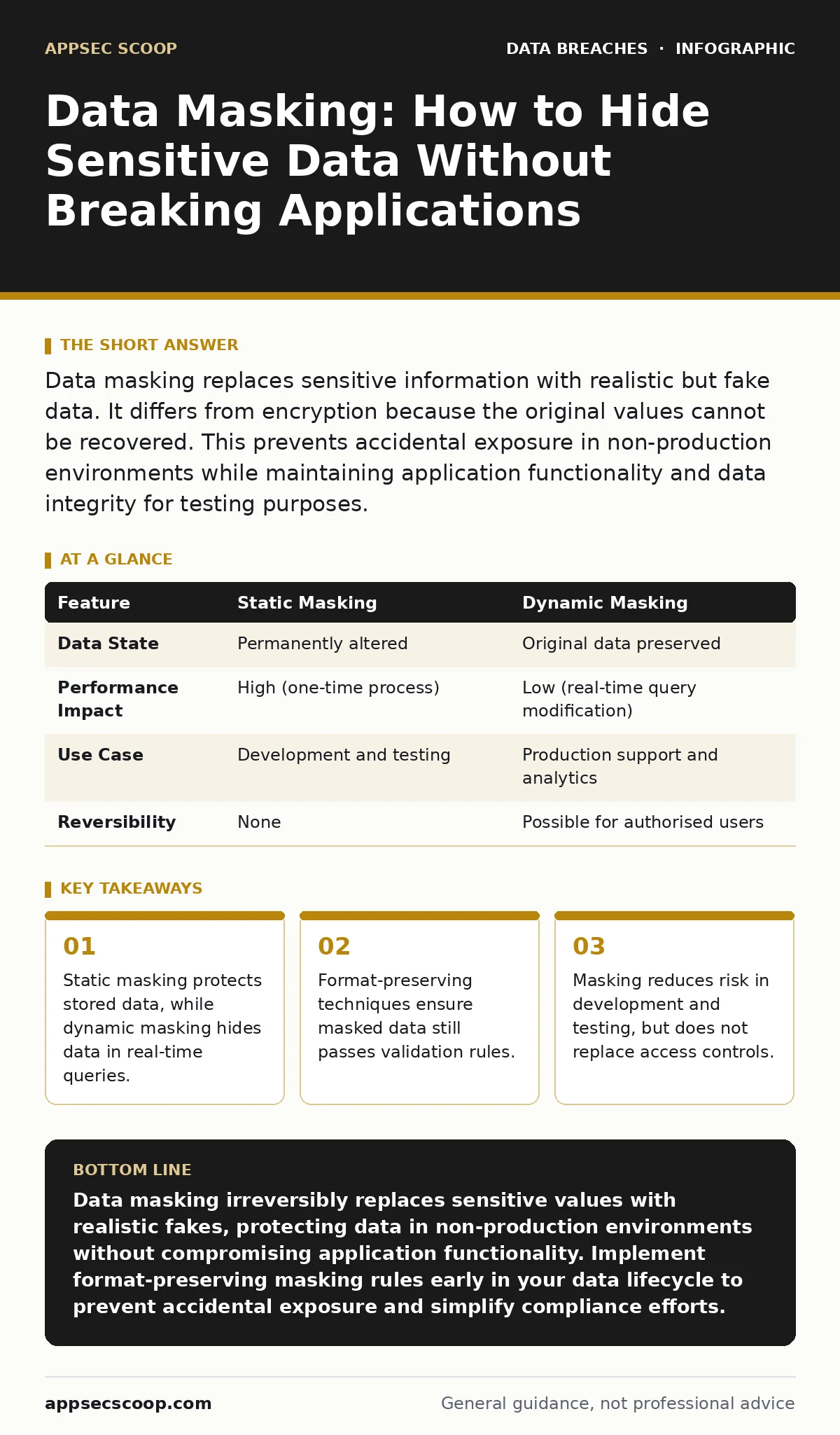
Data masking replaces sensitive information with realistic but fake data. It differs from encryption because the original values cannot be recovered. This prevents accidental exposure in non-production environments while maintaining application functionality and data integrity for testing purposes.
What is the difference between data masking and encryption?
Data masking replaces sensitive values with realistic but fictitious substitutes, whereas encryption transforms data into ciphertext that can be reversed with a key. Masking is irreversible; once the data is masked, the original value is lost. Encryption is reversible, meaning authorised users can decrypt the information back to its original state. You choose masking when you need to share data with parties who should never see the real values, such as third-party developers or testers.
Does data masking protect against internal threats?
Static data masking significantly reduces the risk of internal data theft by ensuring that non-production environments contain no real sensitive data. Developers and testers working with masked datasets cannot exfiltrate genuine customer records because none exist in those systems. However, masking does not protect data in production environments where real values are required for business operations. You must combine masking with strict access controls to mitigate insider risks effectively.
How does dynamic masking differ from static masking?
Dynamic masking hides data in real-time based on the user’s identity or context, while static masking permanently alters the data at rest. When a user with insufficient privileges queries a database, dynamic masking returns obscured values on the fly. The underlying data remains unchanged and accessible to authorised administrators. This approach is useful for sharing live production data with support teams who need context but not personal details.
Imagine a support agent viewing a customer profile. If the system detects the agent lacks ‘full data’ permissions, it replaces the credit card number with asterisks. The agent sees the structure of the record but not the sensitive content. This prevents accidental exposure during troubleshooting without requiring a separate masked copy of the database.
Will masking break my application’s validation rules?
Format-preserving data masking ensures that the substituted data matches the original format, length, and character set. This technique allows masked data to pass standard validation checks, such as email formats or postal code structures. Without format preservation, applications may reject masked data as invalid, causing test failures or system errors. You must configure the masking engine to respect these structural constraints to maintain application stability.
| Feature | Static Masking | Dynamic Masking |
|---|---|---|
| Data State | Permanently altered | Original data preserved |
| Performance Impact | High (one-time process) | Low (real-time query modification) |
| Use Case | Development and testing | Production support and analytics |
| Reversibility | None | Possible for authorised users |
Can masked data be reverse-engineered?
Well-implemented static masking uses deterministic or random algorithms that prevent statistical reconstruction of original values. Deterministic masking ensures the same input always produces the same output, maintaining referential integrity across tables. Random masking generates unique substitutes for each instance, offering higher security but breaking relationships between records. You must assess the risk of correlation attacks when choosing between these methods.
See also: Encryption in Transit: How It Protects Data Between Systems · NoSQL Injection Recovery: Stabilise, Eradicate and Prevent Recurrence
How does masking affect database performance?
Static masking is a batch process that occurs during data extraction or loading, so it does not impact runtime performance. Once the data is masked, queries run at normal speed against the clean dataset. Dynamic masking, however, adds computational overhead to every query because the system must evaluate permissions and transform data in real-time. This latency can become significant in high-throughput environments with complex masking rules.
Is data masking sufficient for compliance requirements?
Regulatory frameworks often require the protection of personally identifiable information, but they rarely mandate masking specifically. Masking helps demonstrate due diligence by reducing the amount of real sensitive data in your environment. It supports compliance by minimising the scope of data subject rights requests and reducing the impact of potential breaches. You should review specific legal obligations to determine if masking meets your jurisdiction’s requirements.
What are the hidden costs of implementing data masking?
The primary cost is not the software licence but the ongoing maintenance of masking rules and policies. Data schemas change frequently, requiring updates to masking configurations to ensure new fields are protected. Poorly maintained rules can lead to unmasked data leaking into test environments or masked data breaking application logic. You must allocate resources for continuous monitoring and rule refinement to keep the masking strategy effective.
How does masking relate to data breach costs?
By removing real sensitive data from non-production systems, masking reduces the potential financial impact of a security incident. If a tester’s laptop is stolen, the attacker gains access to fake data rather than genuine customer records. This limits liability and regulatory fines associated with data exposure. While masking does not prevent all breaches, it significantly lowers the severity of incidents involving development and testing environments.
Can masking help with data subject rights requests?
Masking simplifies the process of fulfilling data erasure or access requests by isolating sensitive data from general datasets. When data is masked in non-production systems, you do not need to search and delete real records from those environments. This reduces the operational burden of responding to individual data rights requests. You can focus your efforts on production systems where real data resides, improving response times and accuracy.
Key takeaways
- Static masking protects stored data, while dynamic masking hides data in real-time queries.
- Format-preserving techniques ensure masked data still passes validation rules.
- Masking reduces risk in development and testing, but does not replace access controls.
Data masking irreversibly replaces sensitive values with realistic fakes, protecting data in non-production environments without compromising application functionality. Implement format-preserving masking rules early in your data lifecycle to prevent accidental exposure and simplify compliance efforts.
Frequently asked questions
Does data masking work for cloud databases?
Yes, most cloud providers offer native masking tools or support third-party solutions that can mask data before it leaves the production environment or within the cloud storage itself.
Can I use the same masked data for different testing teams?
Deterministic masking allows consistent substitutes across environments, enabling different teams to work with the same fake data without conflicts, provided the masking rules are shared.
Is dynamic masking secure against SQL injection?
Dynamic masking protects data visibility but does not prevent SQL injection attacks. You must still use parameterised queries and input validation to secure the database from malicious code execution.
How often should I review my masking policies?
Review masking policies whenever data schemas change or new sensitive fields are added. Regular audits ensure that masking rules remain aligned with current data structures and security requirements.
How this guide was produced: written by the AppSec Scoop editorial team with AI assistance, checked against the public references listed below, and reviewed when the facts change. See our editorial policy or report an error.