
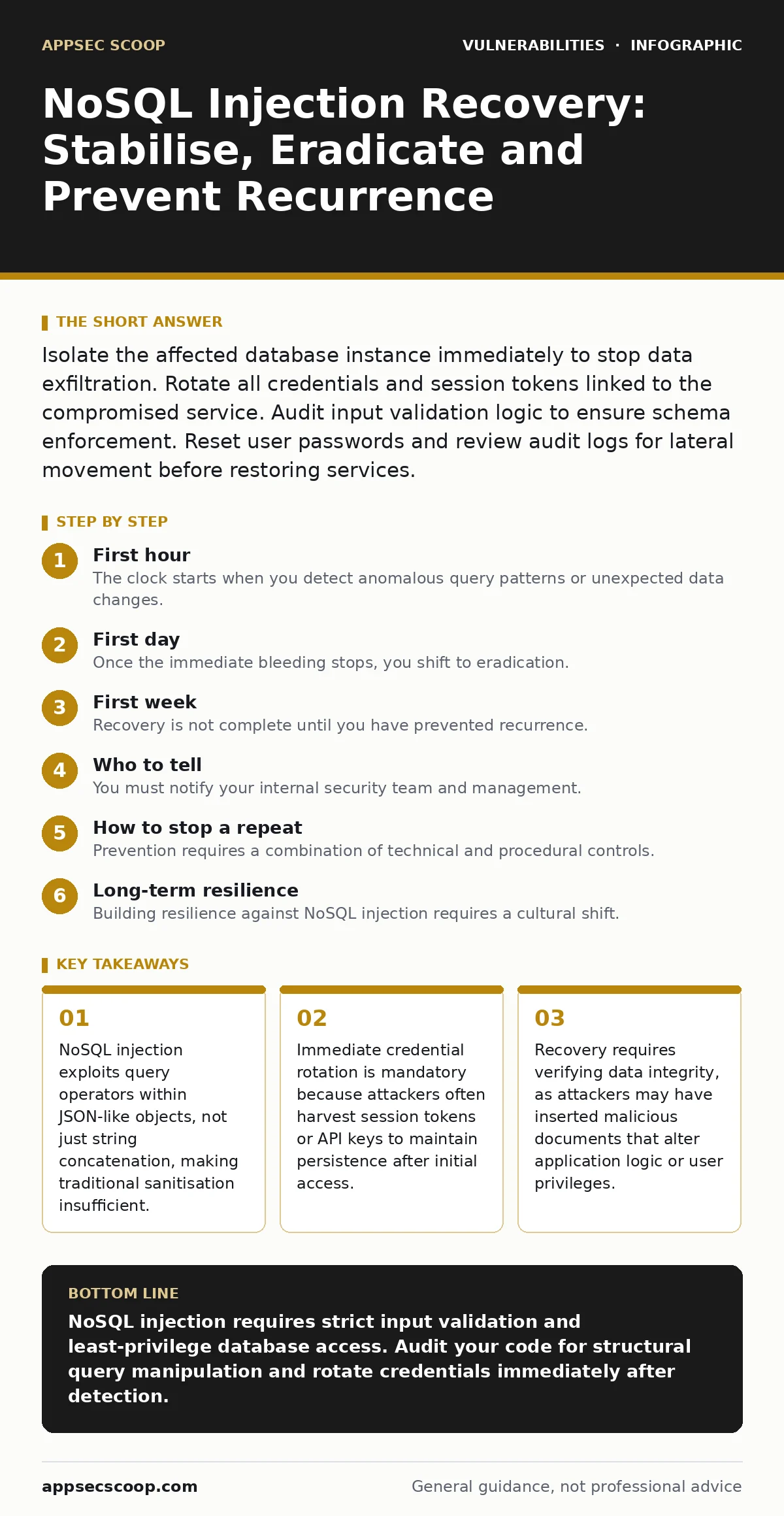
Isolate the affected database instance immediately to stop data exfiltration. Rotate all credentials and session tokens linked to the compromised service. Audit input validation logic to ensure schema enforcement. Reset user passwords and review audit logs for lateral movement before restoring services.
First hour
The clock starts when you detect anomalous query patterns or unexpected data changes. Your primary goal is to limit the blast radius. NoSQL injection differs from SQL injection because it often targets the structure of the query itself. An attacker inserts operators like $gt (greater than) or $ne (not equal) into input fields. This allows them to bypass authentication or extract entire collections.
Immediate Containment Checklist
- Disconnect the compromised database instance from the application layer.
- Block the source IP addresses associated with the malicious traffic at the firewall.
- Rotate the database user credentials used by the application.
- Invalidate all active user sessions and API keys.
- Enable verbose logging on the database and application servers.
Isolating the Damage
You must determine if the breach is isolated. Check the database logs for queries that use comparison operators on unexpected fields. Look for queries that return full collections instead of single documents. If the attacker has written to the database, you need to identify which documents were modified. This is harder than in SQL databases because NoSQL systems often allow schema-less writes. An attacker can inject a new field into a user document, such as "admin": true. This change persists even if you patch the application code.
First day
Once the immediate bleeding stops, you shift to eradication. You need to find every point where user input reaches the database driver. NoSQL drivers often accept objects directly. If you pass user input into these objects without validation, the driver treats it as a query structure. This is a common mistake in frameworks that auto-map JSON payloads to database queries.
Auditing Input Validation
Review your application code for any place where user input is used in a database query. Do not rely on escaping characters. NoSQL injection relies on structural manipulation. You must enforce a strict schema. If a field is supposed to be a string, reject any input that contains an object or an operator. Use allowlists for field names. If an attacker tries to inject $where, your validation layer should reject the key name before it reaches the driver.
This approach aligns with the principles of a secure software development lifecycle. By embedding validation checks early in the development process, you reduce the likelihood of logic errors that lead to injection flaws. It is also worth considering your vulnerability severity ratings when prioritising which endpoints to fix first. Endpoints that handle authentication or administrative functions require immediate attention.
Assessing Data Integrity
You must verify that the data in your database is trustworthy. An attacker may have modified user roles or inserted malicious configuration data. Review the audit logs for any update or insert operations that originated from the compromised application instance. Compare the current state of critical documents with known good backups. If you cannot verify the integrity of the data, you must restore from a clean backup. This is a costly step, but it is necessary if the attacker has tampered with the data structure.
First week
Recovery is not complete until you have prevented recurrence. You need to implement technical controls that make NoSQL injection difficult or impossible. This involves both application-level changes and database-level configurations.
Hardening the Application
Implement strict type checking on all inputs. Use a library that validates JSON structures against a predefined schema. Reject any input that does not match the expected type. For example, if a username field expects a string, reject any input that is an object or an array. This prevents the attacker from injecting query operators.
You should also consider using an abstraction layer between your application and the database. This layer can enforce additional checks and limits. For instance, it can restrict the number of documents returned by a query. This mitigates the risk of an attacker using injection to dump large amounts of data.
Database Configuration
Configure your database to use the least privilege principle. The application user should only have the permissions it needs. If the application only needs to read user profiles, it should not have permission to update them. This limits the damage if an injection occurs.
Additionally, disable any unnecessary database features. Some NoSQL databases support JavaScript execution within queries. If you do not need this feature, disable it. This removes a potential attack vector. This is similar to how you would handle memory corruption bugs in native applications. By disabling unnecessary features, you reduce the attack surface.
Monitoring and Detection
Implement monitoring for suspicious query patterns. Look for queries that use unusual operators or return large amounts of data. Set up alerts for these patterns. This allows you to detect and respond to attacks quickly. You should also review your attack vectors in CVSS to understand the potential impact of different types of NoSQL injection. This helps you prioritise your defensive measures.
Who to tell
You must notify your internal security team and management. They need to understand the scope of the breach and the potential impact on customers. If personal data was compromised, you may need to notify regulators and affected users. Check your local legal requirements for data breach notification.
You should also engage with your development team. They need to understand the root cause of the vulnerability and implement the necessary fixes. This is a learning opportunity for the entire organisation.
How to stop a repeat
Prevention requires a combination of technical and procedural controls. You must enforce strict input validation and use the principle of least privilege. Regularly review your code and database configurations for potential vulnerabilities. Conduct security testing, including penetration testing, to identify and fix issues before they are exploited.
Consider using a software bill of materials (SBOM) to track the components in your application. This helps you identify known vulnerabilities in your dependencies. While NoSQL injection is often a coding error, keeping your dependencies up to date is still important.
See also: Breach Dwell Time: Why Detection Delays Multiply Risk · Cloud Access Key Leak Warning Signs and Immediate Containment Steps
Long-term resilience
Building resilience against NoSQL injection requires a cultural shift. Developers must understand the risks associated with their choices. They must be trained in secure coding practices and the specific risks of NoSQL databases.
You should also consider the impact of other vulnerabilities. For example, open redirect vulnerabilities can be used in conjunction with NoSQL injection to trick users into disclosing credentials. Web cache poisoning can be used to serve malicious content to users, which may include payloads that exploit NoSQL injection. Session fixation can allow an attacker to hijack a user’s session, which may provide access to sensitive data.
By addressing these related vulnerabilities, you create a more robust security posture. This holistic approach is more effective than focusing on a single vulnerability type.
Key takeaways
- NoSQL injection exploits query operators within JSON-like objects, not just string concatenation, making traditional sanitisation insufficient.
- Immediate credential rotation is mandatory because attackers often harvest session tokens or API keys to maintain persistence after initial access.
- Recovery requires verifying data integrity, as attackers may have inserted malicious documents that alter application logic or user privileges.
NoSQL injection requires strict input validation and least-privilege database access. Audit your code for structural query manipulation and rotate credentials immediately after detection.
Frequently asked questions
Does a WAF protect against NoSQL injection?
Standard WAF rules often miss NoSQL injection because the payload is data, not code. You need custom rules that detect query operators in JSON fields.
What is the difference between SQL and NoSQL injection?
SQL injection exploits string concatenation in queries. NoSQL injection exploits the structure of the query object, often using operators like `$gt` or `$ne`.
How this guide was produced: written by the AppSec Scoop editorial team with AI assistance, checked against the public references listed below, and reviewed when the facts change. See our editorial policy or report an error.