
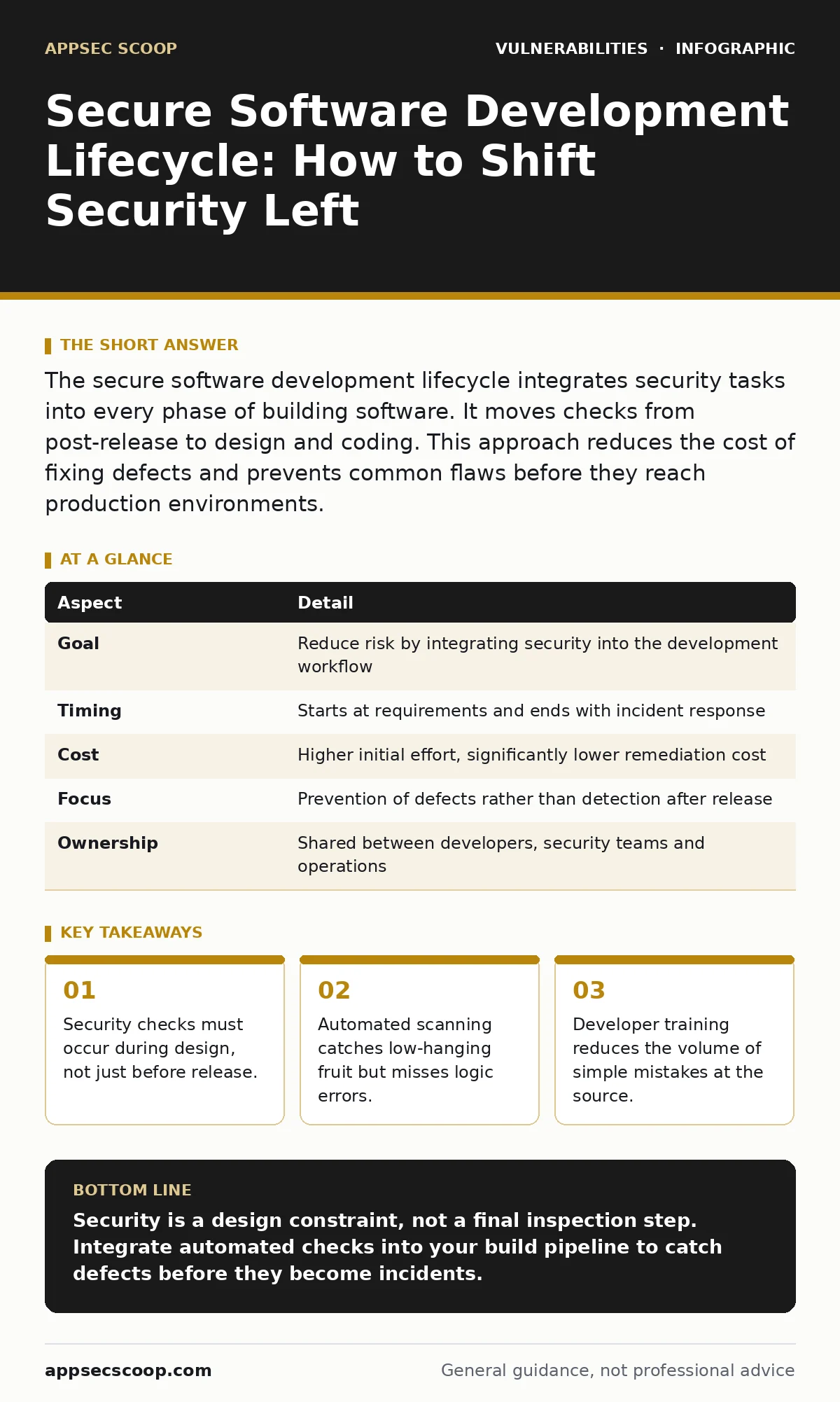
The secure software development lifecycle integrates security tasks into every phase of building software. It moves checks from post-release to design and coding. This approach reduces the cost of fixing defects and prevents common flaws before they reach production environments.
The Architecture of Prevention
Consider building a house. You can inspect the finished structure for cracks in the plaster. This is easy to see but expensive to fix. Alternatively, you can check the foundation alignment while the concrete is wet. This requires different skills but prevents structural failure later.
The secure software development lifecycle (SSDLC) adopts the second approach. It embeds security controls into each stage of creating an application. You do not treat security as a separate phase at the end. You weave it into requirements, design, coding, testing and deployment.
This model solves the problem of technical debt. Fixing a vulnerability after release often requires rewriting large sections of code. It also demands coordination across teams that are no longer aligned. By catching issues early, you reduce the friction of remediation.
| Aspect | Detail |
|---|---|
| Goal | Reduce risk by integrating security into the development workflow |
| Timing | Starts at requirements and ends with incident response |
| Cost | Higher initial effort, significantly lower remediation cost |
| Focus | Prevention of defects rather than detection after release |
| Ownership | Shared between developers, security teams and operations |
Shifting the Cost Curve
The primary economic argument for SSDLC is the cost of change. A defect found in requirements costs little to fix. A defect found in production costs orders of magnitude more. This is because production fixes require hot patches, emergency releases and potential downtime.
Imagine a developer writes a function that accepts user input. They do not validate the length of that input. In design, this is a simple note to add validation. In production, this might lead to a buffer overflow. You then must trace the crash, write a patch and redeploy.
This shift does not stop all breaches. It reduces the surface area. It ensures that the most obvious and automated checks fail early. You avoid the scenario where security is a bottleneck at the finish line.
Defining the Threat Model
You cannot secure what you do not understand. The first technical step in SSDLC is threat modelling. This is a structured way to identify potential attacks. You map the data flows and trust boundaries of your system.
You ask specific questions. Who can access this data? Where does the data travel? What happens if this service fails? This process reveals assumptions that code reviews miss. It highlights where encryption is needed or where authentication is weak.
A common pitfall is treating threat modelling as a one-off document. It must evolve with the architecture. If you change how users authenticate, the threat model changes. You must update it to reflect new attack vectors in CVSS metrics.
Coding Standards and Static Analysis
Developers need rules to follow. Coding standards define how to handle sensitive data. They specify which libraries are approved and which are banned. This reduces the variance in code quality.
Static application security testing (SAST) tools automate the check against these standards. These tools analyse the source code without running it. They look for patterns known to cause issues. For example, they might flag a hardcoded password or an unsafe deserialization call.
SAST is not a silver bullet. It produces false positives. It might flag a benign use of a function as risky. It also misses context. It cannot tell if a variable is actually user-controlled in a specific workflow. You must tune the rules to fit your project.
Dynamic Testing and Runtime Protection
Static analysis checks the code in isolation. Dynamic application security testing (DAST) checks the running application. DAST tools act as attackers. They send malicious inputs to the live system.
This catches issues that SAST misses. It finds configuration errors and runtime logic flaws. It tests how the application handles unexpected input. This is where you might find NoSQL injection flaws that static tools cannot parse.
However, DAST requires a working environment. You need a test instance that mirrors production. This adds complexity to your pipeline. You must manage test data and credentials carefully. It also takes time. You cannot run full DAST suites on every minor commit.
Integration with Other Defences
SSDL C does not replace other security measures. It works alongside them. It reduces the number of vulnerabilities that reach the network. This makes intrusion detection systems more effective. There is less noise to filter.
It also complements the software bill of materials (SBOM). An SBOM lists all third-party components. SSDLC ensures those components are managed. You scan them for known vulnerabilities. You update them before they become liabilities.
Consider memory corruption bugs. These are hard to find in code reviews. SSDLC enforces the use of memory-safe languages or safe libraries. This reduces the likelihood of these complex bugs existing in the first place.
Common Misconceptions
Many teams believe SSDLC means hiring more security engineers. This is incorrect. It means training developers to write secure code. It means giving them better tools. Security engineers act as coaches and architects, not gatekeepers.
Another mistake is thinking automation replaces human judgement. Tools catch syntax errors. Humans catch logic errors. A tool might approve a function that looks safe. A human might see that the function allows privilege escalation. You need both.
Finally, do not assume SSDLC stops all attacks. It reduces the risk. Attackers adapt. You must still monitor for web cache poisoning or open redirect vulnerabilities in production. SSDLC is a baseline, not a finish line.
Key takeaways
- Security checks must occur during design, not just before release.
- Automated scanning catches low-hanging fruit but misses logic errors.
- Developer training reduces the volume of simple mistakes at the source.
Security is a design constraint, not a final inspection step. Integrate automated checks into your build pipeline to catch defects before they become incidents.
Frequently asked questions
Does SSDLC slow down development?
It adds initial overhead but reduces time spent on emergency fixes and rework, leading to faster overall delivery of stable features.
How do I start implementing SSDLC?
Begin with threat modelling for new projects and integrate static analysis tools into your existing continuous integration pipeline.
Is SSDLC only for large enterprises?
No, the principles apply to any software project. Small teams can adopt lightweight versions using open-source tools and basic coding standards.
What is the role of a security champion?
A security champion is a developer who advocates for security practices within the team, helping to bridge the gap between security and development.
How this guide was produced: written by the AppSec Scoop editorial team with AI assistance, checked against the public references listed below, and reviewed when the facts change. See our editorial policy or report an error.