
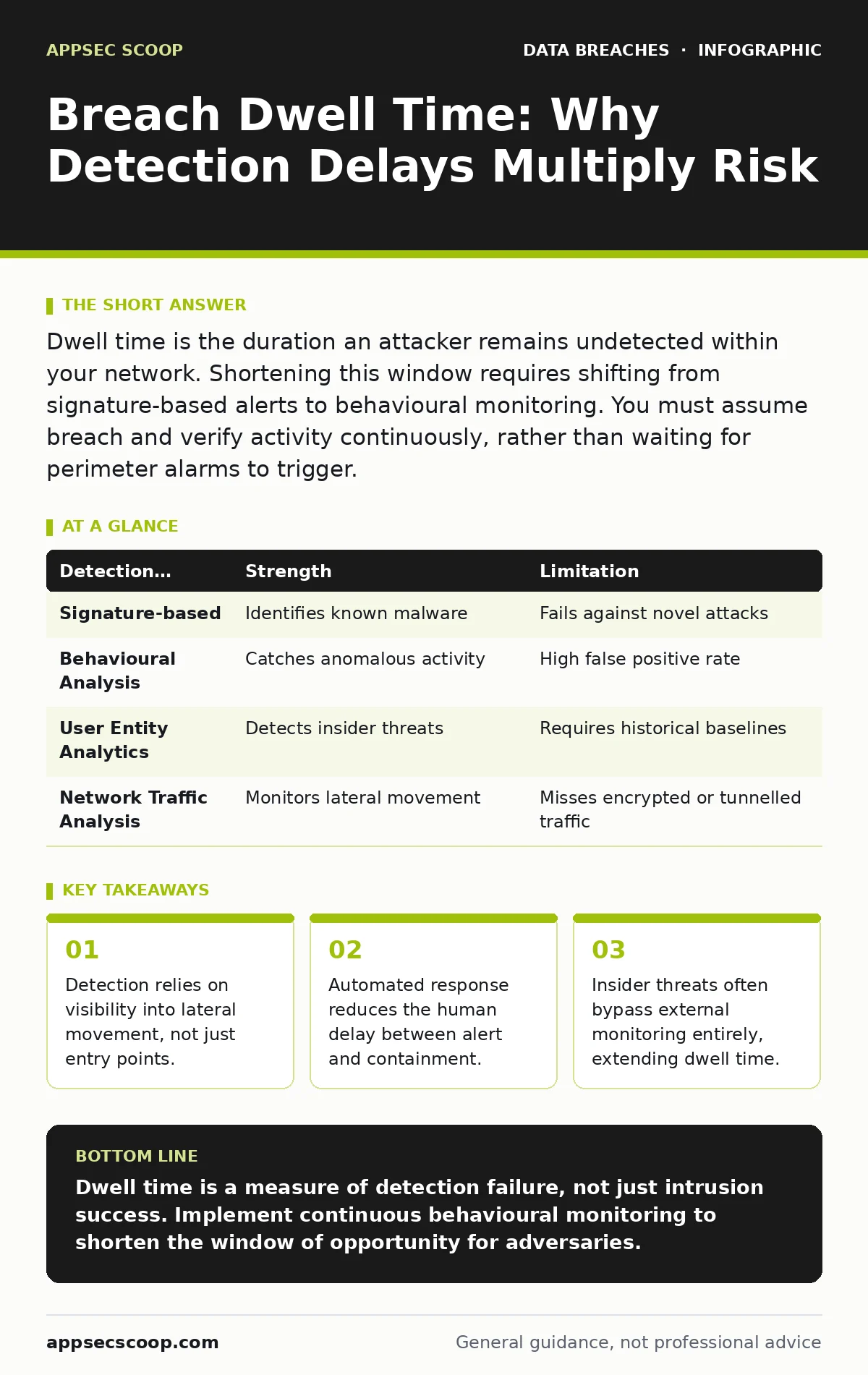
Dwell time is the duration an attacker remains undetected within your network. Shortening this window requires shifting from signature-based alerts to behavioural monitoring. You must assume breach and verify activity continuously, rather than waiting for perimeter alarms to trigger.
What defines dwell time in a security incident?
Dwell time is the interval between an initial compromise and the moment the organisation detects and begins to respond to the intrusion. This metric measures operational failure, not just technical vulnerability. A short dwell time indicates effective monitoring and rapid incident response capabilities. It does not reflect the severity of the damage already inflicted.
Why does dwell time matter more than initial entry?
The initial breach is often a minor technical failure, such as a misconfigured server or a weak credential. The real damage occurs during the dwell period, when attackers move laterally, escalate privileges, and exfiltrate data. Every hour of undetected presence allows the adversary to map your environment and establish persistence. Detection speed directly correlates with the volume of compromised assets.
How do attackers extend their dwell time intentionally?
Adversaries use low-and-slow techniques to avoid triggering automated alerts. They mimic normal user behaviour, accessing files at typical hours and using standard protocols. Some attackers pause their activities for weeks to blend into background noise. This patience exploits the assumption that malicious activity is always frantic and obvious.
What causes detection delays in mature security teams?
Alert fatigue is the primary driver of delayed detection in well-resourced organisations. Security operations centres receive thousands of notifications daily, many of which are false positives. Analysts prioritise high-severity alerts, allowing subtle, low-severity indicators of compromise to languish in queues. The human capacity for sustained attention is finite and easily overwhelmed.
Can automation reduce dwell time effectively?
Automation reduces the time between detection and containment, but it cannot replace context. Automated systems can isolate infected endpoints or revoke compromised credentials instantly. However, they struggle with nuanced decisions, such as distinguishing between a legitimate administrative task and malicious lateral movement. Over-automation can lead to disruptive false positives that degrade trust in the system.
See also: Tabletop Exercises for Small Teams: Run Effective Drills Without the Budget · Cloud Access Key Leak Warning Signs and Immediate Containment Steps
Why do insider threats bypass standard monitoring?
Insiders possess legitimate credentials and expected access patterns, making their malicious actions invisible to perimeter defenses. They do not need to exploit vulnerabilities or bypass firewalls. Their activity often looks identical to routine job functions, such as exporting large datasets for analysis. Detecting them requires behavioural baselining rather than signature matching.
How does data classification impact detection speed?
Unclassified or poorly labelled data allows attackers to exfiltrate sensitive information without triggering data loss prevention rules. When every file appears equally valuable, monitoring systems cannot prioritise critical assets. Clear classification enables targeted monitoring of high-value data stores. This focus reduces noise and highlights anomalous access to sensitive records.
What role does visibility play in shortening dwell time?
You cannot detect what you cannot see. Shadow IT, unmanaged devices, and cloud services often operate outside centralised monitoring. Attackers exploit these blind spots to establish command and control channels. Comprehensive inventory management ensures all assets are monitored for anomalous behaviour. Visibility gaps are the largest contributor to extended dwell times.
| Detection Method | Strength | Limitation |
|---|---|---|
| Signature-based | Identifies known malware | Fails against novel attacks |
| Behavioural Analysis | Catches anomalous activity | High false positive rate |
| User Entity Analytics | Detects insider threats | Requires historical baselines |
| Network Traffic Analysis | Monitors lateral movement | Misses encrypted or tunnelled traffic |
How do you measure dwell time accurately?
Accurate measurement requires a reliable timestamp for both the initial compromise and the detection event. Forensic analysis often reveals that the compromise occurred weeks before the alert. Retroactive logging must be preserved to reconstruct the timeline. Without accurate timestamps, organisations overestimate their detection capabilities.
What is the hidden cost of long dwell times?
Beyond data loss, extended dwell time erodes stakeholder trust and increases remediation complexity. Attackers who remain undetected for months often implant rootkits or backdoors that survive standard cleanup. Removing these persistent mechanisms requires rebuilding systems from scratch. The operational disruption far exceeds the cost of the initial breach.
How does encryption affect dwell time measurement?
Encryption in transit protects data from interception but does not prevent an attacker from accessing it at the endpoint. Once inside the network, attackers can read unencrypted data or decrypt it using stolen keys. Monitoring must focus on access patterns rather than data content. Encryption shifts the detection challenge from network edges to internal endpoints.
Can threat hunting reduce dwell time proactively?
Threat hunting assumes breach and searches for indicators of compromise without waiting for alerts. Hunters use hypothesis-driven investigations to find hidden adversaries. This proactive approach often identifies threats that automated systems missed. Regular hunting exercises shorten the average dwell time by validating detection gaps.
What is the relationship between dwell time and data breach costs?
Longer dwell times correlate with higher financial and reputational damage. The extended presence allows attackers to exfiltrate more data and disrupt operations for longer periods. Reducing dwell time is a direct strategy for limiting incident severity. Investment in detection capabilities yields a measurable return through reduced impact.
Key takeaways
- Detection relies on visibility into lateral movement, not just entry points.
- Automated response reduces the human delay between alert and containment.
- Insider threats often bypass external monitoring entirely, extending dwell time.
Dwell time is a measure of detection failure, not just intrusion success. Implement continuous behavioural monitoring to shorten the window of opportunity for adversaries.
Frequently asked questions
How long is the average dwell time for a breach?
There is no single average, as it varies by industry and maturity. However, many organisations report dwell times exceeding several weeks due to detection gaps.
Can AI eliminate dwell time entirely?
No. AI can accelerate detection but cannot guarantee immediate identification of all novel threats. Human oversight remains necessary for context and validation.
Does zero trust architecture reduce dwell time?
Yes, by limiting lateral movement and requiring continuous verification. Zero trust reduces the blast radius of a compromise, making detection easier.
How do I prove I have reduced dwell time?
Track the time from initial compromise to detection for every incident. Compare these intervals over time to identify trends and improvements.
How this guide was produced: written by the AppSec Scoop editorial team with AI assistance, checked against the public references listed below, and reviewed when the facts change. See our editorial policy or report an error.