
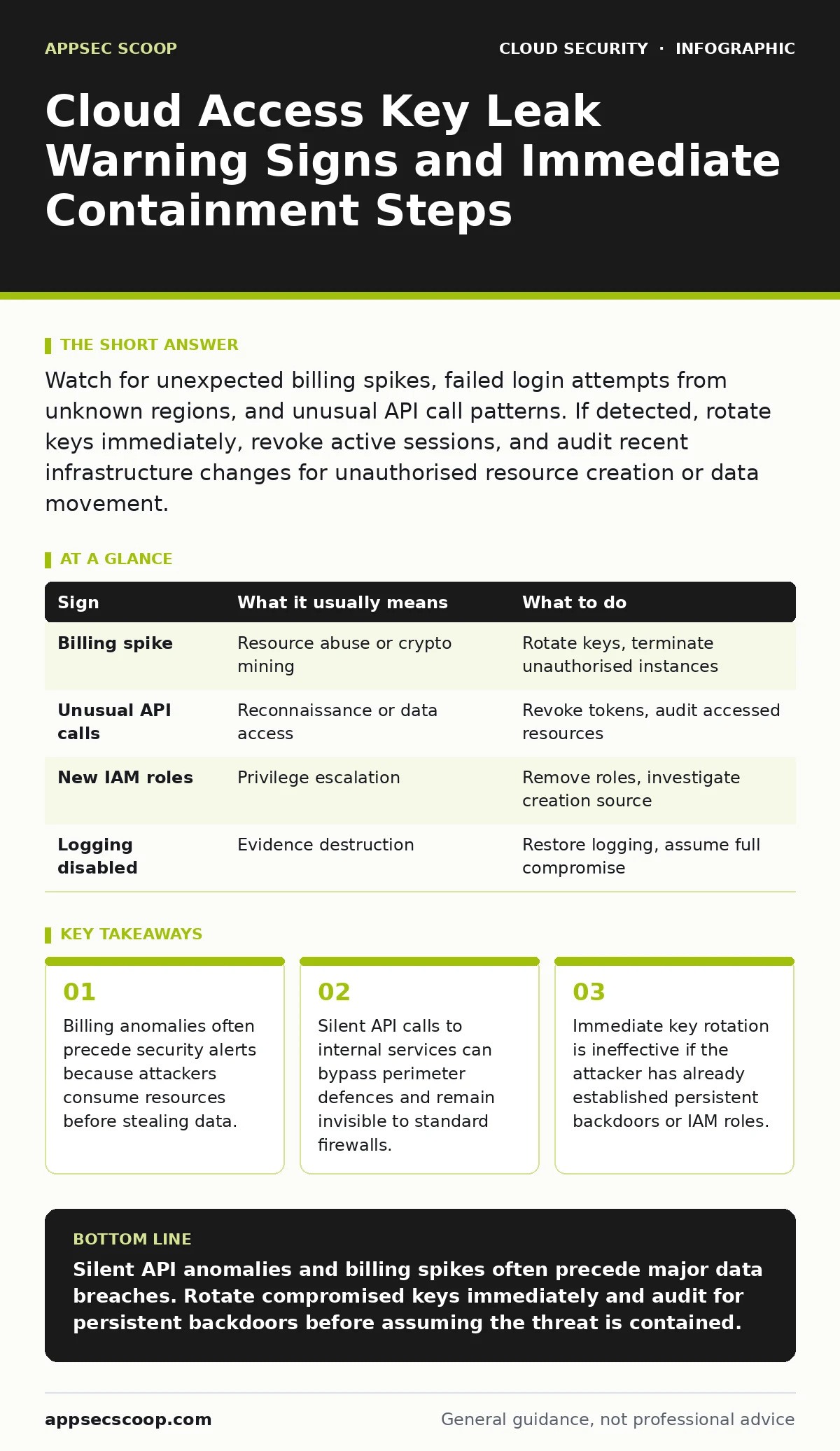
Watch for unexpected billing spikes, failed login attempts from unknown regions, and unusual API call patterns. If detected, rotate keys immediately, revoke active sessions, and audit recent infrastructure changes for unauthorised resource creation or data movement.
The First Obvious Signals
You will likely notice the loud signals first. These are the anomalies that trigger automated alerts or appear in daily operational reviews. They are easy to see but often dismissed as noise or misconfiguration until the pattern becomes undeniable.
Unexpected billing spikes are the most common early indicator. Attackers frequently use compromised keys to spin up high-cost compute instances, such as GPU clusters for cryptocurrency mining or large storage buckets for data hoarding. The cloud provider charges for these resources regardless of who initiated the request.
Sudden increases in failed authentication attempts also stand out. If an attacker is trying multiple stolen keys or guessing permissions, the authentication logs will show a burst of failures followed by a single success. This pattern is distinct from normal user error, which tends to be sporadic and low-volume.
The Silent Indicators
The dangerous signs are the ones that do not trigger alerts. These indicators require a deeper understanding of normal operational baselines. They represent activity that looks legitimate to automated systems but violates the principle of least privilege or expected usage patterns.
Unusual API call sequences are a primary hidden sign. An attacker may not brute-force login but instead use a valid key to query internal service endpoints. For example, a key intended for a build pipeline might suddenly start querying customer databases or listing sensitive storage buckets. The API call succeeds, so no alarm sounds, but the context is wrong.
Resource creation in unexpected regions is another subtle clue. If your organisation operates solely in Europe, the sudden creation of a virtual machine in South America using a valid access key indicates compromise. Attackers often move data or compute workloads to regions with less stringent monitoring or lower costs.
Hidden Infrastructure Changes
Attackers often modify the environment to maintain access or hide their tracks. These changes are easy to miss because they blend in with routine administrative tasks. They alter the security posture without generating immediate security events.
The creation of new IAM roles or policies is a critical red flag. An attacker may grant their compromised key broader permissions to access other services. This escalation of privilege allows them to move laterally through your infrastructure. If you see new roles created outside of your change management process, assume the keys associated with those changes are compromised.
Changes to logging configurations are equally dangerous. An attacker may disable CloudTrail or equivalent logging services to erase their footprint. If you notice gaps in your audit logs or a sudden cessation of log delivery to your SIEM, treat this as a confirmed breach rather than a technical glitch.
Immediate Containment Steps
When you identify a potential leak, speed is paramount. The goal is to stop the attacker from causing further damage while preserving evidence for investigation. Do not attempt to analyse the full scope before cutting off access.
Rotate the compromised access keys immediately. This invalidates the current credentials and forces any active sessions to reconnect. However, rotation alone is insufficient if the attacker has already established persistent access through other means, such as SSH keys or IAM roles.
Revoke active sessions and tokens associated with the compromised identity. Many cloud providers issue session tokens that remain valid for a period even after the access key is rotated. Revoking these tokens ensures the attacker cannot continue using the session while you investigate.
Investigating the Scope
After containment, you must determine what the attacker accessed. This involves reviewing logs from the time of the suspected compromise to the moment of rotation. You are looking for data exfiltration, resource manipulation, or lateral movement.
Review API call logs for any requests to sensitive data stores. Look for GET or LIST operations on storage buckets, databases, or secret management services. Even if no data was downloaded, the mere ability to list contents may indicate reconnaissance for future attacks.
Check for new resources created during the window of compromise. Identify any virtual machines, storage buckets, or network endpoints that appeared without authorisation. Terminate these resources and image them for forensic analysis if required.
| Sign | What it usually means | What to do |
|---|---|---|
| Billing spike | Resource abuse or crypto mining | Rotate keys, terminate unauthorised instances |
| Unusual API calls | Reconnaissance or data access | Revoke tokens, audit accessed resources |
| New IAM roles | Privilege escalation | Remove roles, investigate creation source |
| Logging disabled | Evidence destruction | Restore logging, assume full compromise |
See also: CSPM vs CNAPP: Which Cloud Security Tool Fits Your Stack
Preventing Future Exposure
Prevention requires a shift from static key management to dynamic, short-lived credentials. Long-lived access keys are a liability because they provide attackers with persistent access once stolen.
Implement short-lived credentials using identity providers. Instead of storing long-term keys in code or configuration files, use temporary credentials issued at runtime. This limits the window of opportunity for an attacker, as the credentials expire quickly and cannot be reused.
Enforce strict separation of duties and least privilege. Ensure that no single key has access to both development and production environments. Use resource tags and policies to restrict what each key can do, reducing the blast radius of any single compromise.
Key takeaways
- Billing anomalies often precede security alerts because attackers consume resources before stealing data.
- Silent API calls to internal services can bypass perimeter defences and remain invisible to standard firewalls.
- Immediate key rotation is ineffective if the attacker has already established persistent backdoors or IAM roles.
Silent API anomalies and billing spikes often precede major data breaches. Rotate compromised keys immediately and audit for persistent backdoors before assuming the threat is contained.
Frequently asked questions
How do I know if my keys are exposed in public repositories?
Use automated scanning tools that continuously monitor public code repositories for patterns matching cloud access key formats. Alert immediately if a match is found.
Should I delete the compromised user account?
No, preserve the account for forensic analysis. Disable the account and rotate all associated credentials before considering deletion.
Can IAM roles prevent key leaks?
IAM roles reduce the risk by eliminating long-lived keys, but they do not prevent misuse of temporary credentials or misconfigured policies.
What is the difference between an access key and a secret key?
The access key identifies the user, while the secret key signs requests. Both are required for authentication, and compromising either allows full access.
How this guide was produced: written by the AppSec Scoop editorial team with AI assistance, checked against the public references listed below, and reviewed when the facts change. See our editorial policy or report an error.