
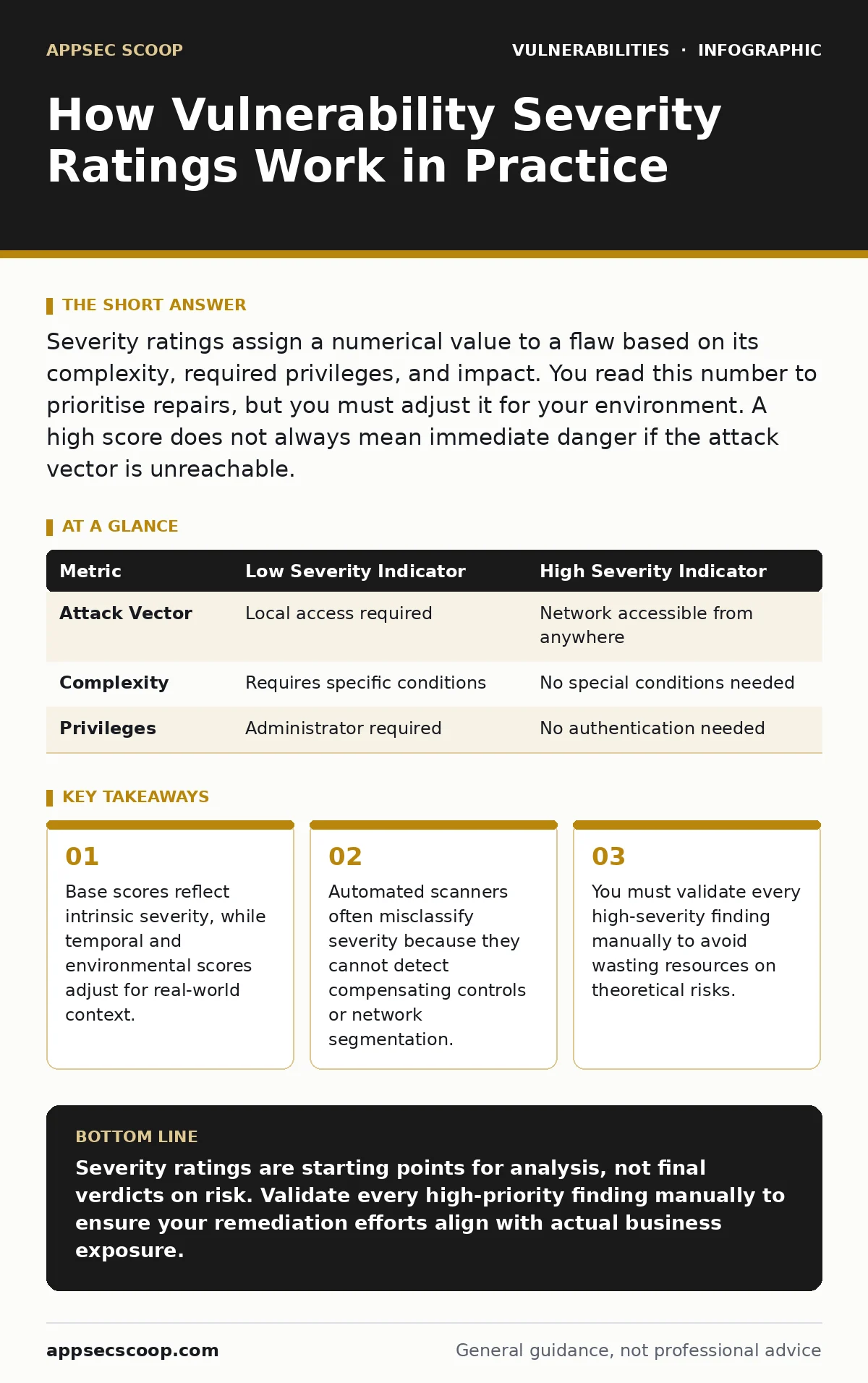
Severity ratings assign a numerical value to a flaw based on its complexity, required privileges, and impact. You read this number to prioritise repairs, but you must adjust it for your environment. A high score does not always mean immediate danger if the attack vector is unreachable.
The Anatomy of a Severity Score
Vulnerability severity ratings attempt to quantify risk in a single number. This metric allows teams to compare disparate flaws, such as a memory corruption bug and a simple configuration error, on a common scale. The standard mechanism separates this calculation into three distinct layers. Each layer adds context to the raw technical data.
The first layer is the base score. This measures the inherent severity of the vulnerability itself, assuming ideal conditions for the attacker. It does not change over time. The second layer is the temporal score. This adjusts the base score for factors that change, such as the availability of exploit code or the existence of a vendor patch. The third layer is the environmental score. This tailors the rating to your specific infrastructure, accounting for network accessibility and data sensitivity.
Most automated tools report only the base score. This creates a distorted view of your actual risk posture. You might spend days fixing a theoretical flaw while ignoring a lower-scored issue that is actively being exploited in your environment. Understanding the separation between these layers is the first step in accurate triage.
Stage 1: Establishing the Base Metric
The base metric evaluates the vulnerability in a vacuum. It asks what the flaw would do if an attacker had unrestricted access and no obstacles. This stage relies on a defined set of metrics, including attack vector, attack complexity, and privileges required.
Attack vector describes how the flaw is reached. A network-based vector is considered more severe than a local one, as it requires no physical proximity. Attack complexity measures the skill or conditions needed to exploit the flaw. A low complexity score means the attack is straightforward and repeatable. Privileges required determine if the attacker needs administrative rights or can act as an unauthenticated user.
| Metric | Low Severity Indicator | High Severity Indicator |
|---|---|---|
| Attack Vector | Local access required | Network accessible from anywhere |
| Complexity | Requires specific conditions | No special conditions needed |
| Privileges | Administrator required | No authentication needed |
This stage is purely theoretical. It ignores your firewalls, intrusion detection systems, and application logic. It also ignores the secure software development lifecycle practices that might have caught the flaw earlier. The base score is a constant. It is the anchor for all subsequent calculations.
Stage 2: Adjusting for Temporal Factors
Vulnerabilities do not exist in a static state. The ease of exploitation changes as time passes. The temporal metric captures this shift. It considers whether a proof-of-concept exploit is publicly available. It also considers whether a vendor has released a fix.
If an exploit is widely available, the temporal score increases. This reflects the higher likelihood of automated attacks. If a patch exists but has not been deployed, the score may remain high until you apply it. This stage introduces a dynamic element to the rating. It acknowledges that a flaw discovered today is more dangerous than one discovered a decade ago, assuming the latter has no known exploits.
This adjustment prevents you from over-prioritising old, obscure flaws. It also prevents you from under-prioritising new flaws that are actively being weaponised. The temporal score bridges the gap between the abstract base metric and the current threat climate. It is a multiplier that reduces or increases the final severity.
Stage 3: Applying Environmental Context
The environmental score is where the rating becomes useful for your specific organisation. It adjusts the previous scores based on your infrastructure. This stage considers whether the vulnerability is actually reachable from the internet. It also considers the importance of the data the system protects.
Imagine a server that hosts internal documentation. It has a high-severity flaw, but it is not accessible from the public internet. The environmental score will lower the severity because the attack vector is restricted. Conversely, a low-severity flaw on a public-facing login page might receive a higher environmental score because it affects user authentication.
You must define your own environmental values. There is no universal standard for what constitutes "high" data sensitivity. You must decide which systems are critical. This subjectivity is a feature, not a bug. It forces you to align security efforts with business value. However, it also means two organisations can assign different severities to the same flaw.
Stage 4: Interpreting the Final Rating
The final rating is a composite of the base, temporal, and environmental scores. It provides a single number for sorting and prioritisation. However, this number is only as good as the inputs. If your environmental data is wrong, the final rating is misleading.
You should not treat the final rating as an absolute truth. It is a heuristic. Use it to create a shortlist of candidates for manual review. Do not use it to automatically trigger remediation workflows for every high-score item. This approach leads to alert fatigue and wasted engineering hours.
Consider the software bill of materials (SBOM) as your data source for environmental context. If you do not know what software you are running, you cannot accurately assess the environmental impact. A missing SBOM means you are guessing at the environmental score. This guesswork undermines the entire rating process.
See also: Responsible Disclosure Myths: 6 Ways Teams Misuse the Process · Zero-Day vs N-Day: Deciding Which Vulnerability Model Fits Your Stack
Stage 5: Validating Against Reality
The final stage is manual validation. You must verify that the vulnerability exists in your specific configuration. Automated scanners often report false positives. They detect patterns in code or headers without understanding the application logic.
Suppose a scanner flags a command injection vulnerability. You must trace the data flow to confirm that user input reaches a system shell. If the input is sanitised by a library, the vulnerability is mitigated. The scanner does not know this. You must check the code or the runtime behaviour.
This stage is the most labour-intensive but the most critical. It separates theoretical risk from actual risk. You should also check for compensating controls. A web application firewall might block the exploit payload. This control does not fix the code, but it reduces the immediate risk. You should record this control in your environmental assessment.
Stage 6: Prioritising Remediation Efforts
Once validated, you can prioritise remediation. High-severity flaws that are reachable and impactful should be fixed first. However, you must balance this against development cycles and resource constraints.
Do not ignore low-severity flaws entirely. They can be chained together to create a high-impact attack. A session fixation flaw might seem minor on its own. Combined with a weak authentication mechanism, it allows full account takeover. You must look for chains of vulnerabilities.
Use the severity rating to communicate risk to stakeholders. A number is easier to understand than a technical description. Explain that a high score means a high probability of exploitation and a high impact. This helps justify the time and cost of remediation.
Common Pitfalls in Severity Assessment
Teams often fall into the trap of trusting automated scores blindly. This leads to a false sense of security or unnecessary panic. Another common error is failing to update environmental scores. Infrastructure changes, and so should your risk assessment.
You might also neglect the temporal aspect. A flaw that was low-risk six months ago might now have a public exploit. You must re-evaluate your inventory regularly. This is not a one-time exercise. It is a continuous process of refinement.
Integrating Severity into Operations
Severity ratings should feed into your incident response and change management processes. When a new vulnerability is disclosed, check your inventory for affected components. Calculate the estimated severity based on your environment.
If the estimated severity is high, escalate immediately. If it is low, schedule it for the next maintenance window. This structured approach prevents ad-hoc reactions. It ensures that every security decision is based on consistent criteria.
Reference guides on attack vectors in CVSS can help you understand the nuances of how different access methods affect the base score. Similarly, understanding web cache poisoning can reveal how seemingly minor flaws can lead to data leakage. Depth of knowledge improves the accuracy of your assessments.
Key takeaways
- Base scores reflect intrinsic severity, while temporal and environmental scores adjust for real-world context.
- Automated scanners often misclassify severity because they cannot detect compensating controls or network segmentation.
- You must validate every high-severity finding manually to avoid wasting resources on theoretical risks.
Severity ratings are starting points for analysis, not final verdicts on risk. Validate every high-priority finding manually to ensure your remediation efforts align with actual business exposure.
Frequently asked questions
Can I trust the severity score from my vulnerability scanner?
No, you should treat scanner scores as estimates. They often lack context about your specific network configuration and compensating controls.
How often should I recalculate environmental scores?
You should recalculate them whenever your infrastructure changes, such as moving services to the cloud or changing network segmentation.
Does a higher score always mean a more dangerous vulnerability?
Not necessarily. A high score might reflect a theoretical worst-case scenario that is impossible in your specific environment due to strict access controls.
What is the difference between base and temporal scores?
Base scores measure the inherent severity of the flaw, while temporal scores adjust for current factors like patch availability and exploit maturity.
How this guide was produced: written by the AppSec Scoop editorial team with AI assistance, checked against the public references listed below, and reviewed when the facts change. See our editorial policy or report an error.