
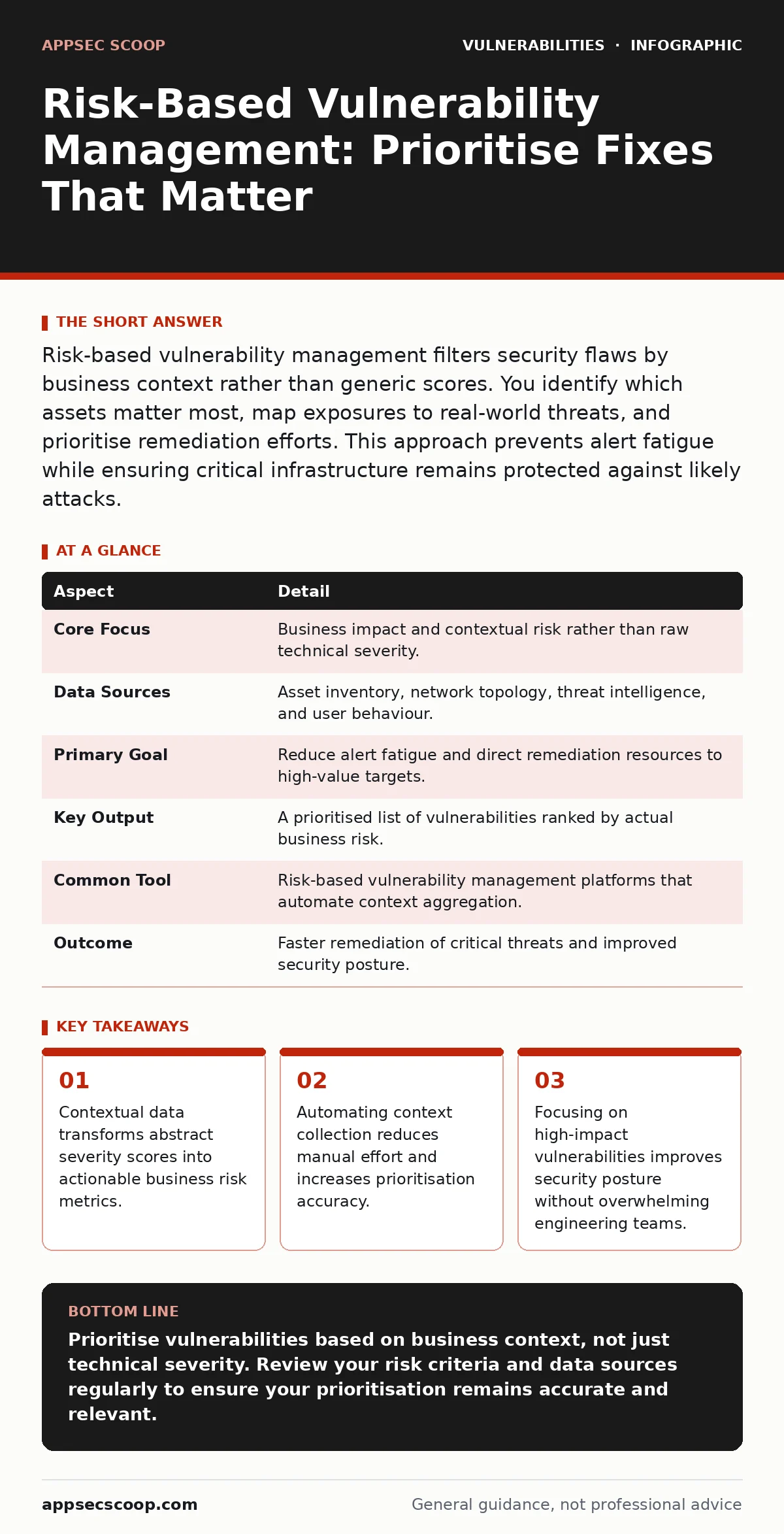
Risk-based vulnerability management filters security flaws by business context rather than generic scores. You identify which assets matter most, map exposures to real-world threats, and prioritise remediation efforts. This approach prevents alert fatigue while ensuring critical infrastructure remains protected against likely attacks.
Everyday Analogy for Security Prioritisation
Imagine you are a property manager overseeing a large estate. One day, you receive reports of a loose floorboard in the lobby, a broken window in the basement, and a faulty lock on the main gate. A generic inspector might list these issues in alphabetical order or by the cost of repair. A prudent manager, however, asks different questions. Is the basement accessible to the public? Is the main gate the primary entry point for visitors? The loose floorboard is annoying but harmless. The broken window is a nuisance. The faulty lock is a critical failure because it exposes the entire estate to intrusion.
Security teams face the same dilemma daily. They receive hundreds of alerts about software weaknesses. Treating each alert as equally urgent is inefficient. It wastes time on minor issues while leaving major doors open. Risk-based vulnerability management applies the property manager’s logic to digital infrastructure. It asks not just what is broken, but what the broken thing protects and who might exploit it.
What Is Risk-Based Vulnerability Management
Risk-based vulnerability management is a process that prioritises software and hardware flaws based on their potential impact on your specific business operations. It moves beyond static scoring systems that treat all vulnerabilities as equal. Instead, it combines technical data with contextual information about asset value, exposure, and threat likelihood.
Traditional methods rely heavily on standard severity ratings. These ratings provide a baseline but lack nuance. They do not know if a vulnerable server sits behind a strict firewall or faces the open internet. They do not know if the software is actively used or retired to a cold storage zone. Risk-based approaches fill these gaps. They answer the question of which vulnerability requires immediate attention by weighing the cost of a breach against the effort of a fix.
| Aspect | Detail |
|---|---|
| Core Focus | Business impact and contextual risk rather than raw technical severity. |
| Data Sources | Asset inventory, network topology, threat intelligence, and user behaviour. |
| Primary Goal | Reduce alert fatigue and direct remediation resources to high-value targets. |
| Key Output | A prioritised list of vulnerabilities ranked by actual business risk. |
| Common Tool | Risk-based vulnerability management platforms that automate context aggregation. |
| Outcome | Faster remediation of critical threats and improved security posture. |
How Contextual Data Changes Prioritisation
Static scores often fail because they ignore the environment. A vulnerability in a library used by a public-facing web application carries more weight than the same vulnerability in an internal development tool. Risk-based systems ingest data from multiple sources to build a holistic view. They integrate with asset management databases to understand what runs where. They connect with network mapping tools to see how systems communicate.
This integration allows the system to calculate exposure. If a vulnerable component is not reachable from the internet, its risk drops significantly. If it is reachable but protected by a web application firewall that blocks specific attack patterns, the risk lowers further. The system also considers asset criticality. A flaw in a payment processing server is more dangerous than a flaw in a legacy reporting tool that no one accesses.
By combining these factors, you get a dynamic risk score. This score changes as your environment changes. If you move a server from an internal network to a public cloud instance, the risk score updates automatically. This agility ensures your prioritisation reflects reality, not a snapshot from months ago.
Who This Approach Affects
This method impacts security operations, development teams, and executive leadership. Security analysts spend less time triaging low-value alerts and more time investigating genuine threats. They gain trust from engineering teams by requesting fixes that make sense, rather than demanding immediate action on every minor issue.
Developers benefit from clearer priorities. Instead of receiving a flood of tickets, they receive a focused list of high-impact items. This reduces context switching and allows them to plan remediation work alongside feature development. It aligns security with business goals, making security a partner rather than a blocker.
Executives gain better visibility into actual risk. They can see which assets pose the greatest threat to revenue or reputation. This information supports budget decisions and resource allocation. It demonstrates that security investments are targeted and effective, rather than scattered and wasteful.
What People Usually Get Wrong
Many organisations confuse risk-based management with ignoring low-severity issues. This is a mistake. Low-severity vulnerabilities can still be exploited, especially if they are part of a chain attack. The goal is not to ignore them, but to address them at an appropriate pace. High-risk items get immediate attention; low-risk items get scheduled maintenance.
Another common error is relying solely on external threat feeds. While threat intelligence is valuable, it does not replace internal context. An attack vector in CVSS might be active globally, but if your environment lacks the specific component or configuration, the risk is nil. Always validate external intelligence against your internal asset data.
Finally, teams often neglect to review their risk models. Business priorities change. A system that was critical last year might be obsolete today. If your risk model does not update, your prioritisation becomes stale. Regular reviews ensure your strategy remains aligned with current business objectives.
See also: Zero-Day vs N-Day: Deciding Which Vulnerability Model Fits Your Stack · How Vulnerability Severity Ratings Work in Practice
Implementation Steps for Your Team
Start by auditing your current data sources. You need accurate information about your assets, network topology, and user access patterns. Incomplete data leads to incomplete risk assessments. Ensure your asset management system is up to date and that network scans run regularly.
Next, define your risk criteria. What constitutes a high-impact asset? How do you weigh exposure versus criticality? Involve stakeholders from different departments to establish these criteria. This ensures your risk model reflects the entire organisation’s perspective, not just the security team’s view.
Select a tool that supports risk-based vulnerability management. Look for platforms that integrate with your existing stack and automate data collection. Manual data entry is error-prone and unsustainable. Automation ensures your risk scores remain current and reliable.
Finally, establish a feedback loop. Review your prioritisation decisions periodically. Did the high-risk items actually pose the greatest threat? Did you miss any significant issues? Use these insights to refine your risk criteria and improve your model over time.
Integrating With Broader Security Practices
Risk-based vulnerability management does not exist in isolation. It works best when integrated with a secure software development lifecycle. By shifting left, you can address vulnerabilities before they reach production. This reduces the volume of issues your risk model needs to process.
Consider how attack surface management complements this approach. Attack surface management identifies all external-facing assets, providing the exposure data needed for accurate risk scoring. Without a clear view of your attack surface, your risk model lacks a key variable.
Similarly, understanding dependency confusion attacks helps you prioritise vulnerabilities in supply chain components. These attacks exploit trust relationships between internal and external repositories. Risk-based systems can highlight dependencies that are both vulnerable and critical to your operations.
By connecting these practices, you create a cohesive security strategy. Each component informs the others, creating a stronger defence. This holistic approach ensures you are not just fixing holes, but strengthening the entire structure.
Key takeaways
- Contextual data transforms abstract severity scores into actionable business risk metrics.
- Automating context collection reduces manual effort and increases prioritisation accuracy.
- Focusing on high-impact vulnerabilities improves security posture without overwhelming engineering teams.
Prioritise vulnerabilities based on business context, not just technical severity. Review your risk criteria and data sources regularly to ensure your prioritisation remains accurate and relevant.
Frequently asked questions
How is risk-based vulnerability management different from traditional vulnerability management?
Traditional management prioritises flaws based on static severity scores like CVSS. Risk-based management adds context such as asset value, exposure, and threat likelihood to determine actual business risk.
Do I need expensive tools to implement risk-based vulnerability management?
You can start with basic data integration and manual analysis. However, automated platforms provide more accurate and scalable risk assessments by continuously aggregating and analysing contextual data.
How often should I update my risk-based vulnerability management criteria?
Review your criteria whenever your business priorities change or significant infrastructure updates occur. Quarterly reviews are a common baseline to ensure alignment with current operational realities.
Can risk-based vulnerability management replace penetration testing?
No. Penetration testing provides deep, targeted insights into specific systems. Risk-based vulnerability management helps you decide which systems to test and prioritise based on their potential impact.
How this guide was produced: written by the AppSec Scoop editorial team with AI assistance, checked against the public references listed below, and reviewed when the facts change. See our editorial policy or report an error.