
Responsible disclosure fails when treated as a binary choice between silence and publication. It requires defined timelines, clear scope boundaries and explicit legal protections. Misunderstanding these mechanics leads to unsafe data leaks, failed negotiations and reputational damage for both researchers and vendors.
Misreading: Disclosure is purely a moral obligation
Correct reading: Responsible disclosure is a contractual and procedural framework, not a moral imperative. Many researchers assume that finding a vulnerability creates an automatic duty to inform the public. This view ignores the legal and operational realities of software maintenance. Vendors require time to assess impact, develop patches and coordinate release dates.
Treating disclosure as a moral act often leads to premature publication, which forces users to choose between exposure and broken functionality. The process exists to balance security transparency with operational stability. You must respect the agreed timeline to maintain trust. This approach differs significantly from the chaotic nature of command injection exploits, where immediate exploitation is the primary goal.
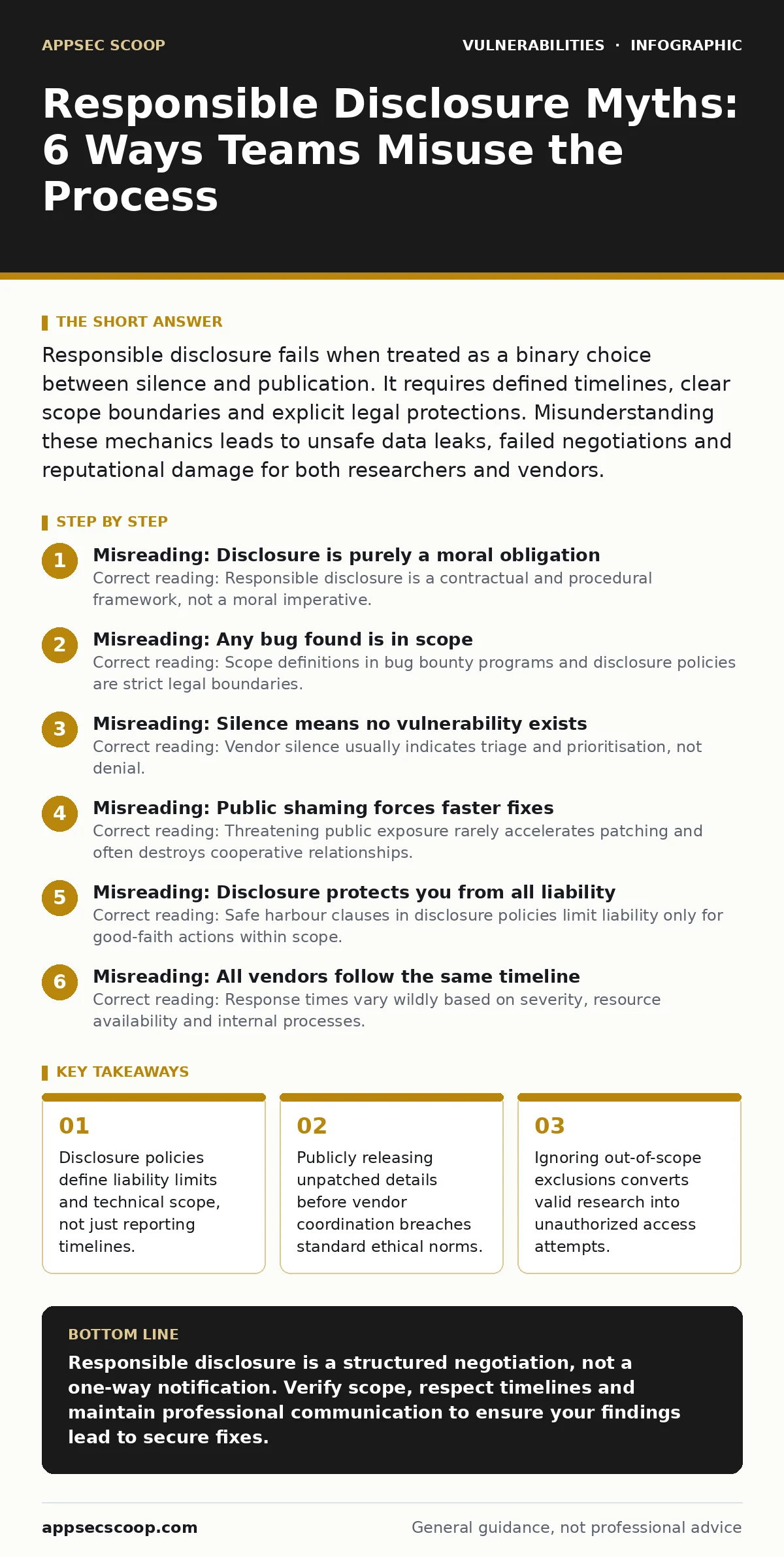
Misreading: Any bug found is in scope
Correct reading: Scope definitions in bug bounty programs and disclosure policies are strict legal boundaries. Researchers often misinterpret "in scope" as meaning any vulnerability affecting the organisation. In reality, policies explicitly exclude third-party dependencies, social engineering and physical security. Attempting to exploit excluded areas can violate computer misuse laws.
For example, a vulnerability in a web cache poisoning configuration might be out of scope if it affects a CDN provider rather than the target application. Always read the exclusion list carefully. Exploiting out-of-scope items converts ethical research into unauthorised access. This distinction protects both the researcher from legal action and the vendor from unnecessary panic.
Misreading: Silence means no vulnerability exists
Correct reading: Vendor silence usually indicates triage and prioritisation, not denial. When a researcher submits a report and receives no response, the assumption is often that the issue is invalid. In practice, vendors may be verifying the report, consulting legal teams or waiting for a coordinated release window. A lack of communication does not negate the validity of the finding.
You must follow the escalation path defined in the policy. If the vendor remains silent beyond the stated deadline, you may proceed with responsible disclosure, but only after documenting all attempts to contact them. This patience prevents false alarms and ensures that attack vectors in CVSS are correctly assessed before public attention focuses on them.
Misreading: Public shaming forces faster fixes
Correct reading: Threatening public exposure rarely accelerates patching and often destroys cooperative relationships. Some researchers believe that leaking details to media outlets will pressure vendors to act quickly. This tactic backfires by causing vendors to deprioritise the reporter or refuse future engagements. Vendors operate on resource constraints and must validate reports before fixing them.
Public pressure can lead to rushed, incomplete patches that introduce new issues, such as memory corruption bugs or regression errors. Constructive dialogue yields better security outcomes than antagonism. The goal is a secure product, not a viral headline. Maintaining a professional tone ensures that your future reports receive timely attention.
Misreading: Disclosure protects you from all liability
Correct reading: Safe harbour clauses in disclosure policies limit liability only for good-faith actions within scope. Many assume that submitting a report grants blanket immunity for all research activities. This is incorrect. If you access production data, cause service disruption or exploit vulnerabilities outside the defined scope, you remain liable for damages.
The protection applies only to the act of reporting, not to the methods used to find the bug. Always operate in isolated environments when possible. Use session fixation testing techniques that do not affect other users. Understanding this legal nuance prevents accidental criminal charges. Responsible disclosure is a shield for the report, not for reckless behaviour.
See also: Zero-Day vs N-Day: Deciding Which Vulnerability Model Fits Your Stack · How Vulnerability Severity Ratings Work in Practice
Misreading: All vendors follow the same timeline
Correct reading: Response times vary wildly based on severity, resource availability and internal processes. There is no universal standard for how quickly a vendor must acknowledge or fix a vulnerability. Critical issues may receive attention within hours, while lower-severity bugs might take months. Assuming a standard 90-day window can lead to premature public disclosure.
You must check the specific policy for each organisation. Some vendors provide status updates, while others remain silent until resolution. Adapting your expectations to each vendor’s workflow prevents frustration. This variability also applies when analysing a software bill of materials (SBOM), where component vendors have different response cultures.
Misreading: Disclosure ends when the patch ships
Correct reading: Post-patch verification and public credit management are critical final steps. Many researchers believe their job is done once the vendor releases a fix. This ignores the need to verify that the patch actually resolves the issue. Incomplete fixes leave users vulnerable. Additionally, managing public credit requires coordination.
Some organisations prefer anonymity, while others welcome recognition. Respecting these preferences maintains long-term relationships. If you plan to write a blog post, share it with the vendor for review. This prevents accidental disclosure of remaining NoSQL injection vectors or other related issues. The process concludes only when the community is fully informed and protected.
Misreading: Automated scanners replace human judgment
Correct reading: Automated tools lack the context to determine responsible disclosure boundaries. Scanners can identify technical flaws but cannot interpret policy nuances, scope exclusions or legal implications. Relying solely on automation leads to false positives and out-of-scope reports. Human analysts must review findings to assess impact and adherence to guidelines.
For instance, a scanner might flag a configuration error that is actually intentional for compliance reasons. Without human judgment, you risk wasting vendor resources and damaging your reputation. Always validate automated findings manually. This diligence ensures that your reports are accurate and actionable.
Key takeaways
- Disclosure policies define liability limits and technical scope, not just reporting timelines.
- Publicly releasing unpatched details before vendor coordination breaches standard ethical norms.
- Ignoring out-of-scope exclusions converts valid research into unauthorized access attempts.
Responsible disclosure is a structured negotiation, not a one-way notification. Verify scope, respect timelines and maintain professional communication to ensure your findings lead to secure fixes.
Frequently asked questions
What should I do if a vendor ignores my report?
Document all communication attempts and wait for the maximum time specified in their policy. If they remain silent, you may proceed with limited public disclosure, focusing on the existence of the flaw without revealing exploit details.
Is it legal to test vulnerabilities in third-party libraries?
Generally, no. Most disclosure policies exclude third-party components. Testing these without permission can violate laws. Focus on how the organisation uses the library, not the library itself.
Can I sell vulnerability details to a vendor?
Only if the vendor has a bug bounty program that explicitly allows monetary rewards. Most responsible disclosure processes are non-monetary. Selling information outside of agreed programmes is unethical and potentially illegal.
How do I verify a patch is effective?
Re-test the vulnerability in a safe environment after the patch is applied. Confirm that the exploit no longer works and check for unintended side effects.
How this guide was produced: written by the AppSec Scoop editorial team with AI assistance, checked against the public references listed below, and reviewed when the facts change. See our editorial policy or report an error.