
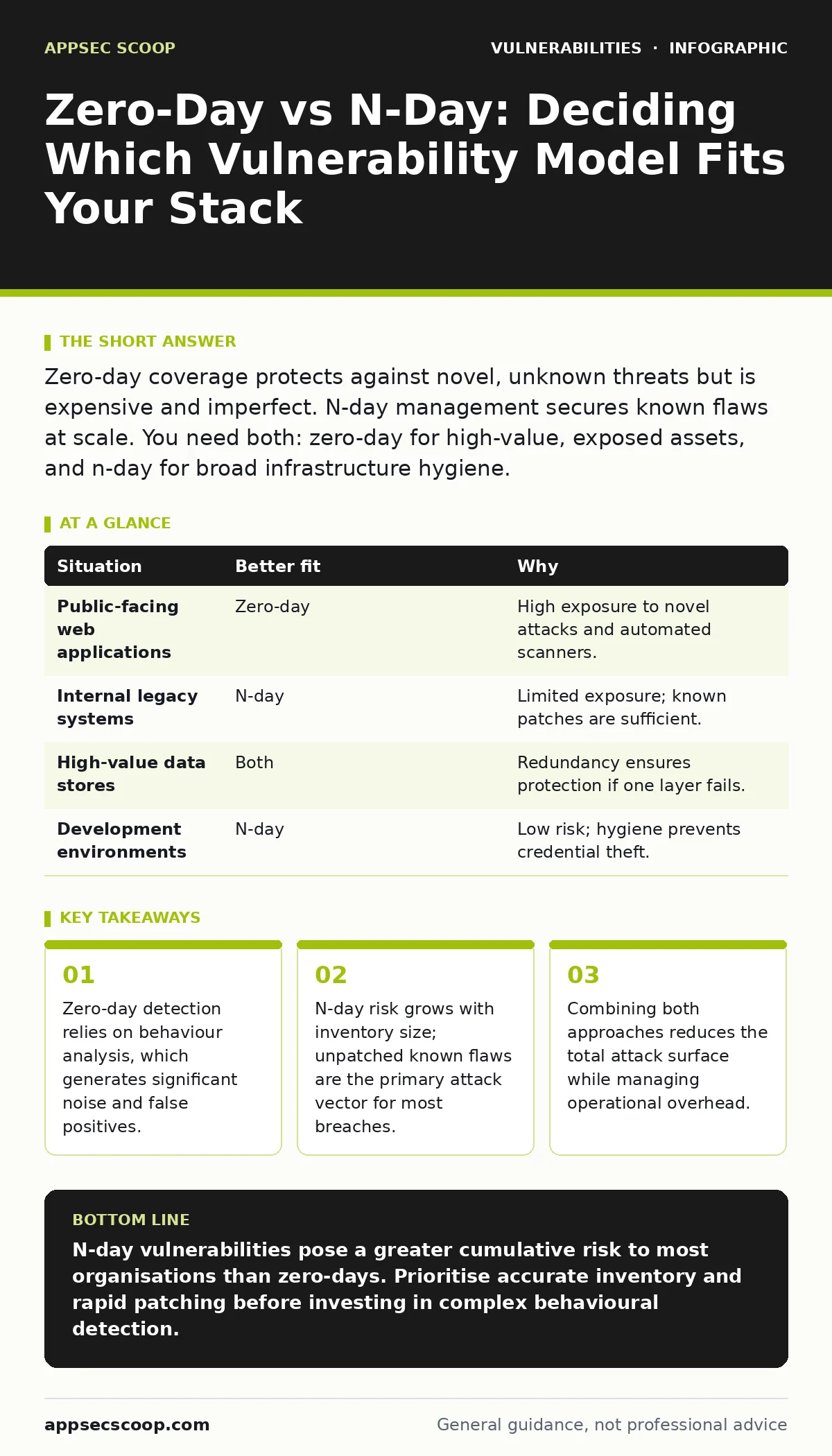
Zero-day coverage protects against novel, unknown threats but is expensive and imperfect. N-day management secures known flaws at scale. You need both: zero-day for high-value, exposed assets, and n-day for broad infrastructure hygiene.
Defining the Threat Horizon
A zero-day vulnerability is a flaw unknown to the vendor and without a public fix. Attackers exploit it before anyone else knows it exists. An n-day vulnerability is a known flaw with a published patch, where the number represents days since disclosure. The distinction is not about severity but about visibility.
You cannot patch a zero-day. You can only detect its exploitation or mitigate its impact. You can patch an n-day. The challenge is doing so quickly enough. Most security teams focus heavily on zero-day protection because it sounds more dangerous. This focus often leaves n-day risks unmanaged.
The Cost of Unknowns
Zero-day protection requires monitoring for abnormal behaviour. You look for code execution that does not match normal application patterns. This approach is computationally expensive. It often flags legitimate activities as malicious, creating alert fatigue.
Imagine a web application that suddenly sends large data packets to an unusual destination. A zero-day detector might flag this. It might also flag a legitimate backup process. The trade-off is high sensitivity for high uncertainty. You pay for the privilege of guessing what an attacker might do next.
The Debt of the Known
N-day vulnerabilities are everywhere. Every software component you use has a history of flaws. If you do not patch them, you invite attackers who use automated tools to scan for known weaknesses. These tools are cheap and effective.
The risk here is not sophistication. It is negligence. An attacker does not need to create a new exploit. They can use a script that targets a flaw disclosed years ago. If your inventory is large, the probability of an unpatched n-day vulnerability is near certainty.
Managing n-days requires accurate inventory. You must know what software you run and where. This is where a software bill of materials (SBOM) becomes valuable. It lists every component in your application. Without it, you are patching blind.
Deciding Factors for Your Architecture
Not all assets require the same protection level. A public-facing login page faces different risks than an internal database. You must match the control to the exposure.
| Situation | Better fit | Why |
|---|---|---|
| Public-facing web applications | Zero-day | High exposure to novel attacks and automated scanners. |
| Internal legacy systems | N-day | Limited exposure; known patches are sufficient. |
| High-value data stores | Both | Redundancy ensures protection if one layer fails. |
| Development environments | N-day | Low risk; hygiene prevents credential theft. |
Zero-day solutions are best for assets that are directly exposed to the internet. These systems are the first line of defence. N-day management is best for the bulk of your infrastructure. It is the foundation of security hygiene.
When to Use Both Together
Using both approaches is not redundant. It is layered. Zero-day detection catches the new. N-day patching closes the old. Together, they cover the full spectrum of risk.
Imagine an attacker finds a zero-day in your web server. Your behavioural detection blocks the exploit. However, if you also have unpatched n-day flaws in the underlying operating system, the attacker might pivot. They move laterally to a system with a known weakness.
This is why vulnerability severity ratings matter. They help you prioritise which n-days to fix first. You cannot fix everything at once. Focus on the flaws that are exploitable from your current attack surface.
See also: Responsible Disclosure Myths: 6 Ways Teams Misuse the Process · How Vulnerability Severity Ratings Work in Practice
The Hidden Cost of Complexity
Adding zero-day detection increases operational complexity. You need skilled analysts to review alerts. You need tuning to reduce noise. This costs time and money. N-day management is simpler but requires discipline. You must patch regularly.
If you lack the resources for sophisticated behavioural analysis, focus on n-days. It is better to have a clean patch record than a noisy zero-day detector. A clean patch record removes the low-hanging fruit for attackers.
Consider secure software development lifecycle practices. Preventing flaws before they enter your code is cheaper than detecting them later. This approach reduces both zero-day and n-day risks.
Edge Cases and Failures
Usual advice fails when you assume zero-day protection is sufficient. It is not. Attackers often combine zero-day exploits with n-day vulnerabilities. They use a zero-day to bypass initial controls. Then they use an n-day to maintain access.
Imagine a scenario where a zero-day allows an attacker to execute code. They then scan the internal network for unpatched systems. They find a server with a known command injection flaw. They exploit it to gain deeper access.
This is why segmentation is critical. Limit the blast radius of any breach. Even if a zero-day succeeds, it should not compromise your entire network.
Prioritising Your Efforts
Start with inventory. Know what you have. Then patch what is known. This removes the majority of risk. Add zero-day detection to your most exposed assets. Tune it carefully.
Do not neglect attack vectors in CVSS. Understanding how a vulnerability is exploited helps you prioritise. A remote code execution flaw is more dangerous than a local privilege escalation.
Finally, consider session fixation and open redirect vulnerabilities. These are often n-day flaws that are easy to exploit. They provide initial footholds for attackers. Fixing them reduces the chance of a successful breach.
Key takeaways
- Zero-day detection relies on behaviour analysis, which generates significant noise and false positives.
- N-day risk grows with inventory size; unpatched known flaws are the primary attack vector for most breaches.
- Combining both approaches reduces the total attack surface while managing operational overhead.
N-day vulnerabilities pose a greater cumulative risk to most organisations than zero-days. Prioritise accurate inventory and rapid patching before investing in complex behavioural detection.
Frequently asked questions
Is zero-day protection necessary for internal networks?
No. Internal networks have low exposure. Focus on patching known vulnerabilities and segmenting the network.
How do I reduce false positives from zero-day detectors?
Tune the detection rules based on normal application behaviour. Exclude known legitimate processes from monitoring.
Can an SBOM help with zero-day vulnerabilities?
Indirectly. It helps you identify components that are frequently targeted, allowing you to apply stricter monitoring.
What is the first step in n-day management?
Create a complete inventory of all software components. You cannot patch what you do not know you have.
How this guide was produced: written by the AppSec Scoop editorial team with AI assistance, checked against the public references listed below, and reviewed when the facts change. See our editorial policy or report an error.