
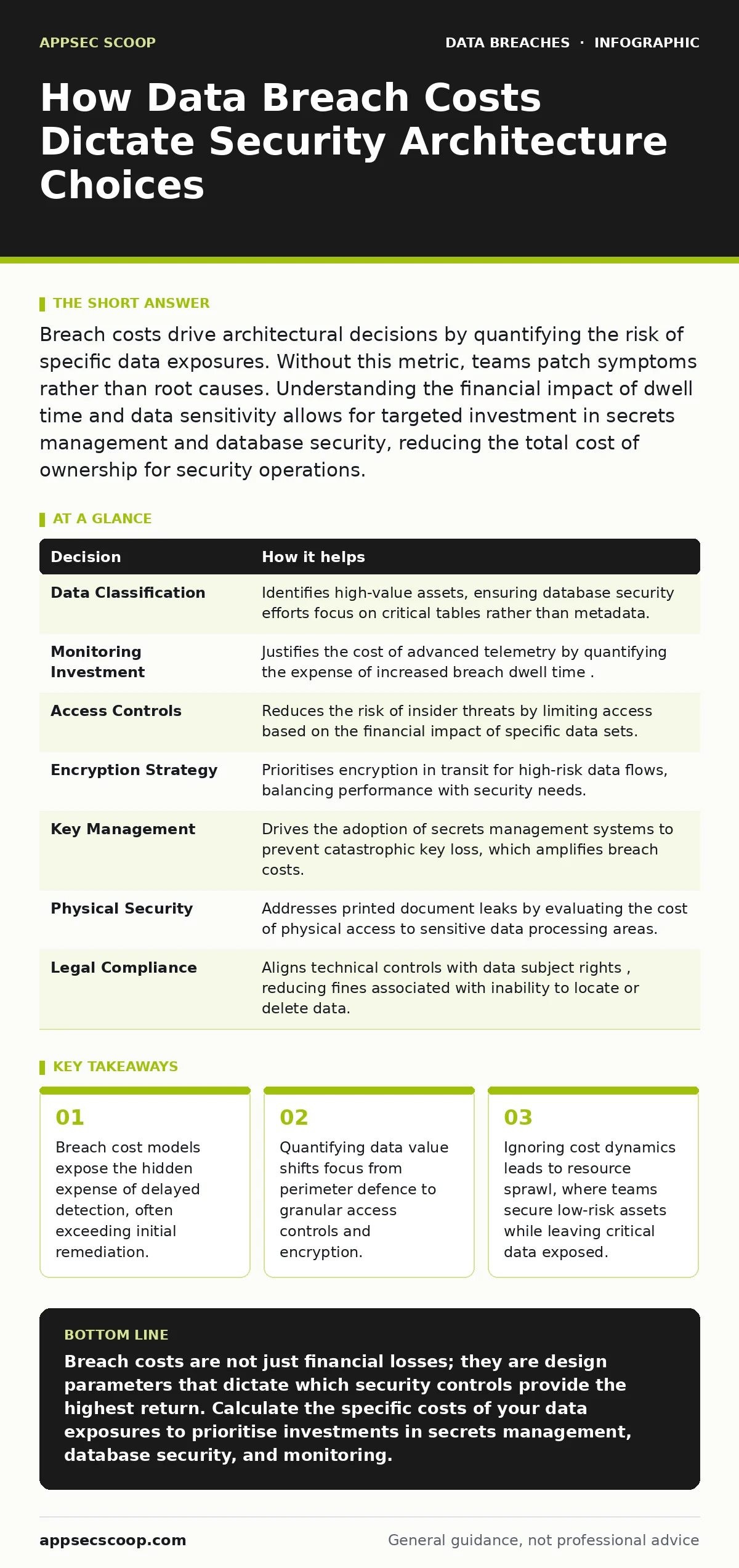
Breach costs drive architectural decisions by quantifying the risk of specific data exposures. Without this metric, teams patch symptoms rather than root causes. Understanding the financial impact of dwell time and data sensitivity allows for targeted investment in secrets management and database security, reducing the total cost of ownership for security operations.
The Arithmetic of Exposure
Security architecture is not built on intuition; it is built on risk calculation. When you ignore the financial implications of a breach, you default to uniform security controls. This approach assumes that all data carries equal weight. It does not. A customer email address has a different market value and regulatory burden than a private key used for decryption. Treating them with the same level of scrutiny wastes resources. It leaves the high-value assets under-protected because the controls designed for low-value data are insufficient for high-value secrets.
The cost of a breach is not a single invoice. It is the sum of detection delay, containment effort, regulatory fines, and reputational damage. Each component requires a different technical intervention. If you do not know which component drives the majority of your potential loss, you cannot select the right control. You might invest heavily in firewall rules while ignoring the fact that your greatest risk lies in misconfigured database permissions. This misalignment is common when cost data is absent from the design process.
Decisions Informed by Cost Metrics
When you attach a monetary value to potential breaches, your security decisions become precise. You stop asking "is this secure?" and start asking "is this secure enough for the data it holds?" This shift changes how you allocate engineering time. It determines whether you implement real-time monitoring or periodic audits. It dictates whether you use hardware security modules or software-based key storage.
Consider the choice between encrypting data at rest and encrypting data in transit. Both are standard practices. However, they serve different risk profiles. If the primary cost driver is interception during transfer, resources should flow toward encryption in transit protocols and certificate management. If the risk is insider theft or physical server compromise, database security and access logging become the priority. Without cost clarity, you implement both everywhere, creating complexity without proportional risk reduction. This complexity itself becomes a liability, increasing the chance of configuration errors.
The Cost of Ignorance
What goes wrong when you ignore breach costs is not immediate failure. It is gradual drift. You build a system that looks secure on paper but fails under pressure. The most dangerous outcome is false confidence. You believe you are protected because you have followed a checklist. You have not, however, aligned your controls with your actual risk profile. This leads to resource sprawl. You spend time securing the front door while the back window remains open.
A common failure mode is the neglect of breach dwell time. This is the period between initial compromise and detection. Every day an attacker remains undetected increases the potential cost. If you do not quantify the cost of each day of dwell time, you have no incentive to invest in advanced monitoring. You settle for basic antivirus and firewall logs. These tools are cheap, but they are often blind to lateral movement and data staging. The result is a long dwell time, which multiplies the impact of the breach. The cost is not just the data lost; it is the time spent investigating a much larger incident than necessary.
Another hidden cost is the failure to address printed document leaks. While digital security gets most attention, physical data remains a vector. If your cost model ignores physical media, you may not invest in secure print release or document tracking. This oversight seems minor until a breach occurs via a printer in a lobby. The remediation cost is disproportionate to the initial investment in physical security controls. Ignoring these edge cases leaves gaps that attackers routinely exploit.
Operationalising Cost Awareness
Teams that use breach cost data operate differently. They do not just buy tools; they design processes. They map data flows and assign risk scores to each segment. They then apply controls based on those scores. This is known as risk-based security. It is more efficient than blanket security. It allows you to say "no" to low-value controls that add complexity. It forces you to say "yes" to high-value controls that reduce the most significant risks.
For instance, consider data masking. This technique replaces sensitive data with realistic but fake values. It is useful for testing environments. If you do not understand the cost of exposing production data to developers, you might not implement masking. You might share live databases for testing. This creates a massive exposure. The potential breach cost of a developer accidentally exposing live customer data is high. By quantifying this risk, you justify the engineering effort to build and maintain a masking pipeline. The control is no longer a "nice to have"; it is a financial necessity.
Table of Decisions and Cost Drivers
The following table illustrates how specific breach cost components inform technical decisions. It maps the problem to the solution, highlighting the role of cost awareness.
| Decision | How it helps |
|---|---|
| Data Classification | Identifies high-value assets, ensuring database security efforts focus on critical tables rather than metadata. |
| Monitoring Investment | Justifies the cost of advanced telemetry by quantifying the expense of increased breach dwell time. |
| Access Controls | Reduces the risk of insider threats by limiting access based on the financial impact of specific data sets. |
| Encryption Strategy | Prioritises encryption in transit for high-risk data flows, balancing performance with security needs. |
| Key Management | Drives the adoption of secrets management systems to prevent catastrophic key loss, which amplifies breach costs. |
| Physical Security | Addresses printed document leaks by evaluating the cost of physical access to sensitive data processing areas. |
| Legal Compliance | Aligns technical controls with data subject rights, reducing fines associated with inability to locate or delete data. |
See also: Bring Your Own Key Encryption Mistakes That Leave Data Exposed · Encryption in Transit: How It Protects Data Between Systems
The Hidden Costs of Complexity
A counterintuitive insight is that adding security controls can increase breach costs. This happens when controls are poorly chosen. If you implement a complex authentication system that users find difficult, they will find ways to bypass it. They will write down passwords or share accounts. This behaviour increases the risk of credential theft. The cost of the breach then includes the failure of the control itself.
This is why understanding the cost of user friction is vital. You must balance security with usability. If the cost of bypassing a control is low for the user, they will do it. The security team then spends time investigating false alarms or minor incidents. This operational drag increases the total cost of security. By analysing these behavioural costs, you can choose controls that are effective and sustainable. You avoid the trap of over-engineering. You focus on controls that provide a clear return on investment by reducing the most expensive risks.
Integrating Cost into the Lifecycle
Breach cost awareness is not a one-time exercise. It is a continuous process. As your business grows, your data landscape changes. New data sources are introduced. New threats emerge. Your cost model must evolve with these changes. This requires a feedback loop. When incidents occur, you must analyse their true cost. You must update your models based on this real-world data.
This approach connects technical security with business objectives. It allows security teams to speak the language of finance. It transforms security from a cost centre to a risk mitigation function. By demonstrating how specific controls reduce specific costs, you gain support for your initiatives. You avoid the cycle of arguing for security based on fear. You argue for it based on logic and economics. This leads to more resilient systems and better resource allocation.
The Role of Data Subjects
One overlooked aspect of breach cost is the impact on individuals. Data subject rights give individuals control over their data. If a breach occurs, the cost includes the effort to notify individuals and process their requests. This operational burden is significant. If you do not design your systems to support these rights, the cost of compliance after a breach increases. You may need to manually search for and delete data. This is slow and error-prone.
By designing for data subject rights from the start, you reduce this cost. You implement automated data mapping and deletion processes. This makes compliance easier and reduces the risk of fines. It also improves customer trust. The cost of implementing these controls is lower than the cost of a breach and the subsequent compliance crisis. Ignoring this aspect leaves you vulnerable to both financial and reputational damage.
Key takeaways
- Breach cost models expose the hidden expense of delayed detection, often exceeding initial remediation.
- Quantifying data value shifts focus from perimeter defence to granular access controls and encryption.
- Ignoring cost dynamics leads to resource sprawl, where teams secure low-risk assets while leaving critical data exposed.
Breach costs are not just financial losses; they are design parameters that dictate which security controls provide the highest return. Calculate the specific costs of your data exposures to prioritise investments in secrets management, database security, and monitoring.
Frequently asked questions
How do I estimate the cost of a breach if I have never had one?
Use a risk assessment model that combines the value of your data, the likelihood of exposure, and the potential impact. Consult with legal and finance teams to understand regulatory fines and reputational damage estimates.
Is it worth spending more on security for low-value data?
Generally, no. Focus resources on high-value data. Low-value data can often be protected with standard, low-cost controls. Over-securing low-value data wastes resources that could be used elsewhere.
How often should I update my breach cost model?
Update it whenever there is a significant change in your data, business processes, or regulatory environment. Annual reviews are a good minimum, but major changes require immediate updates.
Can automation reduce breach costs?
Yes. Automation reduces the time to detect and respond to breaches, lowering dwell time. It also reduces the labour costs associated with incident response and compliance reporting.
How this guide was produced: written by the AppSec Scoop editorial team with AI assistance, checked against the public references listed below, and reviewed when the facts change. See our editorial policy or report an error.