
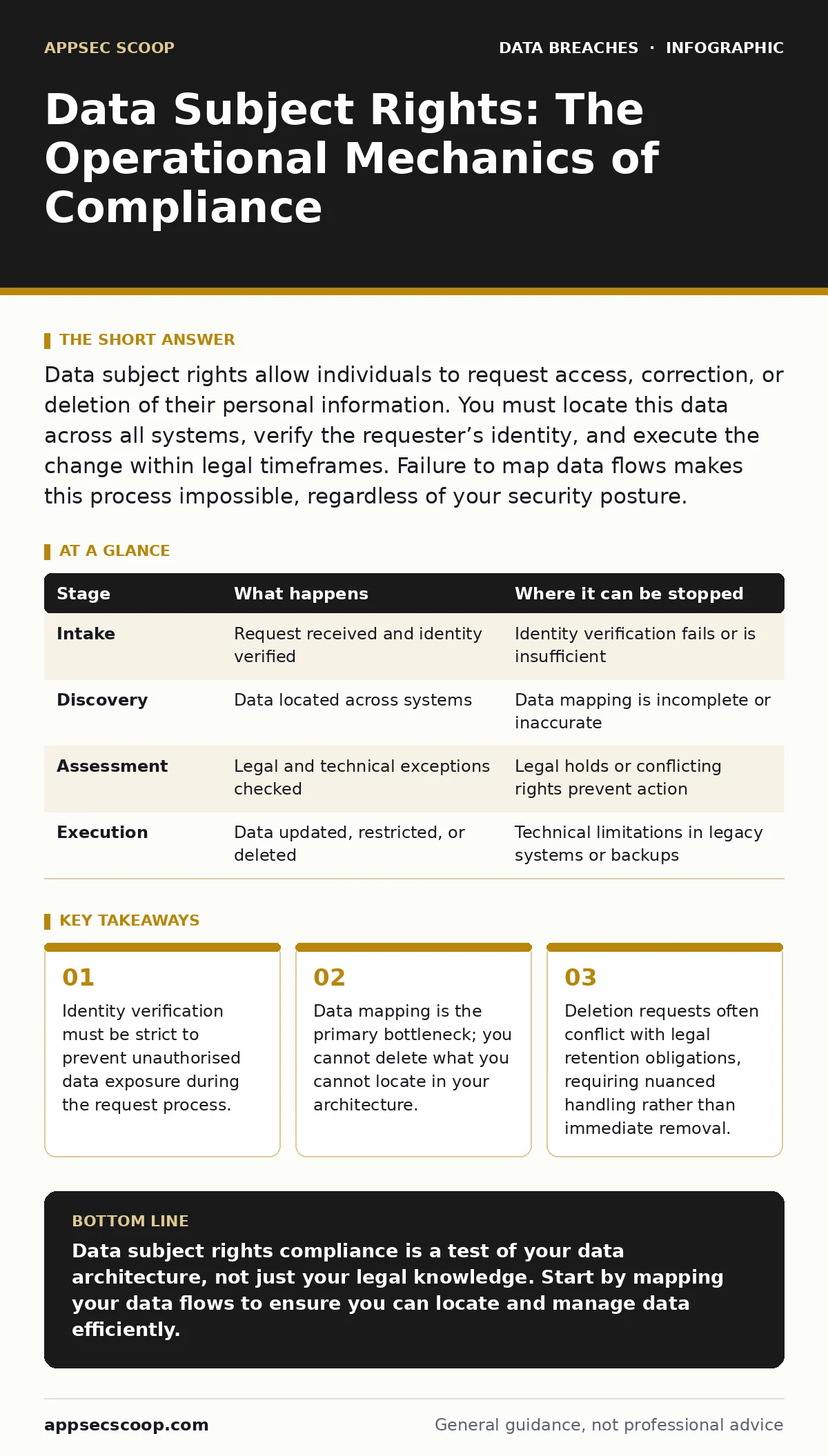
Data subject rights allow individuals to request access, correction, or deletion of their personal information. You must locate this data across all systems, verify the requester’s identity, and execute the change within legal timeframes. Failure to map data flows makes this process impossible, regardless of your security posture.
The Right to Access and Erasure
Data subject rights grant individuals control over their personal data held by an organisation. These rights typically include the right to access, rectify, restrict processing, and erase data. The operational challenge lies not in the legal text, but in the technical execution across distributed systems.
Most organisations treat these requests as administrative tasks. They are not. They are stress tests for your data architecture. If you cannot answer where a specific piece of data resides, you cannot comply with the request. This exposes a gap between your security controls and your data governance.
Stage 1: Intake and Identity Verification
The process begins when an individual submits a request. This can occur via email, a web portal, or a dedicated form. The immediate priority is verifying the identity of the requester. You must ensure the person making the request is the data subject or their authorised representative.
Weak identity verification creates a severe risk. An attacker could submit a request for access to gain detailed insights into an organisation’s data holdings. This is a form of reconnaissance. You should require multiple factors of authentication, similar to what you would use for privileged access.
You must also validate that the request is valid and complete. Ambiguous requests should be clarified before any work begins. This prevents wasted effort and ensures you are acting on accurate information.
Stage 2: Data Discovery and Mapping
Once identity is confirmed, you must locate the data. This is the most difficult stage. Personal data is rarely stored in a single, centralised database. It exists in application logs, backup tapes, analytics platforms, and third-party services.
Your data mapping documentation is critical here. If you have not mapped your data flows, you are searching in the dark. You need to know which systems process which types of data. This requires regular updates to your inventory.
Imagine a user requests deletion of their account. Their profile data is in the primary database. But their chat logs are in a separate messaging service. Their payment history is with a processor. Their usage patterns are in a data lake. Each of these systems requires a separate action.
This stage reveals the true cost of data sprawl. The more systems you have, the longer discovery takes. Delays in discovery can lead to non-compliance and fines. It also highlights the importance of data masking in non-production environments to reduce the attack surface during discovery.
Stage 3: Assessment and Legal Checks
Not all requests can be fulfilled immediately. You must assess whether any exceptions apply. For example, you may need to retain data for legal reasons, such as tax records or litigation holds. In such cases, you cannot delete the data, but you may need to restrict its processing.
You must also check for conflicting rights. One user’s request for erasure might impact another user’s right to access their own data, such as in a shared message thread. Balancing these rights requires careful legal and technical judgement.
This assessment phase is where many organisations fail. They automate deletion without checking for exceptions. This can lead to accidental destruction of legally required records. It can also cause operational issues if dependent systems expect the data to exist.
Stage 4: Execution and Confirmation
Once the assessment is complete, you execute the request. This involves updating, restricting, or deleting data across all identified systems. You must ensure that backups are handled correctly. Deleting live data does not remove it from backups.
You should have a process for handling backups. This might involve waiting for the next backup cycle to overwrite the data, or using specific tools to purge data from backups. This is often the most technically complex part of the process.
After execution, you must confirm completion to the user. This confirmation should include details of what was done and any exceptions that applied. Transparency builds trust and provides a record of compliance.
See also: Difference Between Data Breach and Data Exfiltration: The Operational Truth · Third Party Risk Assessment Checklist for Vendor Security
The Hidden Costs of Compliance
Fulfilling data subject rights is resource-intensive. It requires dedicated personnel, technical tools, and robust processes. The cost is not just financial; it is operational. Every request diverts resources from other security tasks.
There is also a hidden cost in data architecture. Organisations that build systems with data subject rights in mind often have cleaner, more manageable data models. This improves overall data quality and security. Ignoring these rights leads to technical debt that is expensive to resolve later.
Consider how database exposure increases when you create ad-hoc processes to locate data. Temporary scripts or manual queries can introduce vulnerabilities. Standardised, automated processes reduce this risk.
Integrating with Security Operations
Data subject rights are not separate from security operations. They are intertwined. Poor data management increases the impact of a data breach. If you cannot locate data, you cannot determine what was exposed in a breach.
Effective secrets management ensures that the credentials used to access data during these requests are secure. If these credentials are compromised, an attacker could execute malicious deletion or access requests.
You should integrate data subject rights workflows into your security monitoring. Unusual patterns in requests, such as a surge in access requests from a single IP address, could indicate an attack. Monitoring these patterns helps detect and respond to threats faster.
The Path Forward
Compliance with data subject rights is ongoing. It requires continuous effort to maintain data maps, update processes, and train staff. It is not a one-time project.
Organisations that view these rights as a burden often struggle. Those that view them as an opportunity to improve data governance tend to succeed. They build systems that are more transparent, secure, and efficient.
Remember that encryption in transit protects data during movement, but it does not help you locate or delete it at rest. You need both security controls and data governance to meet these obligations.
| Stage | What happens | Where it can be stopped |
|---|---|---|
| Intake | Request received and identity verified | Identity verification fails or is insufficient |
| Discovery | Data located across systems | Data mapping is incomplete or inaccurate |
| Assessment | Legal and technical exceptions checked | Legal holds or conflicting rights prevent action |
| Execution | Data updated, restricted, or deleted | Technical limitations in legacy systems or backups |
Key takeaways
- Identity verification must be strict to prevent unauthorised data exposure during the request process.
- Data mapping is the primary bottleneck; you cannot delete what you cannot locate in your architecture.
- Deletion requests often conflict with legal retention obligations, requiring nuanced handling rather than immediate removal.
Data subject rights compliance is a test of your data architecture, not just your legal knowledge. Start by mapping your data flows to ensure you can locate and manage data efficiently.
Frequently asked questions
How long do I have to respond to a data subject request?
Most regulations require a response within one month, with possible extensions for complex cases. Delays should be communicated to the user promptly.
Can I charge a fee for handling these requests?
Generally, no. You must handle requests free of charge. Fees are only permitted in specific circumstances, such as manifestly unfounded or excessive requests.
What if the data is in a third-party system?
You remain responsible for compliance. You must have contracts with third parties that ensure they can fulfil requests on your behalf.
Does deleting data from the primary database satisfy the request?
No. You must also delete or anonymise data in backups, logs, and analytics systems. Residual copies must be addressed to ensure full compliance.
How this guide was produced: written by the AppSec Scoop editorial team with AI assistance, checked against the public references listed below, and reviewed when the facts change. See our editorial policy or report an error.