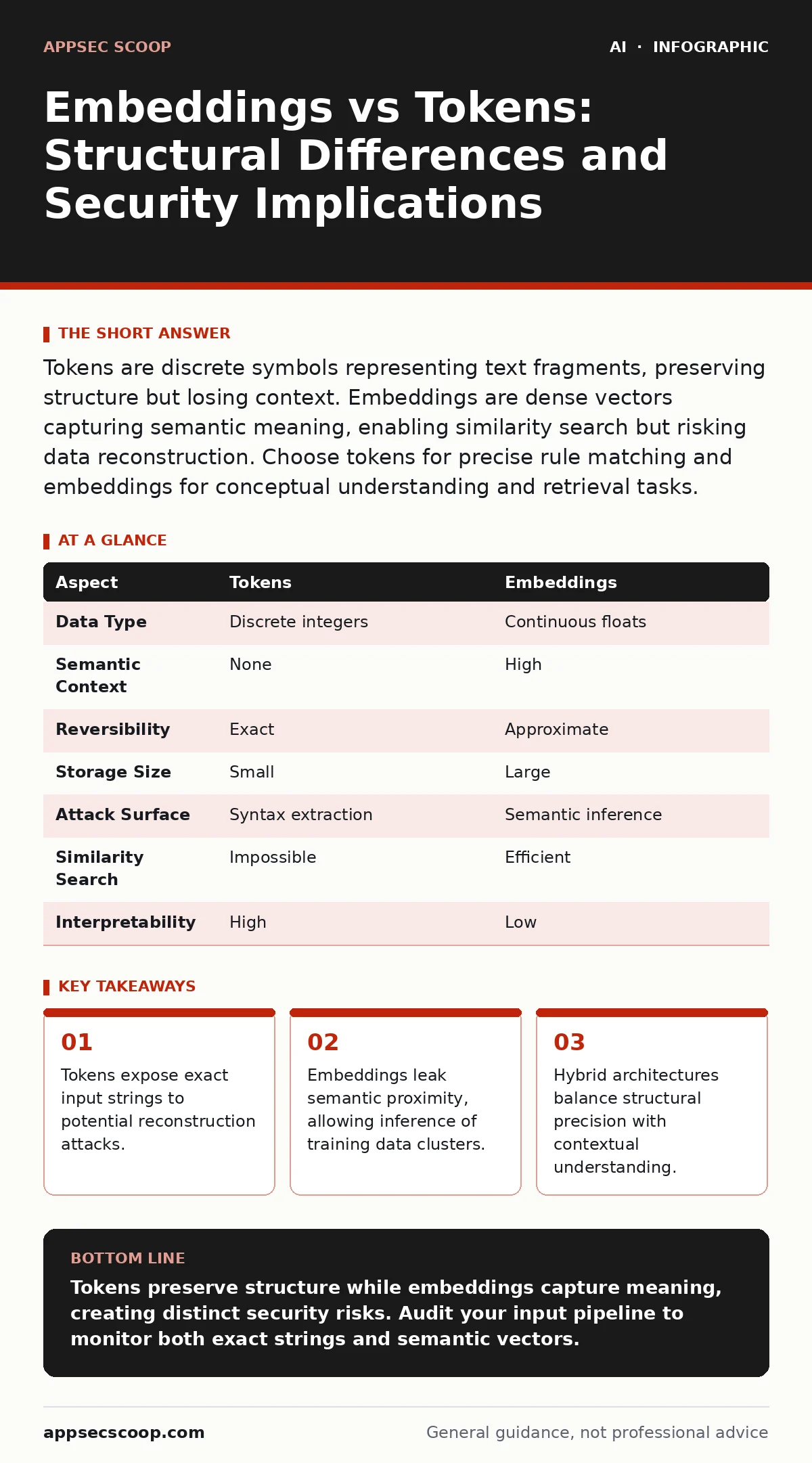
Tokens are discrete symbols representing text fragments, preserving structure but losing context. Embeddings are dense vectors capturing semantic meaning, enabling similarity search but risking data reconstruction. Choose tokens for precise rule matching and embeddings for conceptual understanding and retrieval tasks.
Embeddings vs Tokens: The Core Distinction
Tokens and embeddings serve fundamentally different roles in natural language processing pipelines. A token is a discrete unit of text, such as a word or subword, that retains its original syntactic form. An embedding is a high-dimensional vector representation that maps that token into a continuous space where geometric distance reflects semantic similarity. The critical difference lies in information retention: tokens preserve exact character sequences, while embeddings discard syntax in favour of meaning. This trade-off dictates how you secure your AI systems against data leakage and adversarial manipulation.
What Are Tokens?
Tokens are the atomic units of input data for large language models. Tokenisation splits raw text into manageable chunks using algorithms like byte-pair encoding or unigram models. Each token corresponds to a unique integer ID within the model’s vocabulary. This process preserves the exact ordering and structure of the original text. Security teams must recognise that tokens are reversible. An attacker with access to the tokeniser can reconstruct the original input string from the token IDs. This reversibility makes tokens vulnerable to exact-match extraction attacks, where an adversary queries the model to confirm the presence of specific sensitive phrases.
What Are Embeddings?
Embeddings transform tokens into dense arrays of floating-point numbers. These vectors place semantically similar concepts close together in mathematical space. For example, "king" and "queen" will have vectors with a small distance between them. This representation allows models to generalise from training data to unseen inputs.
However, embeddings are not reversible by simple lookup. Reconstructing the original text from an embedding requires an inverse mapping function, which is often approximate and lossy. This opacity provides a layer of abstraction, but it does not guarantee privacy. Adversaries can use embedding vectors to infer the presence of specific concepts or relationships within the training data.
Point-by-Point Comparison
| Aspect | Tokens | Embeddings |
|---|---|---|
| Data Type | Discrete integers | Continuous floats |
| Semantic Context | None | High |
| Reversibility | Exact | Approximate |
| Storage Size | Small | Large |
| Attack Surface | Syntax extraction | Semantic inference |
| Similarity Search | Impossible | Efficient |
| Interpretability | High | Low |
Tokens excel in tasks requiring precise structural analysis, such as code parsing or regulatory compliance checking. Embeddings dominate in tasks requiring conceptual understanding, such as sentiment analysis or document retrieval. The choice between them affects your security posture. Tokens allow you to audit exact inputs, while embeddings require monitoring for anomalous vector clusters that might indicate data poisoning or model inversion attempts.
When to Choose Tokens
Choose tokens when your application requires exact string matching. This includes scenarios where regulatory compliance demands audit trails of specific inputs. Tokens also suit applications where syntax dictates meaning, such as programming language interpreters or structured data parsers. Using tokens allows you to implement strict allow-lists and block-lists at the input stage. You can detect and reject inputs containing prohibited keywords with high precision. This approach minimises the risk of the model misinterpreting malicious intent disguised as benign text. However, it fails to catch semantically equivalent variations of harmful instructions.
See also: Treat AI Models as Untrusted Insiders: A Step-by-Step Implementation · AI Agent Hijacking Prevention Checklist for Secure Workflows
When to Choose Embeddings
Choose embeddings when your application relies on understanding intent rather than form. This includes search engines, recommendation systems, and chatbots that must handle diverse phrasing. Embeddings enable the system to recognise that "how do I steal data" and "methods for data exfiltration" share the same malicious intent. This semantic alignment improves robustness against simple adversarial obfuscation. You can cluster embeddings to identify unusual patterns of user behaviour that deviate from normal usage. This capability supports proactive threat detection by highlighting inputs that are conceptually similar to known attacks, even if the wording differs.
Overlap and Hybrid Approaches
Many modern systems use both tokens and embeddings simultaneously. The model processes tokens to generate embeddings, then uses those embeddings for reasoning. This hybrid approach combines the structural precision of tokens with the contextual flexibility of embeddings. Security operations must account for both representations. You need to monitor token inputs for exact matches against threat intelligence feeds.
Simultaneously, you must analyse embedding spaces for semantic anomalies. This dual-layer monitoring aligns with the principles of the NIST AI Risk Management Framework, which emphasises multiple lines of defence. It also supports explainable AI initiatives by providing both the raw input and its semantic interpretation for audit purposes.
Security Implications
The choice between tokens and embeddings influences your exposure to specific AI threats. Tokens are vulnerable to prompt injection attacks that exploit syntactic ambiguities. Embeddings are vulnerable to model inversion attacks that reconstruct training data from output vectors. Understanding these differences helps you tailor your defence strategies. For instance, you might apply differential privacy to embeddings to reduce the risk of data leakage. You might apply strict input sanitisation to tokens to prevent syntax-based exploits. This nuanced approach is critical for maintaining AI transparency and ensuring that your models behave predictably under adversarial pressure.
Key takeaways
- Tokens expose exact input strings to potential reconstruction attacks.
- Embeddings leak semantic proximity, allowing inference of training data clusters.
- Hybrid architectures balance structural precision with contextual understanding.
Tokens preserve structure while embeddings capture meaning, creating distinct security risks. Audit your input pipeline to monitor both exact strings and semantic vectors.
Frequently asked questions
Can embeddings be reversed to original text?
Not exactly. Reversing an embedding requires an inverse mapping that is approximate and lossy, making exact reconstruction difficult but semantic inference possible.
Do tokens hide sensitive information?
No. Tokens are reversible integers that map directly to text fragments. An attacker with the tokeniser can reconstruct the original sensitive input.
Which is better for detecting prompt injection?
Embeddings are better for detecting semantic intent of injections, while tokens are better for blocking exact known malicious strings. A hybrid approach is most effective.
How does this relate to MITRE ATLAS?
MITRE ATLAS includes techniques for data poisoning and model inversion. Understanding token and embedding differences helps you implement controls against these specific attack vectors.
How this guide was produced: written by the AppSec Scoop editorial team with AI assistance, checked against the public references listed below, and reviewed when the facts change. See our editorial policy or report an error.