
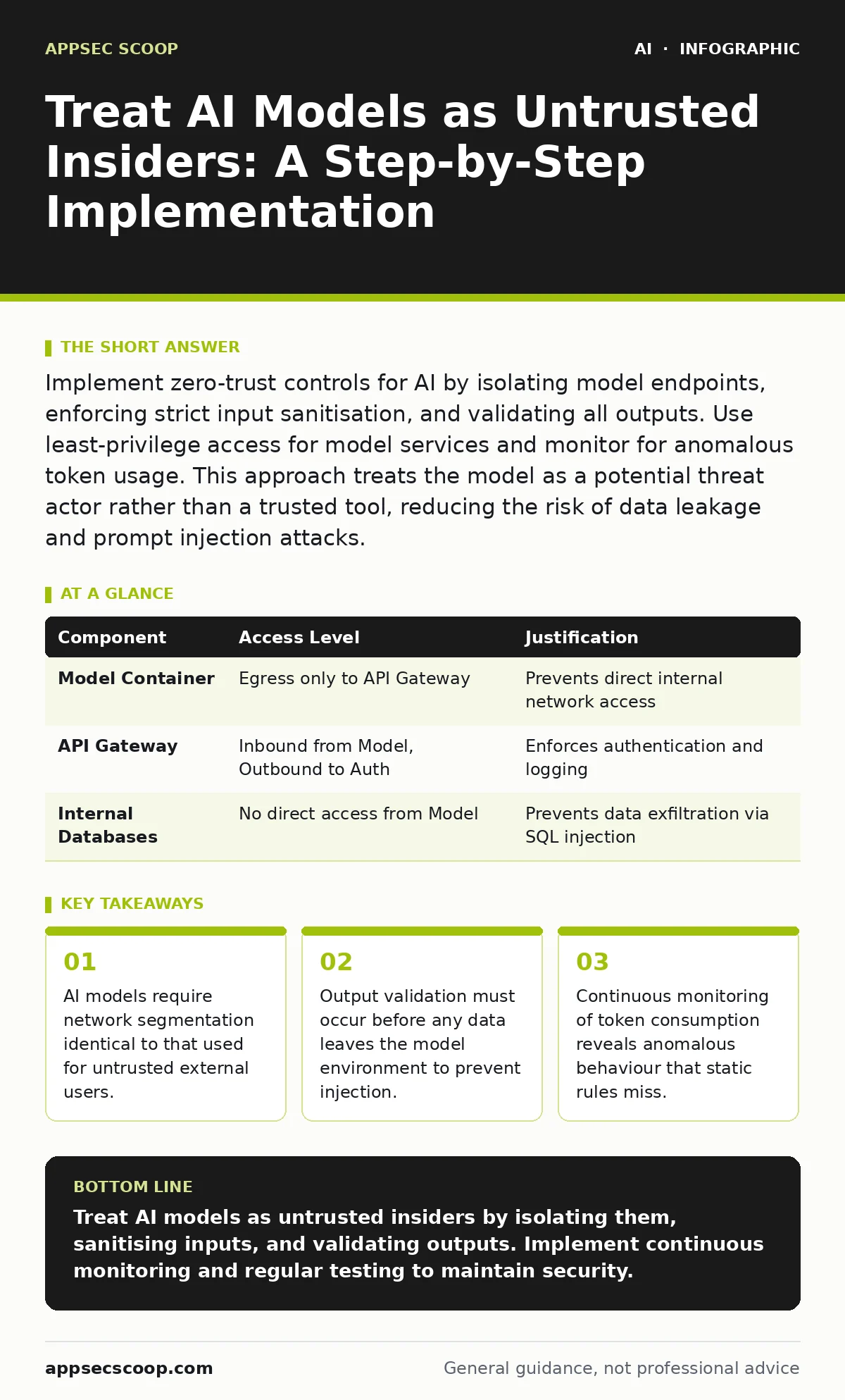
Implement zero-trust controls for AI by isolating model endpoints, enforcing strict input sanitisation, and validating all outputs. Use least-privilege access for model services and monitor for anomalous token usage. This approach treats the model as a potential threat actor rather than a trusted tool, reducing the risk of data leakage and prompt injection attacks.
Define the Trust Boundary for Model Services
You must establish a clear separation between the AI model and the rest of your infrastructure. A large language model operates as a stateless process that accepts text and returns text. It does not understand context beyond the immediate prompt window. This lack of persistent state means it cannot be trusted with long-term credentials or direct database access.
The model acts as a translation layer, not an authority. You must treat the model as an untrusted insider because it can be manipulated by adversarial inputs to reveal hidden instructions or data. This manipulation is known as prompt injection. The model follows the instructions it receives, even if those instructions conflict with your original intent.
Step 1: Isolate the Model Environment
The first action is to place the AI model in a restricted network segment. The model should not have direct access to internal databases, file shares, or other critical systems. You must route all data through an intermediary service that enforces strict access controls. This intermediary acts as a gatekeeper, ensuring that only sanitised data reaches the model.
The model should only be able to communicate with the intermediary, not with other services directly. This isolation prevents the model from being used as a pivot point for lateral movement within your network. You verify this step by attempting to connect from the model’s container to an internal database port. The connection must fail. If the connection succeeds, your network segmentation is insufficient.
| Component | Access Level | Justification |
|---|---|---|
| Model Container | Egress only to API Gateway | Prevents direct internal network access |
| API Gateway | Inbound from Model, Outbound to Auth | Enforces authentication and logging |
| Internal Databases | No direct access from Model | Prevents data exfiltration via SQL injection |
Step 2: Implement Input Sanitisation
You must sanitise all inputs before they reach the model. This process involves removing or encoding special characters that could be interpreted as instructions. You should also limit the length of inputs to prevent resource exhaustion attacks. The sanitisation layer must be independent of the model. It should be a deterministic process that applies consistent rules.
You can use regular expressions or a dedicated sanitisation library to strip out potentially malicious content. This step reduces the surface area for prompt injection attacks. You verify this step by sending a known injection payload to the input sanitiser. The sanitiser must block or neutralise the payload before it reaches the model. If the payload passes through, your sanitisation rules are too permissive.
Step 3: Enforce Output Validation
The model’s output must be validated before it is used or displayed. This validation checks for unexpected content, such as code snippets, sensitive data, or instructions that contradict your original prompt. You should use a secondary model or a rule-based system to inspect the output. The validator must be stricter than the model. It should reject any output that does not match the expected schema or content type. This step prevents the model from leaking data or executing malicious commands. You verify this step by injecting a prompt that attempts to extract system instructions. The output validator must block the response. If the response is delivered, your validation logic is flawed.
Step 4: Apply Least-Privilege Access Controls
The model service should operate with the minimum permissions required to function. This means revoking any administrative or write access to underlying infrastructure. The model should only be able to read the data it needs to process. You must use short-lived credentials for any external API calls the model makes. These credentials should expire after a single use or a short time window. This approach limits the damage if the model is compromised. You verify this step by attempting to use the model’s credentials to access a restricted resource. The access must be denied. If the access is granted, your privilege model is too broad.
See also: AI Agent Hijacking Prevention Checklist for Secure Workflows · Shadow AI usage: how to control unmanaged model access in your firm
Step 5: Monitor Token Consumption Patterns
You must monitor the volume and pattern of token consumption by the model. Unusual spikes in token usage can indicate a prompt injection attack or a data exfiltration attempt. You should set alerts for deviations from baseline usage patterns. This monitoring helps you detect attacks that bypass static rules. You must log all inputs and outputs for forensic analysis. This logging must be secure and tamper-proof. You verify this step by simulating a high-volume attack and checking if the alerting system triggers. The alert must fire within a defined timeframe. If the alert fails to fire, your monitoring thresholds are incorrect.
Verification Checklist
You must confirm that all controls are active and effective. Use this checklist to validate your implementation.
- Model is isolated in a separate network segment with no direct internal access.
- Input sanitisation blocks known injection payloads before they reach the model.
- Output validation rejects responses that contain unexpected schema or content.
- Model service credentials are short-lived and limited to read-only access.
- Monitoring alerts trigger on anomalous token consumption patterns.
- Logs are securely stored and protected from tampering.
Upkeep and Continuous Improvement
You must regularly review and update your controls. AI models evolve, and new attack vectors emerge. You should test your defences against the latest known injection techniques. Review your sanitisation rules to ensure they cover new patterns. Update your output validators to handle new data formats. You must also review your access controls to ensure they remain aligned with the principle of least privilege.
This upkeep ensures your defences remain effective over time. You should also consider the implications of training data leakage. If your model is trained on sensitive data, it may inadvertently reveal that data in its outputs. You must monitor for this risk and adjust your data handling practices accordingly.
Handling Adversarial Examples
You must prepare for adversarial examples that are designed to confuse the model. These examples may look benign but cause the model to produce incorrect or malicious outputs. You should train your model on a diverse dataset that includes adversarial examples. This training helps the model recognise and resist manipulation. You must also implement runtime detection for adversarial inputs.
This detection can use statistical methods to identify inputs that deviate from normal patterns. You verify this step by testing your model against a set of known adversarial examples. The model should produce safe outputs or reject the input. If the model produces malicious outputs, your training or detection needs improvement.
Integrating with Explainable AI
You should integrate explainable AI techniques to understand why the model produced a specific output. This understanding helps you identify biases or vulnerabilities in the model. Explainable AI provides insights into the model’s decision-making process. You can use these insights to refine your sanitisation and validation rules. This integration improves the transparency and trustworthiness of your AI systems. You verify this step by generating explanations for a set of test inputs. The explanations should be consistent and informative. If the explanations are unclear or inconsistent, your explainability tools need adjustment.
Key takeaways
- AI models require network segmentation identical to that used for untrusted external users.
- Output validation must occur before any data leaves the model environment to prevent injection.
- Continuous monitoring of token consumption reveals anomalous behaviour that static rules miss.
Treat AI models as untrusted insiders by isolating them, sanitising inputs, and validating outputs. Implement continuous monitoring and regular testing to maintain security.
Frequently asked questions
How do I detect prompt injection attacks in real time?
Monitor for anomalous token consumption and unexpected output patterns. Use a secondary model to validate outputs against expected schemas.
Can I trust open-source AI models more than proprietary ones?
No. Open-source models may have unknown vulnerabilities. Treat all models as untrusted and apply the same security controls.
What is the role of embeddings in AI security?
Embeddings can be used to detect similar or malicious inputs. They help identify patterns that may indicate an attack.
How does AI-generated phishing relate to model security?
Compromised models can be used to generate convincing phishing content. Securing the model prevents this capability from being abused.
How this guide was produced: written by the AppSec Scoop editorial team with AI assistance, checked against the public references listed below, and reviewed when the facts change. See our editorial policy or report an error.