
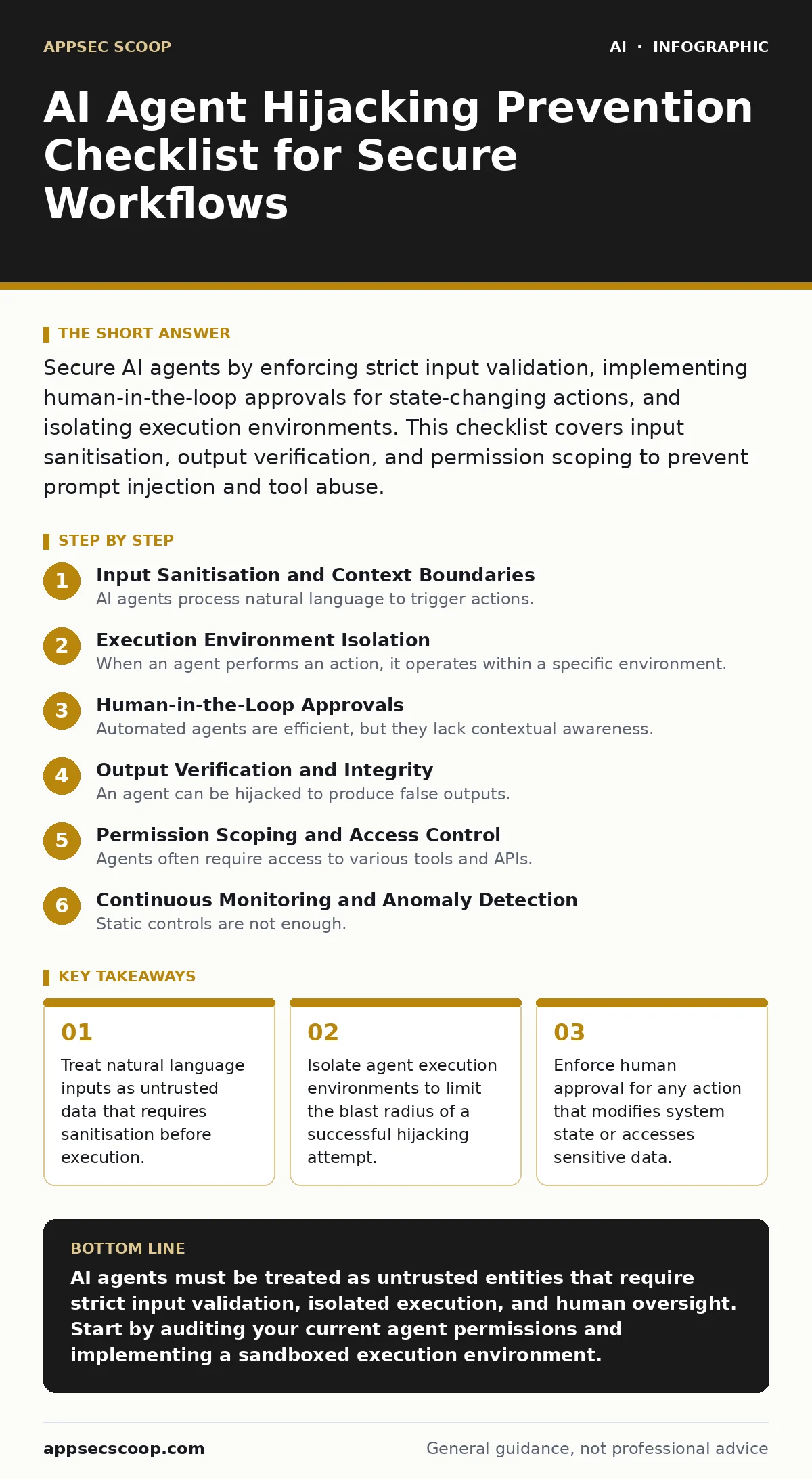
Secure AI agents by enforcing strict input validation, implementing human-in-the-loop approvals for state-changing actions, and isolating execution environments. This checklist covers input sanitisation, output verification, and permission scoping to prevent prompt injection and tool abuse.
Input Sanitisation and Context Boundaries
AI agents process natural language to trigger actions. An attacker can embed malicious instructions within seemingly benign text, a technique known as prompt injection. You must treat every character of user input as potentially hostile. The agent does not distinguish between a request to summarise a document and a command to delete a database.
- Strip metadata from uploaded files: Documents often contain hidden text layers that bypass standard text analysis.
- Validate input length and complexity: Excessive token counts can exhaust memory or trigger logic errors in the processing pipeline.
- Separate user data from system instructions: Use distinct delimiters so the model cannot confuse a user’s query with its own operational rules.
- Reject inputs containing executable code snippets: Prevent the agent from interpreting code blocks as commands unless explicitly authorised.
Execution Environment Isolation
When an agent performs an action, it operates within a specific environment. If that environment has broad permissions, a hijacked agent can cause significant damage. You must restrict the agent’s ability to interact with the broader network. The principle of least privilege applies to AI agents just as it does to human users.
- Run agents in sandboxed containers: Isolate the execution context from the host system to prevent lateral movement.
- Disable outbound network access by default: Agents should only communicate with explicitly whitelisted services.
- Use ephemeral credentials: Generate short-lived tokens for each session to limit the window of opportunity for credential theft.
- Monitor resource usage spikes: Unusual CPU or memory consumption may indicate an agent is performing unintended tasks.
Imagine an agent tasked with summarising emails. If it can access the internal file server, an attacker could force it to exfiltrate sensitive documents. Isolation prevents this lateral movement. For deeper insights on managing these risks, consider reviewing the NIST AI Risk Management Framework for structured guidance.
Human-in-the-Loop Approvals
Automated agents are efficient, but they lack contextual awareness. Not every action should be executed automatically. You must define which actions require human verification. This adds friction to the workflow but significantly reduces the risk of catastrophic errors. The trade-off is speed versus safety.
- Require approval for financial transactions: Never allow an agent to initiate payments without explicit human confirmation.
- Flag data modifications for review: Changes to databases or configuration files should trigger a manual checkpoint.
- Limit the scope of read-only access: Even viewing sensitive data can lead to leakage if the agent is compromised.
- Implement timeout mechanisms: Expire pending approvals after a set period to prevent stale actions from executing.
Output Verification and Integrity
An agent can be hijacked to produce false outputs. These outputs might look correct but contain subtle errors or malicious payloads. You must verify the integrity of the agent’s responses. Blind trust in AI-generated content is a significant security risk.
- Validate output format and structure: Ensure responses match expected schemas to detect anomalies.
- Cross-reference critical data: Verify facts against trusted sources before accepting them as true.
- Log all agent interactions: Maintain a complete audit trail for forensic analysis.
- Implement rate limiting on output generation: Prevent an attacker from flooding the system with false information.
For a broader perspective on securing AI systems, refer to the guide on treating AI models as untrusted insiders. This approach reinforces the need for constant verification.
Permission Scoping and Access Control
Agents often require access to various tools and APIs. Each permission expands the attack surface. You must scope permissions tightly. An agent that only needs to read a calendar should not have access to email sending capabilities.
- Define granular permission sets: Assign only the minimum permissions required for each specific task.
- Rotate API keys regularly: Prevent long-term credential compromise from leading to persistent access.
- Audit permission usage: Regularly review which permissions are actually being used and revoke unused ones.
- Implement role-based access control: Ensure that agents operate under specific roles with defined limits.
See also: Training Data Leakage Explained: How AI Memorises Your Secrets · AI-Generated Phishing: Risks and Protection for Small Businesses
Continuous Monitoring and Anomaly Detection
Static controls are not enough. You must monitor agent behaviour in real-time. Anomalies in behaviour can indicate a hijacking attempt. You need to detect deviations from normal patterns quickly.
- Track command execution sequences: Look for unusual chains of commands that do not align with the agent’s purpose.
- Monitor for sensitive data access: Alert on any attempt to access restricted data stores.
- Analyse prompt patterns: Detect repetitive or structured prompts that may indicate automated attacks.
- Implement automated rollback: Allow for quick reversal of actions if a hijacking is detected.
For related threats, see the guide on AI-generated phishing, which highlights how attackers manipulate communication channels. Understanding these vectors helps in designing better detection rules.
Key takeaways
- Treat natural language inputs as untrusted data that requires sanitisation before execution.
- Isolate agent execution environments to limit the blast radius of a successful hijacking attempt.
- Enforce human approval for any action that modifies system state or accesses sensitive data.
AI agents must be treated as untrusted entities that require strict input validation, isolated execution, and human oversight. Start by auditing your current agent permissions and implementing a sandboxed execution environment.
Frequently asked questions
What is prompt injection in AI agents?
Prompt injection is a technique where an attacker embeds malicious instructions within user input to manipulate the AI agent’s behaviour, causing it to execute unintended actions.
How do I isolate an AI agent’s execution environment?
Use sandboxed containers or virtual machines with restricted network access and ephemeral credentials to limit the agent’s interaction with the broader system.
Why is human-in-the-loop important for AI agents?
Human oversight provides contextual awareness and verification for critical actions, preventing automated errors or malicious commands from causing significant damage.
Can AI agents be hijacked to leak data?
Yes, if an agent has access to sensitive data and is manipulated via prompt injection or other means, it can exfiltrate information to unauthorised destinations.
How this guide was produced: written by the AppSec Scoop editorial team with AI assistance, checked against the public references listed below, and reviewed when the facts change. See our editorial policy or report an error.