
Most teams prioritise vulnerabilities by severity scores alone, which ignores context. Correct prioritisation requires combining technical risk with business impact, exploit availability, and asset value. You must treat a low-severity flaw in a critical database differently from a high-severity flaw in an isolated test server.
Misreading: Severity scores are absolute truth
Correct reading: Severity scores like CVSS (Common Vulnerability Scoring System) measure the theoretical maximum impact of a vulnerability in a perfect storm scenario. They do not account for your specific configuration, network segmentation, or the presence of compensating controls. A score of 9.8 indicates a severe flaw, but it does not tell you if that flaw is reachable from your corporate network. You must treat severity as a starting point for analysis, not a final verdict on urgency.
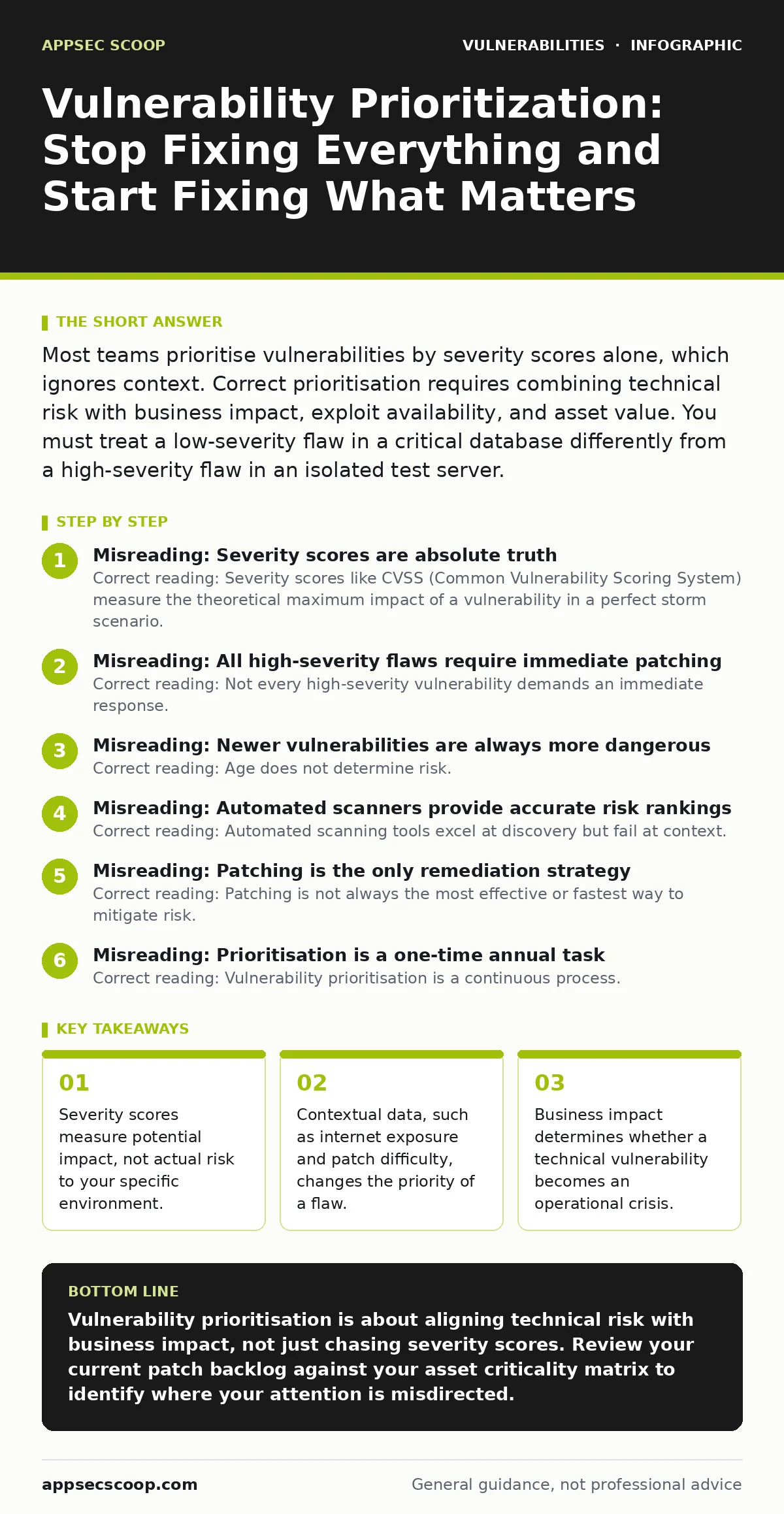
Misreading: All high-severity flaws require immediate patching
Correct reading: Not every high-severity vulnerability demands an immediate response. If a flaw exists in an application that has been decommissioned, or in a system that is air-gapped from the internet, the immediate risk is negligible. Prioritisation requires assessing exploitability. If no public exploit exists and the attack path is complex, the window for remediation widens. You should focus resources on flaws that are actively being exploited in the wild, even if their theoretical severity is lower. This approach aligns with the principles of risk-based vulnerability management, where context dictates action.
Misreading: Newer vulnerabilities are always more dangerous
Correct reading: Age does not determine risk. A vulnerability discovered years ago may remain unpatched across your infrastructure because it resides in legacy systems that are difficult to update. These "zombie" vulnerabilities often pose a higher cumulative risk than a brand-new flaw in a well-maintained system. Attackers frequently reuse known exploits because they are reliable and documented. You must track your backlog of unpatched known issues with the same intensity as you track newly disclosed flaws. Ignoring old vulnerabilities creates a persistent attack surface that defenders often overlook.
Misreading: Automated scanners provide accurate risk rankings
Correct reading: Automated scanning tools excel at discovery but fail at context. They cannot distinguish between a critical production database and a developer’s local test instance. They also struggle to identify false positives, which waste your team’s time. You must apply business context to scan results. A vulnerability in a web server facing the internet carries more weight than the same flaw in an internal file server. Integrating data from your configuration management database helps automate this context, but human validation remains necessary to ensure the tool’s logic matches your operational reality.
Misreading: Patching is the only remediation strategy
Correct reading: Patching is not always the most effective or fastest way to mitigate risk. Sometimes, applying a virtual patch via a web application firewall, disabling a vulnerable feature, or implementing strict network segmentation can reduce risk more quickly than installing a software update.
This is particularly true when a patch is not yet available or when testing the patch is risky. Your remediation strategy should be flexible. The goal is risk reduction, not necessarily code replacement. Understanding the mechanics of remote code execution vulnerabilities helps you determine if temporary network controls are sufficient to block the attack vector while a permanent fix is prepared.
Misreading: Prioritisation is a one-time annual task
Correct reading: Vulnerability prioritisation is a continuous process. Your threat environment changes daily. New exploits emerge, attackers shift their focus, and your business priorities evolve. A vulnerability that was low priority last month may become critical today if a proof-of-concept exploit is released. You must integrate prioritisation into your regular operational rhythm. Review your risk register weekly or even daily for critical assets. This agility ensures that your response matches the current reality, rather than a snapshot from weeks ago. This continuous improvement mindset is central to a mature secure software development lifecycle.
Misreading: Responsible disclosure solves the prioritisation problem
Correct reading: Responsible disclosure processes help you learn about flaws before they are public, but they do not eliminate the need for prioritisation. When a vendor reports a flaw to you, you still must assess its impact on your specific environment. You cannot simply assume all disclosed flaws are high priority. You must evaluate the disclosure against your asset inventory and exposure. Treating every disclosure as an emergency leads to alert fatigue and burnout. You need a triage process that evaluates the disclosed flaw against your current threat model and operational constraints.
Key takeaways
- Severity scores measure potential impact, not actual risk to your specific environment.
- Contextual data, such as internet exposure and patch difficulty, changes the priority of a flaw.
- Business impact determines whether a technical vulnerability becomes an operational crisis.
- Automated tools often create noise by ranking internal, unreachable assets alongside public-facing ones.
Vulnerability prioritisation is about aligning technical risk with business impact, not just chasing severity scores. Review your current patch backlog against your asset criticality matrix to identify where your attention is misdirected.
Frequently asked questions
How do I handle vulnerabilities in legacy systems that cannot be patched?
Focus on isolation and monitoring. Restrict network access to the legacy system, implement strict egress filtering, and deploy enhanced logging to detect unusual activity.
What is the difference between risk-based vulnerability management and patch management?
Patch management is the operational process of applying updates. Risk-based vulnerability management is the strategic process of deciding which updates to apply first based on business impact and exploitability.
Should I prioritise vulnerabilities based on media attention?
Media attention often indicates high exploitability, but it is not a reliable metric. Use it as a signal
How this guide was produced: written by the AppSec Scoop editorial team with AI assistance, checked against the public references listed below, and reviewed when the facts change. See our editorial policy or report an error.