
A responsible disclosure reward is a financial incentive offered by an organisation to researchers who find and report security flaws privately. These programmes vary from fixed fees to tiered payouts based on severity. Understanding the legal boundaries and payment criteria is necessary before submitting any technical findings to avoid rejection or liability.
The Mechanics of Finding Faults
Imagine a library where the shelves are slightly crooked. A casual visitor might not notice, but a librarian with a level will spot the misalignment immediately. In software, the researcher is the librarian with the level, and the crooked shelf is a vulnerability. Responsible disclosure reward programmes exist to encourage this observation without public embarrassment. The mechanism relies on a private channel for reporting.
The researcher sends details of the flaw to the organisation. The organisation acknowledges receipt and begins remediation. Once the fix is verified, the reward is issued. This process avoids the chaos of public disclosure, which forces users to react before a solution exists. It transforms a potential crisis into a managed maintenance task. The reward acts as a carrot, but the stick of potential litigation remains if the reporting process is not followed precisely.
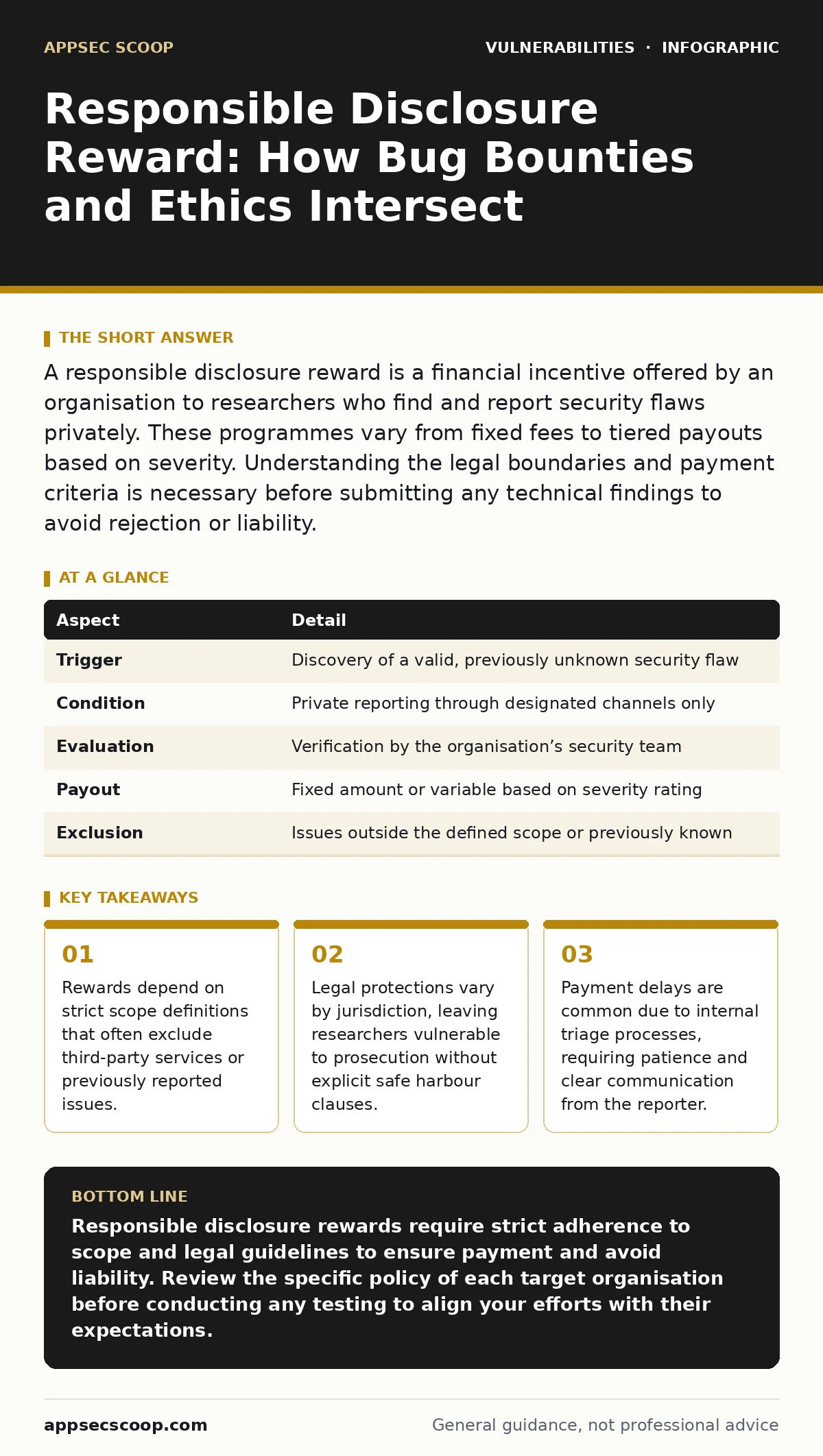
| Aspect | Detail |
|---|---|
| Trigger | Discovery of a valid, previously unknown security flaw |
| Condition | Private reporting through designated channels only |
| Evaluation | Verification by the organisation’s security team |
| Payout | Fixed amount or variable based on severity rating |
| Exclusion | Issues outside the defined scope or previously known |
Defining the Scope of Validity
A reward is not guaranteed for every technical curiosity. Organisations define a scope that lists which systems are eligible for testing. This scope usually includes public-facing web applications, mobile apps, and specific APIs. It rarely includes internal networks, third-party services, or social engineering targets. A researcher who tests a third-party payment processor embedded in the application may find a flaw, but that flaw often falls outside the responsible disclosure reward criteria.
The organisation does not control the third party, so they cannot fix the issue. Reporting such findings can lead to immediate rejection. You must read the policy document carefully. Look for explicit exclusions. Testing outside the scope can be interpreted as unauthorised access, regardless of intent. The definition of a valid vulnerability also matters. Issues that require physical access or simultaneous compromise of multiple systems are often deemed out of scope.
The Reality of Financial Incentives
People typing "responsible disclosure reward" often expect immediate payment upon submission. This expectation is incorrect. The process involves triage, validation, and prioritisation. The organisation must confirm the flaw is real, reproducible, and exploitable. They must then assess the impact. This assessment often references vulnerability severity ratings to determine the payout tier. A high-severity rating might warrant a larger reward, but only if the flaw meets specific criteria.
For instance, remote code execution typically commands a higher payout than cross-site scripting. However, if the flaw requires user interaction to exploit, the payout may be reduced. The timeline for payment is rarely defined in the policy. Researchers often wait weeks or months for communication. This delay is not malicious; it reflects the operational reality of patch management. Security teams must coordinate with engineering, legal, and product teams before acknowledging the flaw publicly or issuing payment.
Legal Protections and Safe Harbour
The most critical aspect of any reward programme is the legal framework. Without explicit safe harbour language, a researcher could face criminal charges for unauthorised access. Safe harbour clauses state that the organisation will not pursue legal action against good-faith researchers who follow the reporting guidelines. This protection is not universal. Some jurisdictions do not recognise safe harbour as a legal defence. In these cases, the researcher operates at their own legal risk.
The policy should explicitly state that testing is permitted within the defined scope. It should also prohibit destructive actions, such as deleting data or causing service outages. Destructive testing voids any legal protection. You must assume that any action you take is logged and monitored. If the organisation detects aggressive scanning, they may block your access and refuse payment. The goal is to demonstrate the flaw, not to exploit it fully. Proof of concept code is sufficient. Full exploitation is unnecessary and dangerous.
Common Misconceptions in Reporting
Many researchers misunderstand the requirements for a valid report. They assume that finding a flaw is enough. In reality, the quality of the report determines the outcome. A vague report that lacks reproduction steps will be closed. The organisation must be able to replicate the issue. You must provide clear, step-by-step instructions. Include screenshots or logs where appropriate. Another common mistake is reporting duplicates.
If another researcher has already reported the flaw, you will not receive a reward. The first valid report usually receives the payout. Subsequent reports are acknowledged but not paid. This encourages speed, but it also creates a race. Researchers may rush to submit incomplete reports to beat others. This harms the organisation, which must spend time clarifying the finding. It is better to submit a complete, well-documented report slightly later than an incomplete one sooner.
See also: Hardening WordPress: Concrete Benefits and Honest Limitations
Integrating with Development Cycles
Responsible disclosure does not exist in a vacuum. It intersects with the secure software development lifecycle. When a flaw is reported, it must be integrated into the development backlog. This integration requires context. The security team must translate the technical finding into a task for developers. This translation is often where delays occur. Developers may not understand the severity or the fix required. Clear communication from the researcher is vital.
Providing a suggested fix can accelerate the process. However, the researcher should not dictate the implementation. The organisation must maintain control over their codebase. The reward programme is a feedback loop. It informs the development team of their blind spots. Over time, this feedback can reduce the number of critical vulnerabilities. It is a collaborative process, not an adversarial one. The goal is to improve security, not to shame the organisation.
What Gets Wrong in Practice
The most frequent failure point is communication breakdown. Researchers submit reports and then silence follows. They assume the report is lost. In reality, it is likely in a queue. Following up politely after a reasonable period can help. Another failure is scope creep. Researchers expand their testing to adjacent systems to find more flaws. This breaches the agreement. The organisation may view this as malicious intent. Stick to the defined scope. Finally, some organisations fail to honour their rewards.
They delay payment indefinitely or reclassify the flaw as out of scope after acceptance. This erodes trust in the responsible disclosure reward ecosystem. Researchers may stop reporting to such organisations. Reputation matters. Organisations that fail to pay may find fewer researchers willing to help them. This leaves them more vulnerable to malicious actors. Transparency and timely payment are the best ways to maintain a healthy relationship with the research community.
Key takeaways
- Rewards depend on strict scope definitions that often exclude third-party services or previously reported issues.
- Legal protections vary by jurisdiction, leaving researchers vulnerable to prosecution without explicit safe harbour clauses.
- Payment delays are common due to internal triage processes, requiring patience and clear communication from the reporter.
Responsible disclosure rewards require strict adherence to scope and legal guidelines to ensure payment and avoid liability. Review the specific policy of each target organisation before conducting any testing to align your efforts with their expectations.
Frequently asked questions
Do I get paid for reporting a vulnerability if I do not use a bug bounty platform?
Payment depends on the organisation’s specific policy. Some organisations handle reports directly and pay independently, while others only process rewards through designated third-party platforms. Check the policy to determine the required submission channel and payment method.
Can I report a vulnerability in a third-party service used by the target organisation?
Generally, no. Most policies exclude third-party services because the target organisation does not control the code or infrastructure. Reporting such flaws may be rejected unless the policy explicitly includes third-party dependencies in the scope of valid targets.
What happens if two researchers report the same vulnerability at the same time?
The organisation typically awards the reward to the first valid report received. Subsequent reports of the same issue are usually acknowledged but not paid. This rule encourages speed but can lead to disputes if timestamps are ambiguous. Clear documentation of submission time is advisable.
Is it legal to test a website without explicit permission even if there is a responsible disclosure policy?
A responsible disclosure policy provides implied permission only within the defined scope and guidelines. Testing outside these boundaries may still be illegal. The policy acts as a contract; violating its terms voids any legal protection and may result in criminal prosecution for unauthorised access.
How this guide was produced: written by the AppSec Scoop editorial team with AI assistance, checked against the public references listed below, and reviewed when the facts change. See our editorial policy or report an error.