The NIST AI Risk Management Framework provides a structured approach to managing risks associated with artificial intelligence systems. It offers guidelines for governance, mapping, measurement, and management. This summary explains how the framework operates, who needs it, and how to implement its core functions without relying on rigid compliance checklists.
NIST AI Risk Management Framework Summary
Imagine a bridge engineer who checks the structure not only before opening it to traffic but also monitors stress points during storms and heavy loads. The NIST AI Risk Management Framework operates on this principle of continuous oversight. It provides a structured approach to identifying, assessing, and mitigating risks inherent in artificial intelligence systems.
This summary outlines the framework’s core components, its operational mechanics, and the practical steps required for effective implementation. The framework does not prescribe specific technologies or rigid rules. Instead, it offers a flexible set of guidelines that organisations can adapt to their unique contexts and risk tolerances.
How the Framework Works
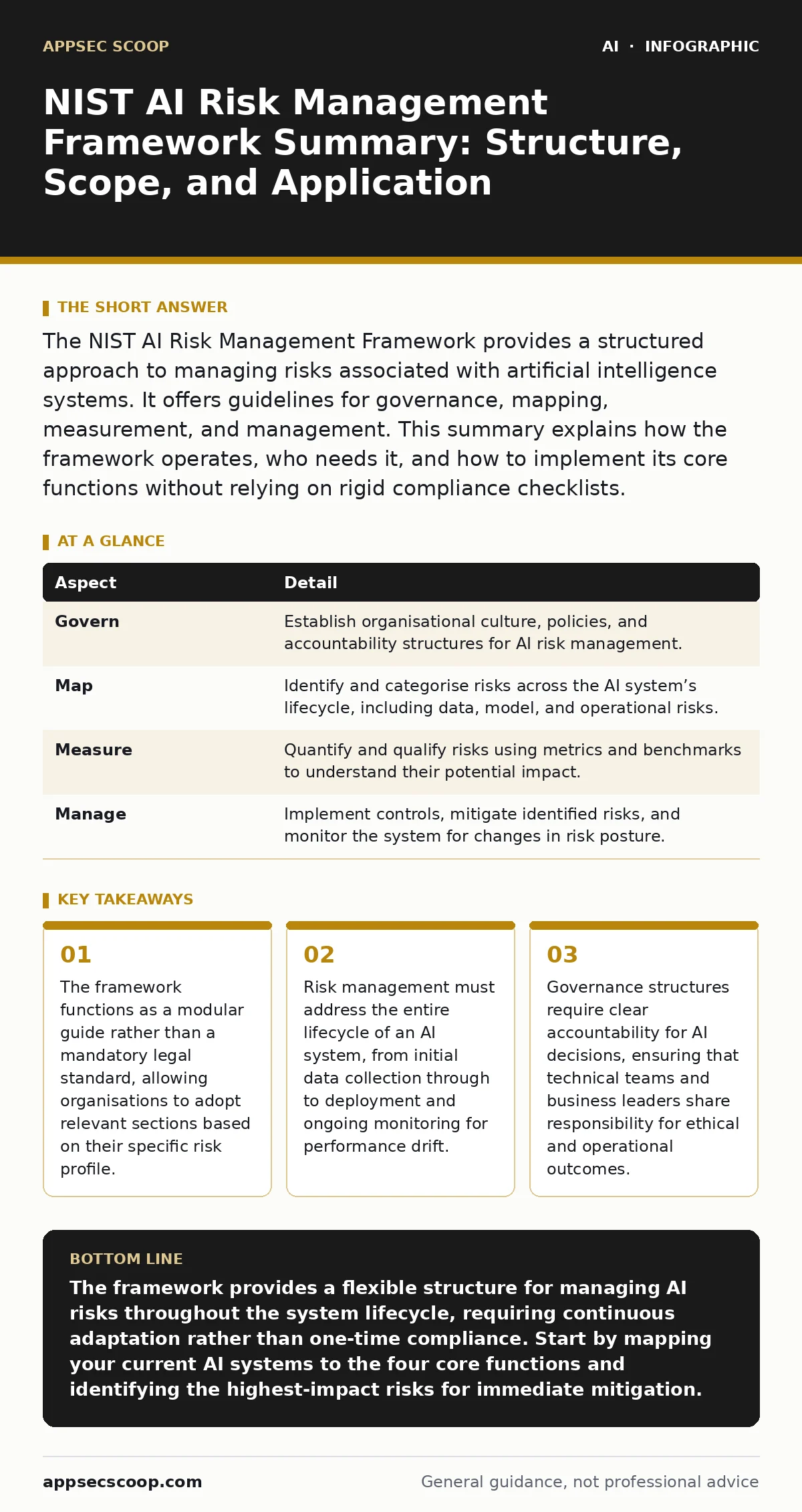
The framework is organised into four core functions that guide the risk management process. These functions are not strictly sequential but often overlap in practice.
| Aspect | Detail |
|---|---|
| Govern | Establish organisational culture, policies, and accountability structures for AI risk management. |
| Map | Identify and categorise risks across the AI system’s lifecycle, including data, model, and operational risks. |
| Measure | Quantify and qualify risks using metrics and benchmarks to understand their potential impact. |
| Manage | Implement controls, mitigate identified risks, and monitor the system for changes in risk posture. |
The Govern function sets the foundation. It requires leadership to define expectations, allocate resources, and establish a culture that prioritises responsible AI development. Without clear governance, technical teams may lack the direction needed to align their work with organisational values. The Map function involves detailed analysis of the AI system. You must identify where risks exist, such as in biased training data or opaque model decisions. This step often reveals hidden vulnerabilities that standard security checks might miss.
The Measure function translates qualitative risks into quantitative data. You use metrics to assess the likelihood and impact of specific risks. This allows you to prioritise mitigation efforts based on actual threat levels rather than assumptions. The Manage function focuses on action. You implement controls to reduce risks to acceptable levels. This includes technical safeguards, process improvements, and ongoing monitoring. The framework emphasises that risk management is iterative. As the AI system evolves, so do its risks.
Who It Affects
The framework applies to any organisation developing, deploying, or procuring AI systems. This includes software vendors, internal IT teams, and third-party service providers. You do not need to be an AI specialist to benefit from these guidelines. The framework is designed for cross-functional teams, including legal, compliance, engineering, and business units.
Organisations in highly regulated industries, such as finance or healthcare, may find the framework particularly useful for meeting regulatory requirements. However, its principles are broadly applicable. Even small teams using off-the-shelf AI tools can use the framework to assess vendor risks and ensure appropriate safeguards are in place.
What to Do About It
Implementing the framework requires a structured approach. Start by assessing your current AI capabilities and risk posture. Identify which parts of the framework are most relevant to your operations. You do not need to implement every recommendation at once. Focus on high-impact areas first. Establish clear roles and responsibilities for AI risk management. Ensure that technical teams have the resources needed to implement controls. Regularly review and update your risk assessments. AI systems change rapidly. Your risk management strategy must evolve alongside them.
Common Misconceptions
Many organisations misunderstand the nature of the framework. A common error is treating it as a compliance checklist. The framework is not a certification or a pass/fail test. It is a guide for continuous improvement. Another misconception is that only AI developers need to understand it. Risk management is a shared responsibility.
Business leaders must understand the strategic implications, while technical teams handle the implementation. Ignoring the human element often leads to ineffective controls. You must also avoid assuming that once a system is deployed, the risk management process ends. Ongoing monitoring is critical. Model drift and changing data patterns can introduce new risks over time.
See also: Embeddings vs Tokens: Structural Differences and Security Implications · Detect AI Agent Hijacking: Log Signals, Blind Spots and Detection Methods
Integrating with Existing Practices
The framework complements existing security and risk management practices. It does not replace them. You can integrate it with standard IT security frameworks and data protection regulations. This creates a more cohesive risk management strategy. For example, you can align AI risk controls with your existing incident response plans. This ensures that AI-specific incidents are handled consistently with other security events. You should also consider the broader ecosystem. AI systems often interact with other technologies. Understanding these dependencies helps you identify indirect risks.
Addressing Technical Risks
Technical risks require specific attention. You must address issues such as adversarial examples, where malicious inputs trick the model into making incorrect predictions. These attacks can bypass traditional security controls. You should also consider training data leakage, where sensitive information is inadvertently exposed through the model’s outputs. Implementing techniques like differential privacy can help mitigate this risk. Embeddings, which are numerical representations of data, can also carry biases or sensitive information. You must ensure that these representations are handled securely.
Looking Ahead
The field of AI is evolving rapidly. New techniques and threats emerge regularly. You must stay informed about developments in the field. Frameworks and guidelines will update to reflect these changes. Engaging with the broader community helps you stay ahead of emerging risks. You should also consider the ethical implications of your AI systems. Technical controls alone are not enough. You must ensure that your AI systems align with societal values and expectations. This includes considerations of fairness, accountability, and transparency.
Conclusion
The NIST AI Risk Management Framework provides a valuable structure for managing AI-related risks. It offers a comprehensive approach that covers the entire lifecycle of an AI system. By following its guidelines, you can identify, assess, and mitigate risks effectively. Remember that risk management is an ongoing process. Continuous monitoring and adaptation are key to maintaining a secure and responsible AI environment.
Key takeaways
- The framework functions as a modular guide rather than a mandatory legal standard, allowing organisations to adopt relevant sections based on their specific risk profile.
- Risk management must address the entire lifecycle of an AI system, from initial data collection through to deployment and ongoing monitoring for performance drift.
- Governance structures require clear accountability for AI decisions, ensuring that technical teams and business leaders share responsibility for ethical and operational outcomes.
The framework provides a flexible structure for managing AI risks throughout the system lifecycle, requiring continuous adaptation rather than one-time compliance. Start by mapping your current AI systems to the four core functions and identifying the highest-impact risks for immediate mitigation.
Frequently asked questions
Is the NIST AI RMF mandatory for all organisations?
No, it is a voluntary framework. However, it may become a de facto standard as regulators and customers increasingly expect structured AI risk management practices.
How does this differ from general cybersecurity frameworks?
It specifically addresses risks unique to AI, such as model bias, data drift, and adversarial attacks, which traditional security frameworks may not cover in sufficient detail.
Can small teams use this framework effectively?
Yes, the framework is modular. Small teams can focus on the most relevant sections, such as mapping and managing specific risks, without implementing the entire structure.
How often should we update our risk assessments?
You should update assessments regularly, especially when the AI model is retrained, new data sources are added, or the operational environment changes significantly.
How this guide was produced: written by the AppSec Scoop editorial team with AI assistance, checked against the public references listed below, and reviewed when the facts change. See our editorial policy or report an error.