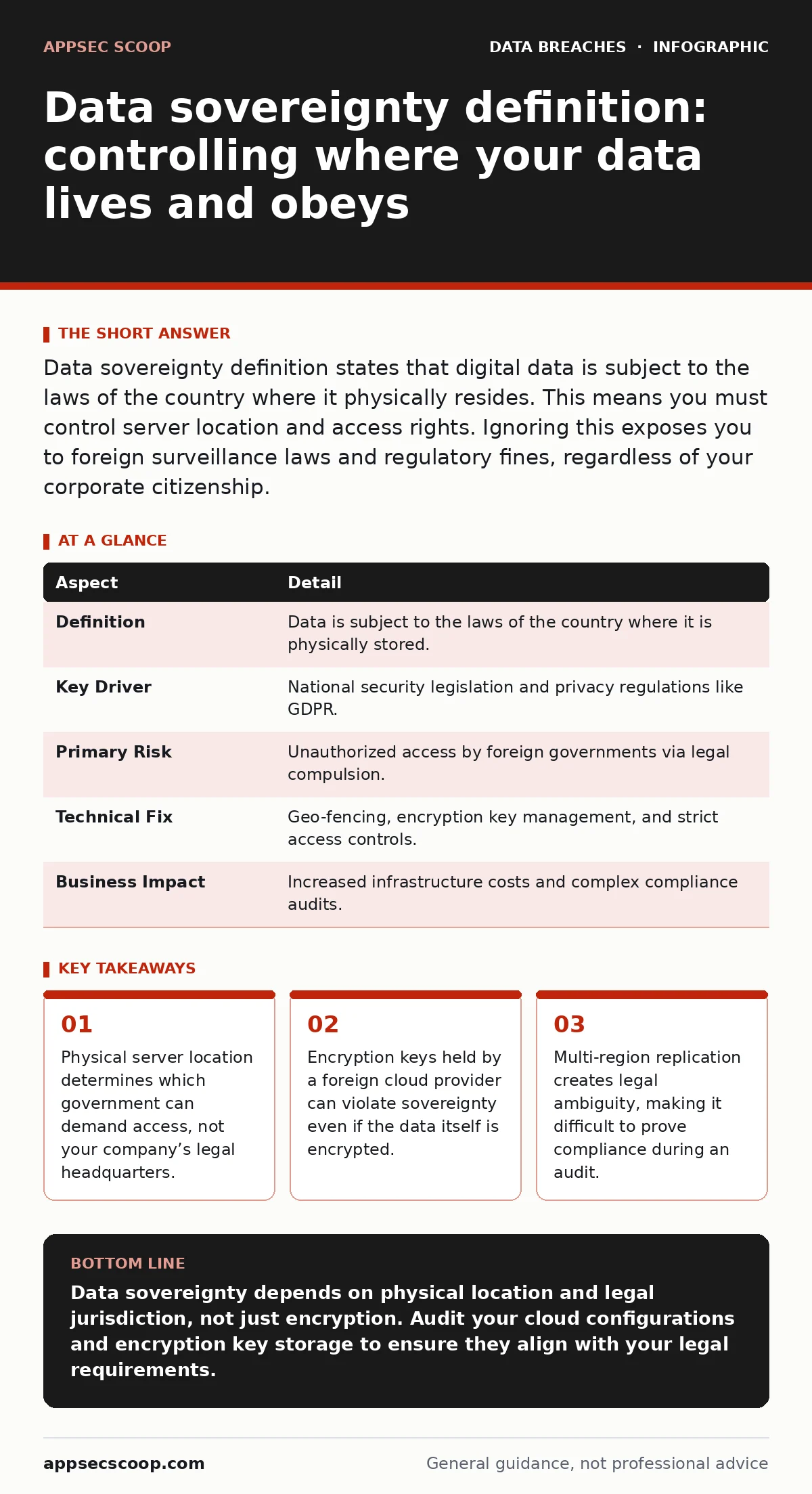
Data sovereignty definition states that digital data is subject to the laws of the country where it physically resides. This means you must control server location and access rights. Ignoring this exposes you to foreign surveillance laws and regulatory fines, regardless of your corporate citizenship.
The geography of bits
Imagine you mail a sealed letter to a friend in another country. Customs officials can inspect the envelope, but they cannot read the contents without breaking the seal. Data sovereignty is the digital equivalent, but the seal is often held by the cloud provider, not you. The physical location of the server determines which national laws apply to the information stored on it.
This concept separates data residency from data sovereignty. Residency is simply where the data sits. Sovereignty is which legal framework governs it. A company in Germany storing data in France enjoys strong privacy protections. The same company storing that data in the United States may face different scrutiny under foreign intelligence laws. The distinction matters when you handle sensitive personal or financial records.
| Aspect | Detail |
|---|---|
| Definition | Data is subject to the laws of the country where it is physically stored. |
| Key Driver | National security legislation and privacy regulations like GDPR. |
| Primary Risk | Unauthorized access by foreign governments via legal compulsion. |
| Technical Fix | Geo-fencing, encryption key management, and strict access controls. |
| Business Impact | Increased infrastructure costs and complex compliance audits. |
How data sovereignty works in practice
The mechanism relies on the intersection of physical infrastructure and legal jurisdiction. When you store data in a cloud region, you are placing it under the authority of that region’s government. If that government passes a law requiring data disclosure, the cloud provider must comply. You have little recourse to stop this, even if your own country’s laws forbid sharing.
This creates a hidden dependency on the vendor’s legal structure. If a US-based cloud provider hosts your European data, they may be compelled to hand it over under foreign surveillance acts. The data never leaves the EU physically, but the legal sovereignty shifts. This is why many organisations now demand that encryption keys remain within their own control, stored in a separate jurisdiction from the data itself.
You must map your data flows to understand these risks. Data often moves between regions for processing or backup. Each hop introduces a new legal environment. If you replicate data to a distant region for disaster recovery, that copy is subject to the local laws of the destination. You cannot claim sovereignty over data you cannot physically restrict.
Who data sovereignty affects most
This issue affects any organisation that processes data across borders. It is particularly acute for financial institutions, healthcare providers, and public sector bodies. These sectors handle sensitive data that attracts regulatory scrutiny and national security interest. Ignoring sovereignty requirements can lead to severe penalties and loss of license to operate.
Multinational corporations face the greatest complexity. They often have centralised data lakes in one region and operational data in many others. Ensuring that no data crosses a sovereign boundary requires strict architectural controls. You must define which data can leave which region and enforce this through automated policy checks.
Third-party vendors introduce additional risk. When you outsource IT services, you lose direct control over where data is processed. Your vendor may use sub-processors in jurisdictions with weak privacy laws. This chain of custody must be audited regularly. Refer to our guide on third-party risk assessments to understand how to vet these supply chains effectively.
What people usually get wrong
Many teams confuse data residency with data sovereignty. They assume that placing servers in a compliant country is enough. This is false. If the server provider is subject to foreign laws, the data is not sovereign. You must control both the location and the legal authority over the infrastructure.
Another common error is assuming encryption solves everything. Encryption protects confidentiality, but it does not hide metadata. Metadata reveals who accessed the data, when, and from where. Governments can demand this metadata even if they cannot read the encrypted content. This metadata can still violate privacy laws and compromise user anonymity.
Technical controls for sovereignty
Implementing sovereignty requires a combination of technical and procedural controls. Geo-fencing is the first line of defence. This restricts data storage and processing to specific geographic regions. Cloud platforms allow you to define these boundaries, but you must verify that no automatic replication crosses them.
Encryption key management is the second critical control. If you hold the keys, the cloud provider cannot read the data even if compelled by law. This is known as client-side encryption. You must store the keys in a hardware security module located in a trusted jurisdiction. This separates the legal authority over the data from the technical ability to access it.
Access controls must be strictly enforced. Only authorised personnel should be able to access the data. Multi-factor authentication and role-based access control reduce the risk of insider threats. You should also monitor access logs for unusual activity. Refer to our guide on data masking to understand how to hide sensitive fields from unnecessary users.
See also: Cloud Security Groups: The Silent Trade-Offs in Network Isolation
Legal and compliance considerations
Compliance is not a one-time check. Laws change, and interpretations evolve. You must stay updated on the legal requirements of every jurisdiction where you store data. This includes understanding the implications of international data transfer mechanisms.
Audit trails are essential for proving compliance. You must be able to demonstrate where data is stored, who accesses it, and how it is protected. Regular audits help identify gaps in your sovereignty controls. These audits should include both technical reviews and legal assessments.
If you handle payment data, you must also consider industry-specific standards. Refer to our guide on PCI DSS to understand how sovereignty intersects with payment security requirements. Failure to meet these standards can result in significant financial penalties and reputational damage.
Managing the ongoing risk
Data sovereignty is a continuous process. You must regularly review your data flows and storage locations. New services and features may introduce new risks. For example, a new analytics tool might replicate data to a different region for processing. You must catch these changes before they become compliance issues.
Training is also important. Developers and operations teams must understand sovereignty requirements. They should be able to identify when a configuration change might violate these rules. Include sovereignty checks in your deployment pipelines. This ensures that no code is released if it violates data location policies.
Monitor for changes in law and regulation. Legal teams must work closely with security teams to interpret new requirements. This collaboration ensures that technical controls align with legal obligations. Refer to our guide on data classification to understand how to prioritise your sovereignty efforts based on data sensitivity.
Key takeaways
- Physical server location determines which government can demand access, not your company’s legal headquarters.
- Encryption keys held by a foreign cloud provider can violate sovereignty even if the data itself is encrypted.
- Multi-region replication creates legal ambiguity, making it difficult to prove compliance during an audit.
Data sovereignty depends on physical location and legal jurisdiction, not just encryption. Audit your cloud configurations and encryption key storage to ensure they align with your legal requirements.
Frequently asked questions
Does encryption alone satisfy data sovereignty requirements?
No. Encryption protects data confidentiality but does not change the legal jurisdiction of the server. Governments can still demand metadata or compel the provider to hand over keys if they are stored locally.
How do I handle data residency for multinational teams?
Implement geo-fencing to restrict data to specific regions. Use local storage for regional teams and ensure that no data crosses borders without explicit legal approval and technical controls.
What is the difference between data residency and sovereignty?
Residency is where the data physically sits. Sovereignty is which laws apply to that data. You can have residency in one country but sovereignty governed by another if the provider is foreign-owned.
Can I use public cloud services for sovereign data?
Yes, but you must configure them carefully. Use client-side encryption, hold your own keys, and restrict regions. Verify that the provider’s legal structure does not expose your data to foreign compulsion.
How this guide was produced: written by the AppSec Scoop editorial team with AI assistance, checked against the public references listed below, and reviewed when the facts change. See our editorial policy or report an error.