
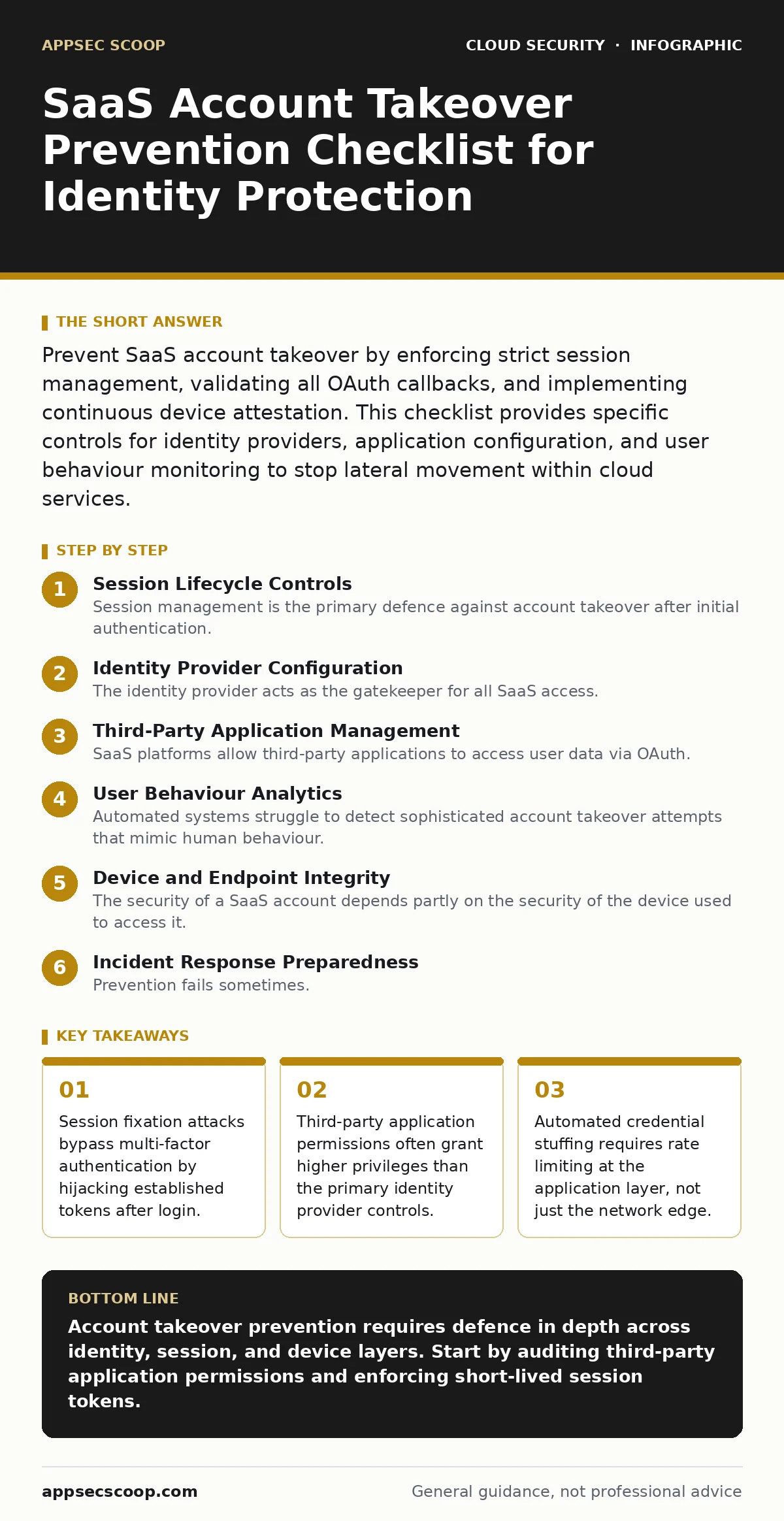
Prevent SaaS account takeover by enforcing strict session management, validating all OAuth callbacks, and implementing continuous device attestation. This checklist provides specific controls for identity providers, application configuration, and user behaviour monitoring to stop lateral movement within cloud services.
Session Lifecycle Controls
Session management is the primary defence against account takeover after initial authentication. Attackers frequently target active sessions rather than credentials.
- Enforce short-lived access tokens: Tokens expire quickly, limiting the window for replay attacks.
- Implement binding to client attributes: Tie sessions to user-agent strings or IP ranges to detect hijacking.
- Invalidate sessions on password change: This forces re-authentication, stopping attackers who changed credentials.
- Require re-authentication for sensitive actions: High-risk operations need fresh proof of identity, not just a valid token.
Session fixation occurs when an attacker sets a known session ID for a victim. If the SaaS platform does not rotate session IDs after login, the attacker retains access. Binding sessions to device fingerprints adds friction for legitimate users but stops automated token theft.
Identity Provider Configuration
The identity provider acts as the gatekeeper for all SaaS access. Misconfigurations here allow attackers to bypass application-level security.
- Disable password-based login for SaaS apps: Force users to authenticate via the central identity provider only.
- Enforce multi-factor authentication everywhere: MFA must be required at the identity provider, not just the SaaS app.
- Monitor for impossible travel: Detect logins from geographically distant locations within short timeframes.
- Restrict federation to known domains: Prevent attackers from registering similar domains to intercept authentication requests.
Many organisations assume that enabling MFA in the SaaS application is sufficient. This fails if the attacker compromises the identity provider directly. Centralising authentication ensures that security policies apply consistently across all connected services. See our guide on cloud entitlements for details on managing access rights.
Third-Party Application Management
SaaS platforms allow third-party applications to access user data via OAuth. These integrations are a common vector for account takeover.
- Audit connected applications regularly: Remove unused integrations that retain access tokens.
- Restrict OAuth scope to minimum necessary: Applications should only request permissions they strictly need.
- Validate OAuth callback URLs: Ensure redirects only go to trusted domains to prevent open redirect attacks.
- Monitor for unusual API usage: Detect bulk data exports or permission escalation attempts by third-party apps.
An attacker who compromises a single third-party tool can often pivot to the main SaaS account. This is especially dangerous if the third-party app has administrative privileges. Regular audits of connected applications reduce this attack surface significantly.
User Behaviour Analytics
Automated systems struggle to detect sophisticated account takeover attempts that mimic human behaviour. User behaviour analytics provide an additional layer of detection.
- Establish baseline activity patterns: Define normal login times, locations, and usage patterns for each user.
- Alert on privilege escalation attempts: Flag attempts to change security settings or add new administrators.
- Detect credential stuffing patterns: Identify multiple failed login attempts from distributed IP addresses.
- Monitor for data exfiltration signs: Alert on large downloads or unusual API calls outside business hours.
Behavioural analytics rely on machine learning models that require training data. False positives are common in the early stages. Tuning these systems takes time and expertise. For deeper insights on detecting anomalies, refer to our guide on cloud-native security.
Device and Endpoint Integrity
The security of a SaaS account depends partly on the security of the device used to access it. Compromised endpoints can steal credentials and session tokens.
- Require device compliance checks: Ensure devices meet security standards before allowing access.
- Enforce encryption at rest and in transit: Protect data on the device and during transmission to the SaaS platform.
- Disable local credential caching: Prevent attackers from retrieving saved passwords from the browser or OS.
- Implement hardware-based security keys: Use FIDO2 keys for phishing-resistant multi-factor authentication.
Hardware security keys are resistant to phishing and man-in-the-middle attacks. They require physical possession for authentication. This adds a significant barrier for remote attackers. However, they introduce management overhead for key provisioning and loss recovery.
See also: Seven Social Engineering Mistakes That Leave Your Defences Open · Stop Overprivileged Cloud Identities Before They Leak Data
Incident Response Preparedness
Prevention fails sometimes. A clear incident response plan limits damage when an account takeover occurs.
- Define automated containment steps: Automatically disable compromised accounts upon detection of suspicious activity.
- Maintain an inventory of critical accounts: Identify which accounts require immediate protection and monitoring.
- Test account recovery procedures: Ensure that administrators can regain control without relying on compromised credentials.
- Document forensic data collection: Preserve logs and session data for investigation and legal purposes.
Rapid containment is critical. Every minute an attacker retains access, they can exfiltrate data or escalate privileges. Automated responses reduce the time between detection and containment. Review your access key rotation policies to ensure that compromised keys are invalidated quickly.
Key takeaways
- Session fixation attacks bypass multi-factor authentication by hijacking established tokens after login.
- Third-party application permissions often grant higher privileges than the primary identity provider controls.
- Automated credential stuffing requires rate limiting at the application layer, not just the network edge.
Account takeover prevention requires defence in depth across identity, session, and device layers. Start by auditing third-party application permissions and enforcing short-lived session tokens.
Frequently asked questions
How do I detect if a SaaS account has been taken over?
Look for unusual login locations, unexpected password changes, or new admin accounts added to the service.
Is multi-factor authentication enough to prevent account takeover?
No, MFA can be bypassed via session hijacking, phishing, or compromised third-party applications.
What is the biggest risk with SaaS integrations?
Third-party apps often retain access tokens indefinitely, allowing attackers to pivot if one app is compromised.
How often should I review SaaS access permissions?
Review permissions quarterly or whenever an employee changes roles or leaves the organisation.
How this guide was produced: written by the AppSec Scoop editorial team with AI assistance, checked against the public references listed below, and reviewed when the facts change. See our editorial policy or report an error.