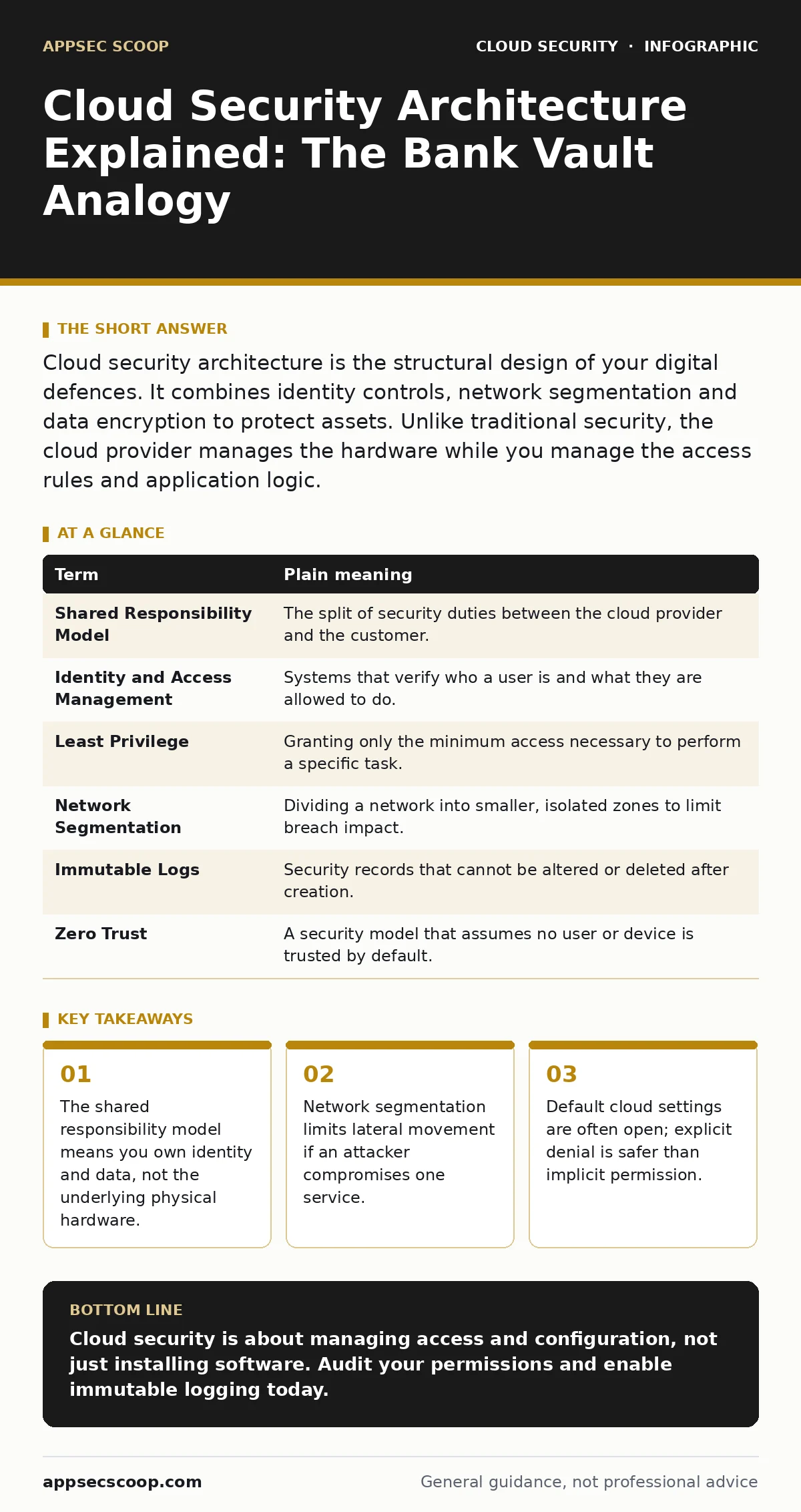
Cloud security architecture is the structural design of your digital defences. It combines identity controls, network segmentation and data encryption to protect assets. Unlike traditional security, the cloud provider manages the hardware while you manage the access rules and application logic.
The Bank Vault Analogy
Imagine a high-security bank vault. The bank provides the steel walls, the locking mechanism and the alarm system. This represents the cloud provider’s infrastructure. You provide the combination, the list of authorised staff and the insurance for the contents. This is your security responsibility. If you leave the combination written on a sticky note on the door, the steel walls do not matter. Cloud security architecture is the process of defining who holds the key, what they can touch and how the vault connects to the rest of the building.
Defining the Shared Responsibility
The cloud model shifts ownership boundaries. The provider secures the cloud itself, including physical data centres and hypervisors. You secure what you put in the cloud, including operating systems, applications and data. A common point of confusion is assuming the provider secures your database contents. They do not. If you misconfigure the database firewall, your data is exposed. This division is known as the shared responsibility model. Understanding where your duty begins and the provider’s ends is the first step in building a secure architecture.
| Term | Plain meaning |
|---|---|
| Shared Responsibility Model | The split of security duties between the cloud provider and the customer. |
| Identity and Access Management | Systems that verify who a user is and what they are allowed to do. |
| Least Privilege | Granting only the minimum access necessary to perform a specific task. |
| Network Segmentation | Dividing a network into smaller, isolated zones to limit breach impact. |
| Immutable Logs | Security records that cannot be altered or deleted after creation. |
| Zero Trust | A security model that assumes no user or device is trusted by default. |
Identity as the New Perimeter
Traditional security relied on a network perimeter, like a castle wall. The cloud has no fixed walls. Access comes from anywhere. Therefore, identity becomes the primary control point. You must verify every request, regardless of its origin. This approach is called zero trust. It assumes breach and verifies each request as if it originated from an open network. Strong identity management includes multi-factor authentication and strict role-based access controls. Without this, network rules are insufficient because attackers often use stolen credentials to bypass network defences.
Network Segmentation and Isolation
Even within the cloud, not all services should talk to each other. A web server does not need direct access to the payroll database. Network segmentation creates virtual walls between services. If an attacker compromises the web server, segmentation prevents them from moving laterally to sensitive data. This is often achieved using security groups or virtual private clouds. Imagine the bank vault having separate rooms for cash, bonds and records. A thief in the cash room cannot reach the bonds. This containment strategy reduces the blast radius of any single compromise.
Data Protection at Rest and in Transit
Data moves through the cloud in two states: at rest on storage devices and in transit across networks. Both states require encryption. Encryption at rest ensures that if physical media is stolen or accessed improperly, the data remains unreadable. Encryption in transit protects data moving between services or users. You must manage the encryption keys. If you use provider-managed keys, you share access rights. If you manage your own keys, you retain full control but bear the burden of key rotation and backup. See our guide on access key rotation for details on maintaining key hygiene.
See also: Hybrid Cloud Security Best Practices for Consistent Control · What Is Federated Identity: How Single Sign-On Works and Why It Matters
Configuration Drift and Automation
Cloud environments change rapidly. New instances are created, permissions are adjusted and firewalls are updated. Manual tracking of these changes is impossible. Configuration drift occurs when the actual state of your infrastructure diverges from the intended secure state. This is a silent risk. An engineer might open a port for testing and forget to close it. Automated compliance tools scan for these deviations and alert you or remediate them automatically. This aligns with shift-left security principles, catching issues before they reach production.
Common Points of Confusion
Teams often confuse cloud-native security with traditional on-premise security. Cloud-native services behave differently. A serverless function has no OS to patch, but it has code vulnerabilities. Containers share a kernel, meaning a breach in one container can affect others if not isolated. Another confusion is assuming that private cloud means private data. Data can still be exposed through misconfigured APIs or leaked cloud access keys. See our guide on leaked cloud access keys for how credentials often become the weakest link.
Try This Now
- Audit your current cloud accounts for any users with administrative privileges who do not need them. Remove excess permissions immediately.
- Enable logging for all management actions. Ensure these logs are sent to a separate, write-only storage bucket that no one can delete.
- Review your public-facing services. Identify any storage buckets or databases that are accessible without authentication and restrict them to specific IP ranges or identities.
Key takeaways
- The shared responsibility model means you own identity and data, not the underlying physical hardware.
- Network segmentation limits lateral movement if an attacker compromises one service.
- Default cloud settings are often open; explicit denial is safer than implicit permission.
Cloud security is about managing access and configuration, not just installing software. Audit your permissions and enable immutable logging today.
Frequently asked questions
Does cloud security architecture replace firewall rules?
No, it complements them. Firewalls control network traffic, while architecture defines identity, data protection and overall policy. Both are needed for defence in depth.
How does hybrid cloud security differ from pure cloud?
Hybrid environments connect on-premise data centres to cloud services. This adds complexity in identity management and network connectivity, requiring consistent policies across both environments. See our guide on hybrid cloud security for integration strategies.
Is container runtime security part of cloud architecture?
Yes. Containers are a common deployment model in the cloud. Securing the runtime environment ensures that compromised containers do not impact the host system or other containers. Refer to container runtime security for specific hardening steps.
What is the first step in cloud penetration testing?
The first step is gaining authorised access to the environment. Pen testers then attempt to exploit misconfigurations and application vulnerabilities to assess the effectiveness of your security architecture. See cloud penetration testing for methodology details.
How this guide was produced: written by the AppSec Scoop editorial team with AI assistance, checked against the public references listed below, and reviewed when the facts change. See our editorial policy or report an error.