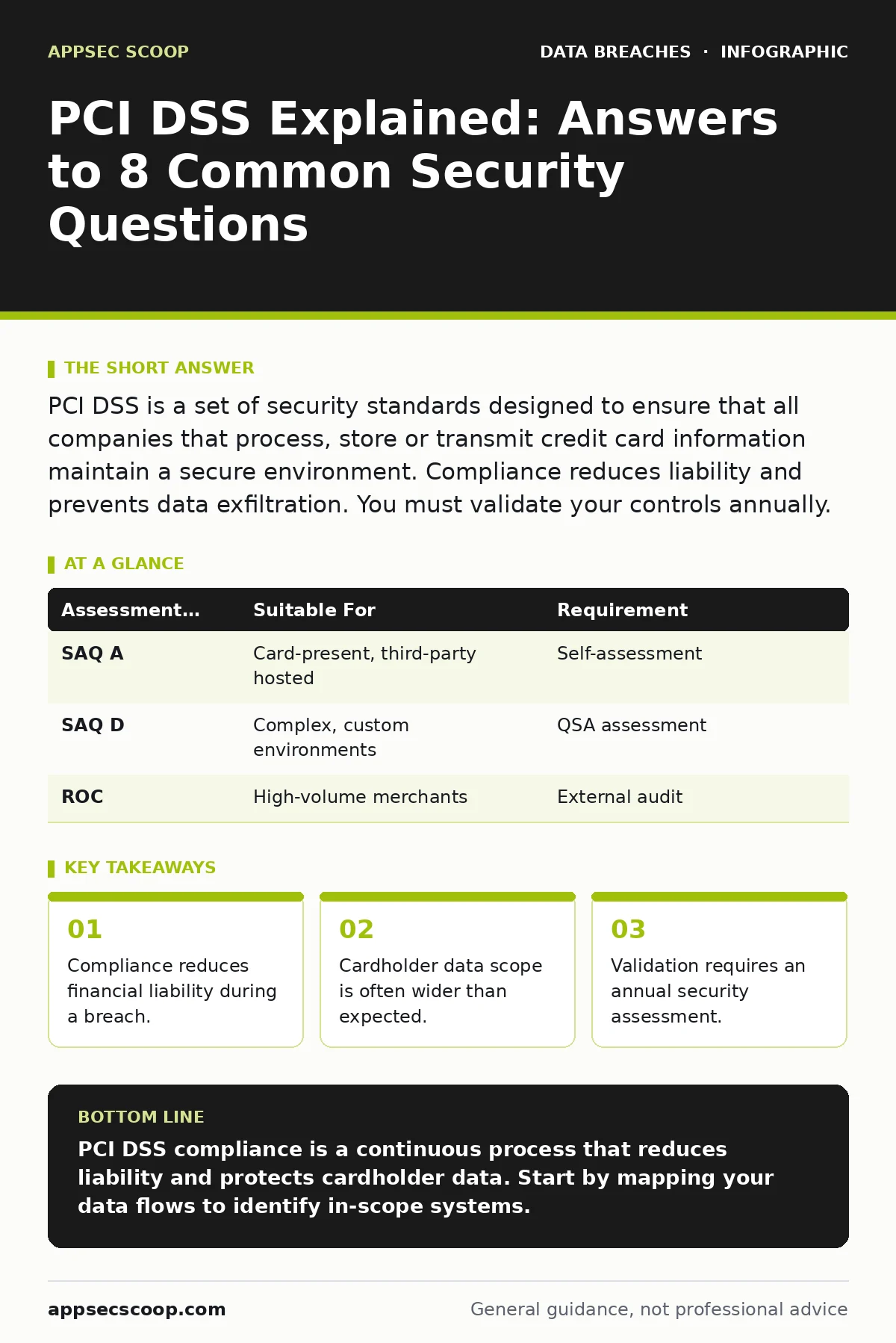
PCI DSS is a set of security standards designed to ensure that all companies that process, store or transmit credit card information maintain a secure environment. Compliance reduces liability and prevents data exfiltration. You must validate your controls annually.
What is PCI DSS and who must comply?
PCI DSS is a global security standard that applies to any entity that stores, processes or transmits cardholder data. Merchants, service providers and payment gateways must all adhere to these requirements. The standard exists to protect payment card data from theft and fraud. Compliance is mandatory if you handle sensitive authentication data or primary account numbers.
How do you define cardholder data?
Cardholder data includes the primary account number, cardholder name, expiry date and service code. Sensitive authentication data includes the magnetic stripe data, chip PIN block data and PINs. You must identify every system that touches this data. Even if you only display the last four digits, the system is in scope if it previously held the full number.
Does tokenisation remove PCI DSS scope?
Tokenisation replaces cardholder data with a surrogate value called a token. This removes the data from your environment if done correctly. However, the tokenisation service itself remains in scope. If your application can reverse the token, the system remains in scope. You must verify that tokens cannot be used to reconstitute the original account number without the tokenisation provider.
What is the difference between SAQ and ROC?
Self-Assessment Questionnaires (SAQs) allow merchants to assess their own compliance for lower-risk environments. Reports on Compliance (ROCs) require an external Qualified Security Assessor (QSA) to validate your controls. Larger merchants or those with complex networks must use the ROC process. The choice depends on your transaction volume and payment channel architecture.
| Assessment Type | Suitable For | Requirement |
|---|---|---|
| SAQ A | Card-present, third-party hosted | Self-assessment |
| SAQ D | Complex, custom environments | QSA assessment |
| ROC | High-volume merchants | External audit |
How does encryption affect compliance scope?
Encryption renders data unreadable to unauthorised users. If you encrypt cardholder data at rest, you must still protect the encryption keys. The key management infrastructure becomes part of your compliance scope. Weak key generation or storage can invalidate the encryption protection. You must follow strict key rotation and access policies for the cryptographic modules.
See also: Bring Your Own Key Encryption Mistakes That Leave Data Exposed · Encryption in Transit: How It Protects Data Between Systems
Can you store sensitive authentication data?
You must never store sensitive authentication data after authorisation. This includes magnetic stripe data, PIN blocks and CVV2 codes. Storing this data violates the standard immediately. Some legacy systems may retain this data for reconciliation. You must purge this data or migrate to a system that does not store it. Violations here result in immediate non-compliance.
What role does network segmentation play?
Network segmentation isolates cardholder data environments from the rest of your IT infrastructure. This reduces the scope of your assessment. If a breach occurs in the corporate network, segmented cardholder systems remain protected. Poor segmentation often leads to wider scope and higher costs. You must test segmentation annually to ensure it holds against internal threats.
How often must you validate compliance?
You must validate compliance annually. This includes vulnerability scanning and penetration testing. Quarterly scans detect new vulnerabilities introduced by changes. Penetration tests verify that controls work together effectively. Failure to perform these tests regularly leaves gaps that attackers can exploit. Continuous monitoring improves your ability to detect data exfiltration attempts in real time.
What happens if you fail a scan?
A failed vulnerability scan indicates a security gap. You must remediate the vulnerability before proceeding. Critical vulnerabilities require immediate attention. High-risk issues must be fixed within a set timeframe. Ignoring scan results can lead to loss of payment processing privileges. Your payment card processor will enforce these deadlines strictly.
How does PCI DSS interact with data sovereignty?
PCI DSS is a global standard, but local laws may dictate where data resides. Data sovereignty laws require certain data to stay within national borders. You must align your PCI DSS controls with these legal requirements. This often means hosting cardholder data in specific geographic regions. Conflict between standards and law requires legal consultation before implementation.
Is role-based access control sufficient?
Role-based access control limits user permissions to what is necessary for their job. This principle reduces the risk of insider threats. However, it must be combined with multi-factor authentication. Shared accounts violate the standard. You must review access rights regularly to ensure they remain appropriate. Removing access promptly when staff leave is a critical control.
Key takeaways
- Compliance reduces financial liability during a breach.
- Cardholder data scope is often wider than expected.
- Validation requires an annual security assessment.
PCI DSS compliance is a continuous process that reduces liability and protects cardholder data. Start by mapping your data flows to identify in-scope systems.
Frequently asked questions
Does PCI DSS apply to digital wallets?
Yes, if the digital wallet stores or processes cardholder data, it falls under the standard’s requirements.
Can I use a third-party scanner?
You must use an Approved Scanning Vendor (ASV) to perform quarterly external vulnerability scans.
What if I use a payment gateway?
If the gateway handles the card data, your scope may be reduced to SAQ A, provided no data touches your servers.
How long must I keep compliance records?
You must retain audit logs and evidence of compliance for at least one year, with 12 months available online.
How this guide was produced: written by the AppSec Scoop editorial team with AI assistance, checked against the public references listed below, and reviewed when the facts change. See our editorial policy or report an error.